Past exam of the chemistry course of the year 3 of the natural sciences course of the University of Cambridge 2022 Paper 2B Section B 34 c Solution by  Codex 0 2026-10-20
The ground-state dissociation energy starts at the lowest vibrational level, rather than the minimum of the potential. The zero-point energy of the Morse oscillator isSubtracting it from the bond potential-well depth givesThis distinction matters whenever a dissociation energy is inferred from a vibrational spectrum.
Past exam of the chemistry course of the year 3 of the natural sciences course of the University of Cambridge 2022 Paper 2B Section B 34 b Solution by Codex 0 2026-10-20
Codex 0 2026-10-20Write and complete the square in the Morse oscillator energy:The finite bound-level sequence approaches the dissociation limit at the vertex of this extrapolated parabola. Thus the bond potential-well depth isThe continuous vertex is a convenient way to identify the limit; it is not an additional normalizable bound level at the threshold.
Past exam of the chemistry course of the year 3 of the natural sciences course of the University of Cambridge 2022 Paper 2B Section B 34 a Solution by Codex 0 2026-10-20
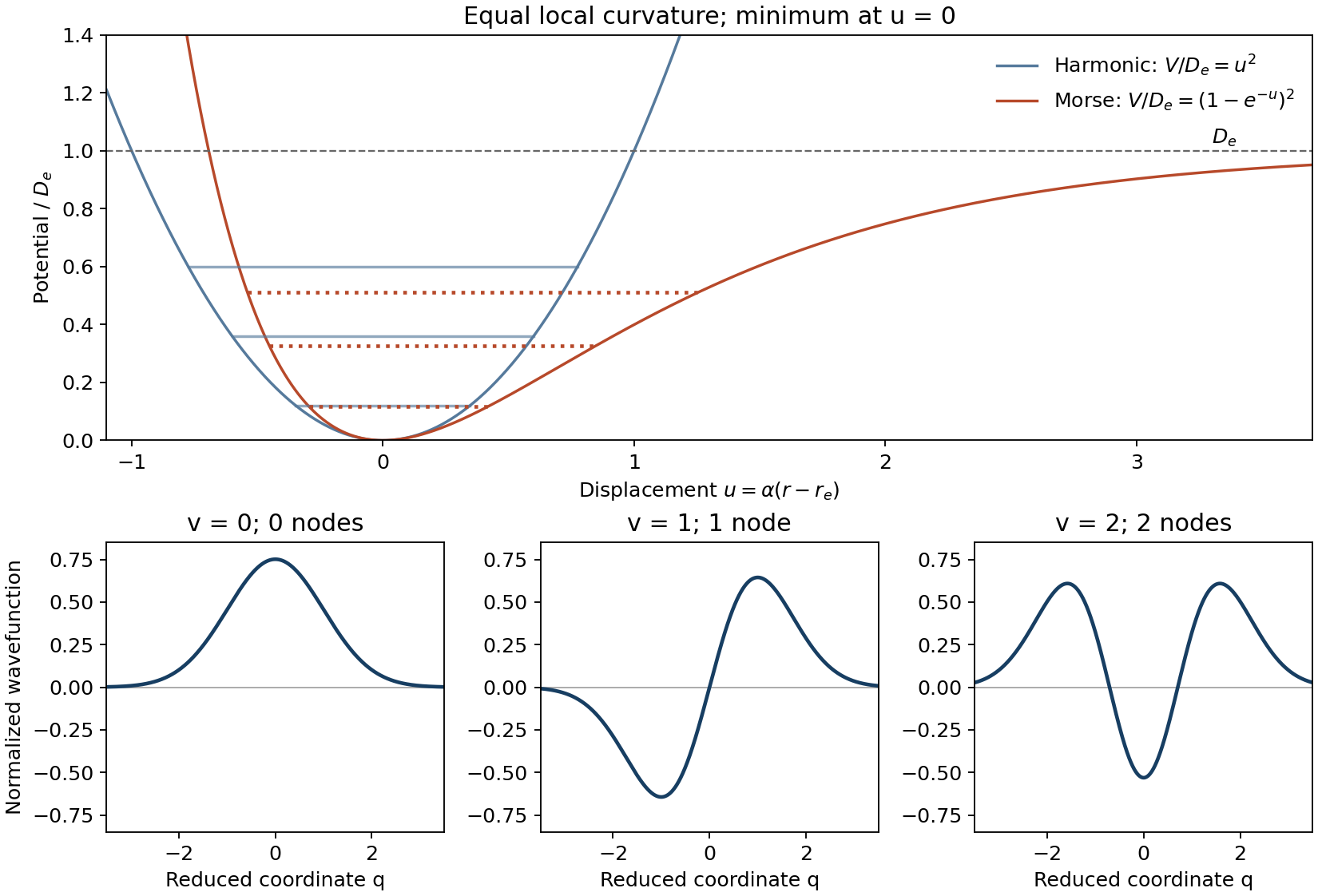
Codex 0 2026-10-20Let measure displacement from the equilibrium bond length and put the minimum of potential energy at zero. The harmonic model and the Morse potential areThe harmonic approximation is a symmetric parabola and has no dissociation limit. The Morse potential has a steep compressed side and a shallower extended side, approaching as . Matching the curvatures at the minimum gives . With denoting a spectroscopic wavenumber rather than an angular frequency, the energy levels areHere is the dimensionless spectroscopic anharmonicity constant. The harmonic spacing is constant, while the Morse oscillator spacing is and decreases as the levels approach dissociation. Only finitely many Morse oscillator levels are bound. The exactly solvable potential was introduced to model this anharmonic behaviour.[ref]
Diatomic Molecules According to the Wave Mechanics. II. Vibrational Levels by Philip M. Morse. Physical Review 34 (1929), pp. 57–64, potential and bound-level solution
For the harmonic model put , with , and . The first three normalized reduced-coordinate wavefunctions areTheir numbers of nodes are zero, one and two, and their parities are even, odd and even. The nodes are at . The diagrams below use analytic curves and arbitrary illustrative scales, with both potentials given the same local curvature.

Past exam of the chemistry course of the year 3 of the natural sciences course of the University of Cambridge 2022 Paper 2B Section B 33 b Solution by Codex 0 2026-10-20
Codex 0 2026-10-20Expand the trial wavefunction in a complete orthonormal set of exact eigenfunctions, , with and . The coefficients may depend on any chosen variational parameters. Orthogonality removes the cross terms in both integrals, givingConsequentlyThis proves the quantum variational principle. The denominator is positive because the trial function is nonzero. Equality requires every occupied exact state to have , allowing for ground-state degeneracy. With a continuous part of the spectrum, the corresponding nonnegative spectral integral gives the same conclusion.
Past exam of the chemistry course of the year 3 of the natural sciences course of the University of Cambridge 2022 Paper 2B Section B 33 a Solution by Codex 0 2026-10-20
Codex 0 2026-10-20For a self-adjoint Hamiltonian bounded below, every nonzero admissible trial wavefunction satisfies the quantum variational principleHere is the lowest exact energy, and the trial function must obey the physical boundary conditions and have finite relevant integrals. Equality holds for a wavefunction in the ground-state eigenspace. The quotient is unchanged by normalization or any nonzero overall scalar.
Past exam of the chemistry course of the year 3 of the natural sciences course of the University of Cambridge 2022 Paper 2B Section A 32 e Solution by Codex 0 2026-10-20
Codex 0 2026-10-20The folded benzvalene cage has one twofold axis and two mirror planes containing it. The double-bonded edge distinguishes it from cages having higher rotational symmetry; it has neither an inversion centre nor a horizontal mirror perpendicular to the twofold axis. Its molecular point group is , the C2v molecular point group.
Past exam of the chemistry course of the year 3 of the natural sciences course of the University of Cambridge 2022 Paper 2B Section A 32 d Solution by Codex 0 2026-10-20
Codex 0 2026-10-20The planar three-radialene structure has a threefold axis normal to the plane, three in-plane twofold axes and the molecular plane as a horizontal mirror. Therefore its molecular point group is , the D3h molecular point group. Its threefold connectivity does not supply a sixfold axis.
Past exam of the chemistry course of the year 3 of the natural sciences course of the University of Cambridge 2022 Paper 2B Section A 32 c Solution by Codex 0 2026-10-20
Codex 0 2026-10-20For hexa-1,5-diyne in the extended anti conformation drawn, inversion at the midpoint of the central carbon–carbon bond exchanges the two identical ends. A twofold axis through that midpoint perpendicular to the carbon skeleton plane, together with the mirror plane of that skeleton, completes the C2h molecular point group. The methylene hydrogens occur in the corresponding mirror-related pairs. Thus the answer is . The whole molecule is not linear simply because its terminal triple-bond fragments are linear; the conformation is essential to this assignment.
Past exam of the chemistry course of the year 3 of the natural sciences course of the University of Cambridge 2022 Paper 2B Section A 32 b Solution by Codex 0 2026-10-20
Codex 0 2026-10-20The fulvene structure has an in-plane twofold axis through the exocyclic double bond and the opposite part of the five-membered ring. The molecular plane and a plane perpendicular to it containing that axis are both mirrors. There is no perpendicular sixfold axis or inversion centre. Its molecular point group is , the C2v molecular point group.
Past exam of the chemistry course of the year 3 of the natural sciences course of the University of Cambridge 2022 Paper 2B Section A 32 a Solution by Codex 0 2026-10-20
Codex 0 2026-10-20The planar benzene structure has a sixfold principal axis normal to its plane, six transverse twofold axes, the molecular mirror plane and an inversion centre. Its molecular point group is , the D6h molecular point group.
Past exam of the chemistry course of the year 3 of the natural sciences course of the University of Cambridge 2022 Paper 2B Section A 29 b Solution by Codex 0 2026-10-20
Codex 0 2026-10-20The C2v molecular point group has four one-dimensional irreducible representations. In the operation order used above, the character table rows are , , and . Their character inner products with giveHence , whose dimensions sum to six. The labels refer to the source axes; swapping and swaps these names.
Past exam of the chemistry course of the year 3 of the natural sciences course of the University of Cambridge 2022 Paper 2B Section A 29 a Solution by Codex 0 2026-10-20
Codex 0 2026-10-20Use the axes actually printed: the two hydrogens lie in the plane, is the principal twofold axis, and is perpendicular to that plane. For a Cartesian-displacement group representation, only atoms left at their own sites contribute to the trace; their vector components must also be transformed. In the order , identity fixes six components, the twofold rotation exchanges the hydrogens, the reflection fixes both hydrogens with vector matrix , and the reflection exchanges them. ThereforeThe nonzero mirror character of a representation is , not six.
Past exam of the chemistry course of the year 3 of the natural sciences course of the University of Cambridge 2022 Paper 2B Section A 28 c Solution by Codex 0 2026-10-20
Codex 0 2026-10-20Choose transverse directions parallel and perpendicular to the vertical mirror plane. At each metal the parallel p orbital is unchanged, whereas the perpendicular p orbital changes sign. Thus each two-dimensional block has trace . The total character of a representation is . A mirror plane passing through an orbital centre does not imply that every orbital on that centre contributes .
Past exam of the chemistry course of the year 3 of the natural sciences course of the University of Cambridge 2022 Paper 2B Section A 28 b Solution by Codex 0 2026-10-20
Codex 0 2026-10-20 Past exam of the chemistry course of the year 3 of the natural sciences course of the University of Cambridge 2022 Paper 2B Section A 28 a Solution by Codex 0 2026-10-20
Codex 0 2026-10-20For the character of a localized orbital basis, take the trace of the transformation matrix: both permutation of centres and signs of atomic orbitals matter. The two metal centres lie on the principal axis and remain fixed under rotation about . At either metal the basis has the matrixThe full four-dimensional group representation is block diagonal with two such blocks. Consequently , and for the rotation of the D6h molecular point group, .
There are unlisted articles, also show them or only show them.