Past exam of the chemistry course of the year 3 of the natural sciences course of the University of Cambridge 2022 Paper 4 54 g 1 Solution by  Codex 0 2026-10-20
 Past exam of the chemistry course of the year 3 of the natural sciences course of the University of Cambridge 2022 Paper 4 53 a iv Solution by Codex 0 2026-10-20
Codex 0 2026-10-20 Past exam of the chemistry course of the year 3 of the natural sciences course of the University of Cambridge 2022 Paper 4 53 a iii Solution by Codex 0 2026-10-20
Codex 0 2026-10-20 Past exam of the chemistry course of the year 3 of the natural sciences course of the University of Cambridge 2022 Paper 4 53 a ii Solution by Codex 0 2026-10-20
Codex 0 2026-10-20 Past exam of the chemistry course of the year 3 of the natural sciences course of the University of Cambridge 2022 Paper 4 53 a i Solution by Codex 0 2026-10-20
Codex 0 2026-10-20 Past exam of the chemistry course of the year 3 of the natural sciences course of the University of Cambridge 2022 Paper 4 51 c vi Solution by Codex 0 2026-10-20
Codex 0 2026-10-20The target dianion consumes two electrons per molecule, sogiving Faradaic yield. Of the passed electron equivalents, are not accounted for by the quantified bis-adduct.
They can reside in incompletely captured reduced quinones, other reduction products or parasitic solvent/proton/CO chemistry. The data do not identify one unique loss pathway. The starting solution contains BQ, so the target product represents only of that inventory; low bulk conversion alone does not explain a sub-unity Faradaic yield, because unreacted BQ has consumed no charge.
Past exam of the chemistry course of the year 3 of the natural sciences course of the University of Cambridge 2022 Paper 4 51 c v Solution by Codex 0 2026-10-20
Codex 0 2026-10-20Within the stated ECEC model and with CO genuinely in large excess, its concentration is effectively constant. Both capture steps are then pseudo-first-order in the quinone species, and at the same scan rate the faradaic current is linear in bulk AQ concentration.
The sketch therefore retains the peak potentials, sweep directions and relative features of the trace, including the positive-potential return feature III, but reduces the faradaic current scale by a factor of ten. Charging/background current need not scale with AQ concentration and should be shown separately. A changed normalized shape would indicate effects outside this simple scaling limit, such as CO depletion, adsorption or reactions between quinone species.
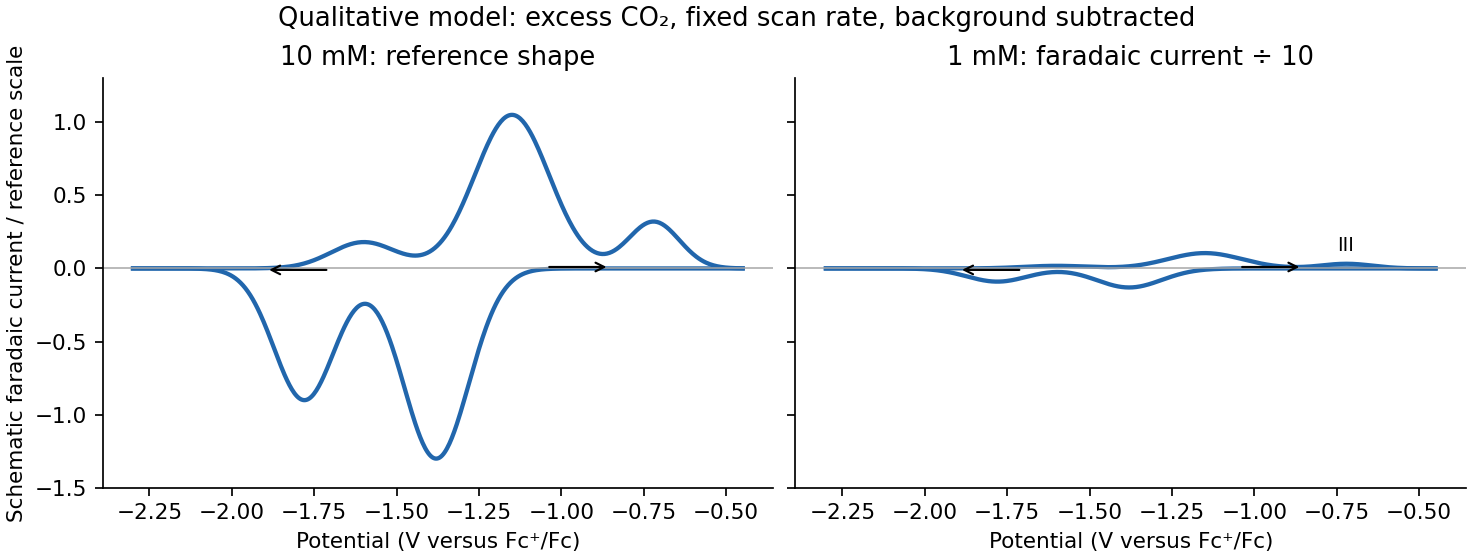
Qualitative tenfold faradaic-current scaling at fixed scan rate and excess carbon dioxide
. Details. 
Past exam of the chemistry course of the year 3 of the natural sciences course of the University of Cambridge 2022 Paper 4 51 c iv Solution by Codex 0 2026-10-20
Codex 0 2026-10-20Peak I is the cathodic reduction shifted positive of the unbound AQ/AQ event, consistent with reduction of the CO-bound semiquinone to mono-carbonate dianion. Peak II is the corresponding relatively negative-potential return oxidation of mono-carbonate dianion. Peak III, appearing farther positive on the faster return scan, is consistent with direct oxidation of the more strongly protected bis-carbonate dianion, followed by CO release.
This assignment is consistent with binding making the reduced species harder to oxidize. At slow scan, chemical interconversion and CO dissociation can feed the easier mono-carbonate oxidation pathway; at fast scan a larger fraction of kinetically retained bis-adduct survives to its direct oxidation potential. The two separated reductions also show that initial capture and its associated potential shift are not sufficient to make every ECEC step a single equilibrated two-electron wave.
These traces support coupled electron-transfer/binding chemistry but do not determine every microscopic rate constant or exclude EECC pathways. The peak assignments are species-family assignments within the stated mechanism, rather than proof of a unique elementary sequence from voltammetry alone.
Past exam of the chemistry course of the year 3 of the natural sciences course of the University of Cambridge 2022 Paper 4 51 c iii Solution by Codex 0 2026-10-20
Codex 0 2026-10-20A useful electrode-surface scheme for the proposed ECEC mechanism isElectron-transfer arrows occur at the electrode, whereas both capture steps occur in the adjacent solution layer. CO is attacked by an oxygen-centered nucleophilic component of the reduced quinone, forming an O-carbonate linkage rather than simply physically adsorbing on neutral AQ.
At potentials more negative than , direct second reduction of any unbound semiquinone is also accessible: , followed by carbonate formation. Thus the fully reduced unbound and mono-adduct species can feed the bis-adduct, and the drawing should include CO transport into the layer and adduct transport away. ECEC is the proposed sequence; competing EECC transfer/capture ordering is possible at such negative potentials.
Past exam of the chemistry course of the year 3 of the natural sciences course of the University of Cambridge 2022 Paper 4 51 c ii Solution by Codex 0 2026-10-20
Codex 0 2026-10-20Event a probes electron transfer between the semiquinone and dianion. Benzoquinone's smaller framework localizes charge and undergoes a greater change in bonding and solvation on this reduction; a larger effective reorganization barrier can make its heterogeneous transfer insufficiently fast for Nernst equilibrium on the time scale. Anthraquinone's extended framework distributes the added charge and can support the more reversible response seen here.
This is a kinetic interpretation of quasi-reversibility, not a claim that benzoquinone cannot be reduced. Follow-up chemistry or adsorption can also distort peak separation and return-current ratios; scan-rate-dependent measurements would distinguish them from slow electron transfer. A single trace does not uniquely identify the cause.
Past exam of the chemistry course of the year 3 of the natural sciences course of the University of Cambridge 2022 Paper 4 51 c i Solution by Codex 0 2026-10-20
Codex 0 2026-10-20Read the potential labels rather than the alphabetical order: b, the less negative event, is ; a, the more negative event, is . These are the first and second reductions respectively, with the reverse branches giving the corresponding oxidations. The second electron is harder to add to an already negatively charged species.
Past exam of the chemistry course of the year 3 of the natural sciences course of the University of Cambridge 2022 Paper 4 51 a ii Solution by Codex 0 2026-10-20
Codex 0 2026-10-20The midpoint potential characterizes the redox couple under specified solution conditions: it is the potential at which oxidized and reduced forms have equal activities, or equal concentrations in the corresponding formal-potential convention. For a reversible cyclic voltammogram it is estimated by . It approximates the formal redox potential when the usual reversibility and diffusion assumptions apply; it is not the potential halfway along a scan chosen arbitrarily.
Past exam of the chemistry course of the year 3 of the natural sciences course of the University of Cambridge 2022 Paper 4 51 a i Solution by Codex 0 2026-10-20
Codex 0 2026-10-20Make heterogeneous electron transfer fast relative to delivery of reactant, usually by applying sufficient overpotential so that its surface concentration approaches zero. Use excess supporting electrolyte to suppress migration. For purely diffusional transient transport, suppress uncontrolled convection; for a rotating disk electrode, controlled convection supplies the bulk while diffusion across the thin interfacial boundary layer limits the current. A limiting current that no longer increases with driving potential is the characteristic test; a large current alone is not sufficient.
Past exam of the chemistry course of the year 3 of the natural sciences course of the University of Cambridge 2022 Paper 3 49 c iv Solution by Codex 0 2026-10-20
Codex 0 2026-10-20The relevant decomposition is unchanged:Thus the same and vibrational symmetries are linearly Jahn-Teller active. Their coupling constants and the resulting energy surface can differ from those of a state. The ground-geometry methane normal-mode representation and the symmetry-allowed harmonic invariants are also unchanged; actual force constants in the excited state need not have the same values.
Past exam of the chemistry course of the year 3 of the natural sciences course of the University of Cambridge 2022 Paper 3 49 c iii Solution by Codex 0 2026-10-20
Codex 0 2026-10-20For a real nonmagnetic electronic triplet, the symmetric square of a group representation decomposes asThe coordinate shifts all components equally and does not remove the degeneracy. The linear Jahn-Teller selection rule therefore permits and vibrational modes to couple and split the triplet. Both methane vibrational triplets are symmetry-eligible. A nonzero allowed coupling generally produces a symmetry-lowering instability, although symmetry alone does not determine its strength or the preferred minimum.
Past exam of the chemistry course of the year 3 of the natural sciences course of the University of Cambridge 2022 Paper 3 49 c ii Solution by Codex 0 2026-10-20
Codex 0 2026-10-20Choose mass-weighted coordinates , , and two triplets for the two copies. About a stationary equilibrium geometry, the allowed harmonic potential isThe kinetic energy is one-half the sum of the squared conjugate momenta. Cross terms between inequivalent irreducible representations are forbidden, but the two equivalent triplets permit the displayed scalar-product term. This is equivalent-mode harmonic coupling. An orthogonal rotation between the two triplets diagonalizes their force-constant matrix. In molecular normal coordinates the complete Hamiltonian becomesSymmetry enforces degeneracies within each multiplet; it does not require equal frequencies for the two distinct normal modes.
Past exam of the chemistry course of the year 3 of the natural sciences course of the University of Cambridge 2022 Paper 3 49 c i Solution by Codex 0 2026-10-20
Codex 0 2026-10-20In the class order , the 15 Cartesian nuclear displacements of methane have characters . Only nuclei left fixed by an operation contribute to that operation's trace. Subtract translations and rotations to obtain the methane normal-mode representationIts dimension is . There are four frequency families: a nondegenerate symmetric stretch, a doubly degenerate bend, and triply degenerate stretch and bend modes.
Past exam of the chemistry course of the year 3 of the natural sciences course of the University of Cambridge 2022 Paper 3 49 b ii Solution by Codex 0 2026-10-20
Codex 0 2026-10-20For a real-character irreducible molecular representation with character , the multiplicity of the fully symmetric representation in its tensor square isby character orthogonality. The identity uses the real-character assumption appropriate to the usual real irreducible representations intended here. For a general complex irreducible representation, the trivial representation in a tensor square has multiplicity one precisely when it is self-dual, and zero otherwise, by Schur's lemma. The universally valid tensor product is .
Past exam of the chemistry course of the year 3 of the natural sciences course of the University of Cambridge 2022 Paper 3 49 b i Solution by Codex 0 2026-10-20
Codex 0 2026-10-20For representation spaces , the tensor product of group representations acts on product basis vectors throughIts character is the trace. Summing diagonal elements explicitly,No step assumes one-dimensional matrices, so the result applies to both degenerate and nondegenerate representations.
Past exam of the chemistry course of the year 3 of the natural sciences course of the University of Cambridge 2022 Paper 3 49 a iii Solution by Codex 0 2026-10-20
Codex 0 2026-10-20The spin isomers of hydrogen illustrate how nuclear spin statistics constrain the product of electronic, vibrational, rotational and nuclear-spin exchange symmetries. In the ground electronic and vibrational states of these homonuclear molecules, the first two factors are symmetric. Exchanging the nuclei reverses the internuclear direction, so a rotational state has parity .
For , the protons are spin-one-half fermions and the total nuclear-exchange wavefunction must be antisymmetric. The antisymmetric spin singlet pairs with even (para-hydrogen, one spin state); the symmetric spin triplet pairs with odd (ortho-hydrogen, three spin states). For , spin-one deuterons are bosons, so the total must be symmetric. Nuclear spins supply six symmetric states paired with even (ortho-deuterium); supplies three antisymmetric states paired with odd (para-deuterium). The high-temperature ortho/para statistical ratios are for hydrogen and for deuterium, while low-temperature equilibrium populations also depend on rotational energies and whether spin conversion can occur.
There are unlisted articles, also show them or only show them.