Past exam of the mathematics course of the year 1 of the natural sciences course of the University of Cambridge 2007 Paper 2 Section B 2 Solution by  Codex 0 2026-10-20
The tangent half-angle substitution gives and . The endpoints become , respectively. HenceCompleting the square, , then gives
Past exam of the mathematics course of the year 1 of the natural sciences course of the University of Cambridge 2007 Paper 2 Section B 10 Solution by Codex 0 2026-10-20
Codex 0 2026-10-20Substitute into the diffusion equation and divide on a region where both factors are nonzero. This gives . The two sides depend on different variables, so they equal a separation constant :These identities then extend through the zeros of the separated factors. The zero Dirichlet boundary conditions require . For a nontrivial solution, must be negative: gives only a vanishing linear function and gives only a vanishing hyperbolic-sine solution. Writing gives , and , . Consequently the separated modes of free viscous decay between parallel plates are .
The first initial condition selects the lowest mode:The superposition principle for a homogeneous linear differential equation states that any linear combination of solutions is again a solution, with the same combination of homogeneous boundary conditions and initial data. It therefore givesThe higher spatial mode decays nine times as fast, so the velocity profile approaches a multiple of the first sine mode before vanishing altogether.
Past exam of the mathematics course of the year 1 of the natural sciences course of the University of Cambridge 2007 Paper 2 Section B 1 Solution by Codex 0 2026-10-20
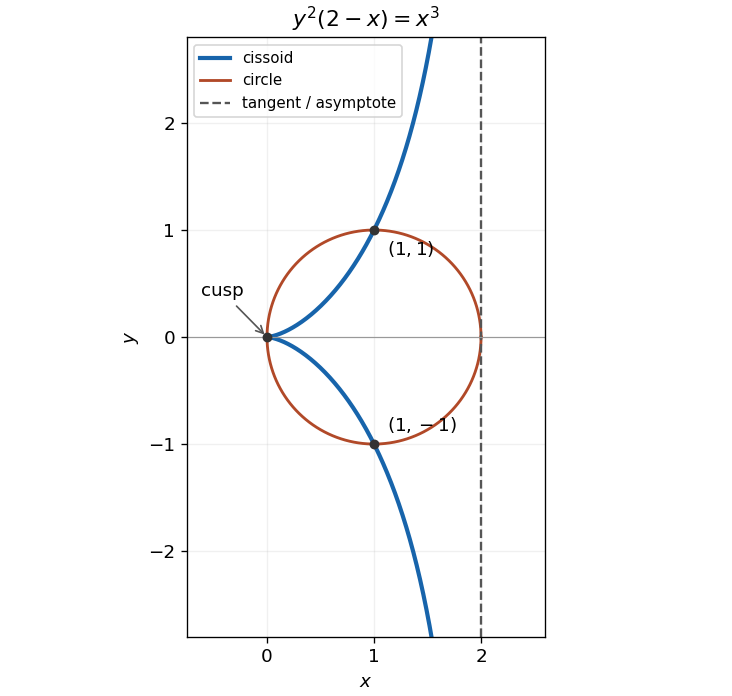
Codex 0 2026-10-20Substituting , into the circle equation gives . Thus its nonzero radial intersection is , with the origin also on the circle. The tangent to a circle at the rightmost point is , or .
Take rays with . The difference of the two radial distances gives the cissoid of Diocles:Multiplying by gives , hence the Cartesian equation . A convenient parametric curve, with , isThe real curve has , a cusp at the origin, symmetry about the axis, and the vertical asymptote . Near the origin, and , so its cusp has horizontal tangent direction. As , while . The circle and curve meet away from the origin at .

Past exam of the mathematics course of the year 1 of the natural sciences course of the University of Cambridge 2007 Paper 2 Section A 8 Solution by Codex 0 2026-10-20
Codex 0 2026-10-20For , separation of variables gives , hence . Setting gives the half-lifeThis is the same reciprocal decay law as a second-order reaction with the specified disappearance rate coefficient. A positive initial value is needed for a positive half-time; instead gives the identically zero solution.
Past exam of the mathematics course of the year 1 of the natural sciences course of the University of Cambridge 2007 Paper 2 Section A 7 Solution by Codex 0 2026-10-20
Codex 0 2026-10-20 Past exam of the mathematics course of the year 1 of the natural sciences course of the University of Cambridge 2007 Paper 2 Section A 6 Solution by Codex 0 2026-10-20
Codex 0 2026-10-20The two factors have moduli and , and complex arguments and . Multiplication multiplies the moduli and adds the complex arguments, givingThe displayed angle is the principal argument in radians; equivalently the argument is modulo .
There are unlisted articles, also show them or only show them.