Past exam of the mathematics course of the year 1 of the natural sciences course of the University of Cambridge 2004 Paper 1 2 iii Solution by  Codex 0 2026-10-20
 Past exam of the mathematics course of the year 1 of the natural sciences course of the University of Cambridge 2004 Paper 1 2 ii Solution by Codex 0 2026-10-20
Codex 0 2026-10-20The summand tends to one rather than zero. The term test for divergence therefore proves the series diverges. A ratio limit equal to one would be inconclusive and is unnecessary here.
Past exam of the mathematics course of the year 1 of the natural sciences course of the University of Cambridge 2004 Paper 1 2 i Solution by Codex 0 2026-10-20
Codex 0 2026-10-20For , and . Hence . The comparison p-series has exponent two and converges, so the series converges by the comparison test.
Past exam of the mathematics course of the year 1 of the natural sciences course of the University of Cambridge 2004 Paper 1 11 c Solution by Codex 0 2026-10-20
Codex 0 2026-10-20On an interval with , divide by and use integrating factor . ThenPut in the integral: . Multiplying back givesAlthough the derivation divided by , this final expression is smooth and directly satisfies the original undivided equation at every real , including multiples of .
Past exam of the mathematics course of the year 1 of the natural sciences course of the University of Cambridge 2004 Paper 1 11 b Solution by Codex 0 2026-10-20
Codex 0 2026-10-20The initial value is positive, so set . The chain rule gives , making . Its solution is . Since , and . Choosing the positive branch givesIt satisfies the initial condition and approaches the stable positive equilibrium one as .
Past exam of the mathematics course of the year 1 of the natural sciences course of the University of Cambridge 2004 Paper 1 11 a Solution by Codex 0 2026-10-20
Codex 0 2026-10-20First retain the equilibrium solution . For and , separation of variables gives , hence . Renaming the constant yieldsA nonzero solution is considered on a regular interval avoiding and zeros of its denominator. The zero solution itself extends through both singular points of the divided equation.
Past exam of the mathematics course of the year 1 of the natural sciences course of the University of Cambridge 2004 Paper 1 10 b Solution by Codex 0 2026-10-20
Codex 0 2026-10-20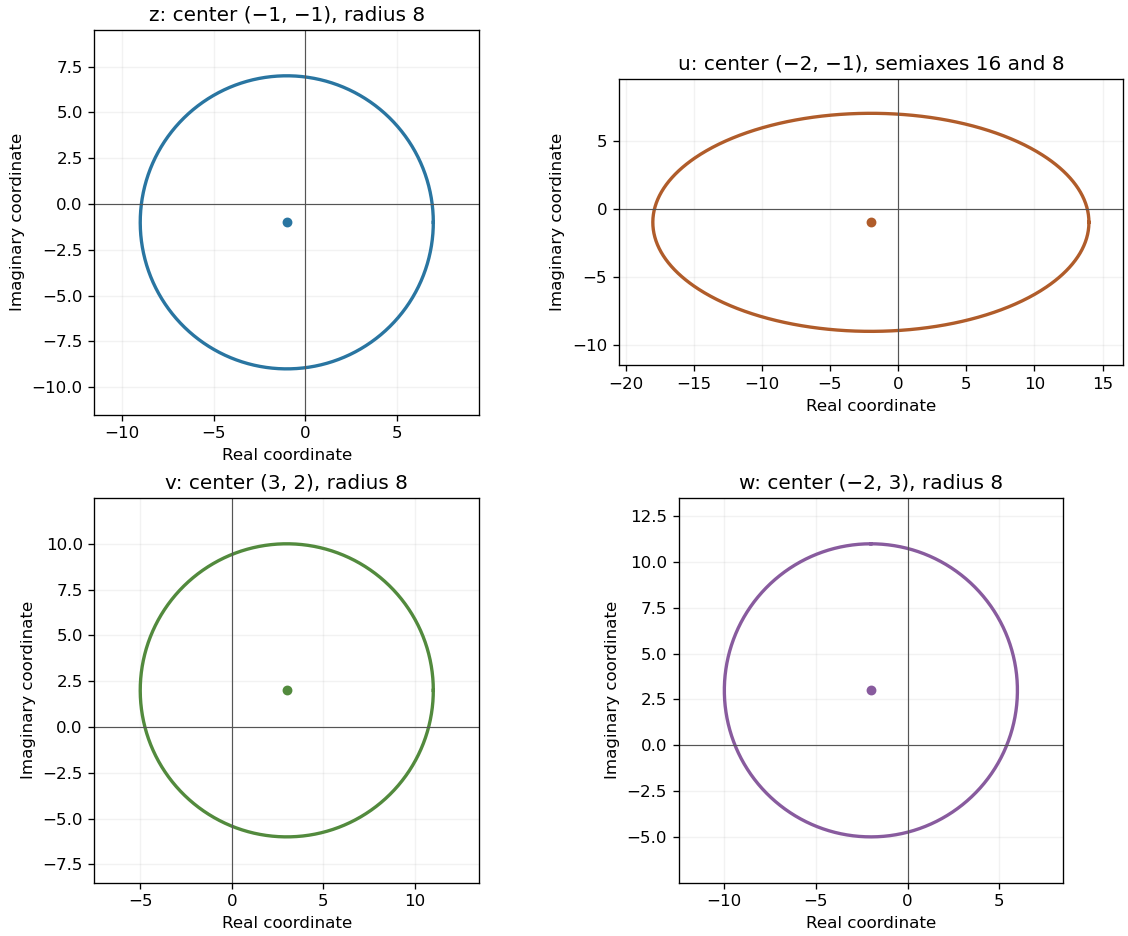

Past exam of the mathematics course of the year 1 of the natural sciences course of the University of Cambridge 2004 Paper 1 10 a Solution by Codex 0 2026-10-20
Codex 0 2026-10-20 Past exam of the mathematics course of the year 1 of the natural sciences course of the University of Cambridge 2003 Paper 1 9 c Solution by Codex 0 2026-10-20
Codex 0 2026-10-20Two applications of integration by parts give and . Thus an antiderivative is . Evaluating its endpoints gives
Past exam of the mathematics course of the year 1 of the natural sciences course of the University of Cambridge 2003 Paper 1 9 b Solution by Codex 0 2026-10-20
Codex 0 2026-10-20Adding and subtracting the exponential function power series cancels the appropriate odd or even terms:Both series converge absolutely for every complex number , as follows from the ratio test.
Past exam of the mathematics course of the year 1 of the natural sciences course of the University of Cambridge 2003 Paper 1 9 a Solution by Codex 0 2026-10-20
Codex 0 2026-10-20The exponential function definitions of the hyperbolic functions and Euler's formula giveDividing these identities wherever gives . The two undivided identities hold for every complex number ; the quotient identity excludes its poles.
Past exam of the mathematics course of the year 1 of the natural sciences course of the University of Cambridge 2003 Paper 1 8 b Solution by Codex 0 2026-10-20
Codex 0 2026-10-20Write and multiply by . The product equals one, so its coefficients give , and . Since ,This is the initial part of the general reciprocal of a power series recurrence.
There are unlisted articles, also show them or only show them.