Past exam of the mathematics course of the year 1 of the natural sciences course of the University of Cambridge 2002 Paper 1 8 c Solution by  Codex 0 2026-10-20
For the specified coordinate vectors,Choose the orthogonal matrix representing a quarter-turn,Then and direct matrix multiplication gives . Thus these two shear mappings are orthogonally similar.
Past exam of the mathematics course of the year 1 of the natural sciences course of the University of Cambridge 2002 Paper 1 8 b Solution by Codex 0 2026-10-20
Codex 0 2026-10-20Since , nilpotence already gives . Explicitly, in index notation,Thus , or equivalently . Here is the Kronecker delta.
Past exam of the mathematics course of the year 1 of the natural sciences course of the University of Cambridge 2002 Paper 1 8 a Solution by Codex 0 2026-10-20
Codex 0 2026-10-20Let . The orthogonality condition gives : this is the nilpotent part of a transvection when both vectors are nonzero. In two dimensions,Expanding its determinant, the fourth-degree terms cancel:These formulas also cover either vector being zero.
Past exam of the mathematics course of the year 1 of the natural sciences course of the University of Cambridge 2002 Paper 1 7 b Solution by Codex 0 2026-10-20
Codex 0 2026-10-20The Bernoulli differential equation becomes linear after : multiplying by gives . A quadratic particular solution is , while the homogeneous solution is . The initial condition gives and . HenceThe denominator is positive for all real , since . Thus this initial value problem has the displayed solution on the entire real line. The separate solution does not satisfy its initial condition.
Past exam of the mathematics course of the year 1 of the natural sciences course of the University of Cambridge 2002 Paper 1 6 b Solution by Codex 0 2026-10-20
Codex 0 2026-10-20For and , the outer products areTheir inner product is zero and both squared norms are two. Thus and are orthogonal spectral projectors, with . Since and , the eigenvalues are , , andMultiplying these decompositions uses and , , giving the identity matrix.
Past exam of the mathematics course of the year 1 of the natural sciences course of the University of Cambridge 2002 Paper 1 6 a Solution by Codex 0 2026-10-20
Codex 0 2026-10-20Direct matrix multiplication givesConsequently , the Cayley-Hamilton theorem for its characteristic polynomial . Rearranging gives , so
Past exam of the mathematics course of the year 1 of the natural sciences course of the University of Cambridge 2002 Paper 1 5 b Solution by Codex 0 2026-10-20
Codex 0 2026-10-20The upper boundary follows until its intersection with at , then follows the hyperbola to . The lower boundary is . Therefore the two vertical-slice descriptions are , , and , .
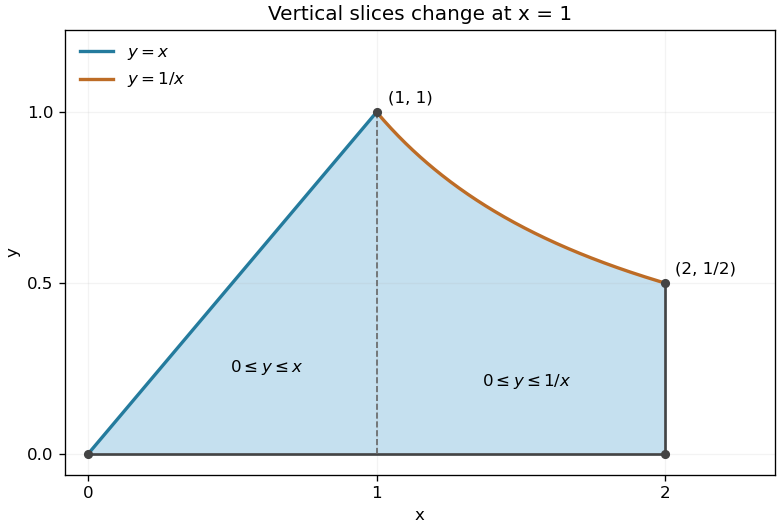
Integrating with respect to first reduces the double integral toUsing the antiderivatives from part (a),
Past exam of the mathematics course of the year 1 of the natural sciences course of the University of Cambridge 2002 Paper 1 5 a Solution by Codex 0 2026-10-20
Codex 0 2026-10-20Let . Positivity allows the squared integral to be written as a first-quadrant double integral. In polar coordinates the Jacobian determinant is , soUsing integration by parts, with the boundary term vanishing at both endpoints,The substitution also gives the two antiderivativesThese values also follow from the Gaussian moment recurrence and can be checked by differentiation.
Past exam of the mathematics course of the year 1 of the natural sciences course of the University of Cambridge 2002 Paper 1 3 a Solution by Codex 0 2026-10-20
Codex 0 2026-10-20At an interior local extremum of a differentiable function, . The second-derivative test classifies a stationary point: a positive second derivative gives a strict local minimum, and a negative second derivative gives a strict local maximum. A zero second derivative is inconclusive: , , and at zero illustrate a minimum, a maximum, and neither.
Past exam of the mathematics course of the year 1 of the natural sciences course of the University of Cambridge 2002 Paper 1 12 iii Solution by Codex 0 2026-10-20
Codex 0 2026-10-20Expand the constant right-edge value in a Fourier sine series. Its coefficients areThe superposition principle combines the normalized modes, givingThis is a harmonic function in a rectangle with one constant boundary value, with the coordinate roles interchanged. The series and its derivatives converge uniformly on compact subsets of , so it satisfies Laplace's equation there. It vanishes on the other three edges and approaches one at every interior point of the right edge. At the two right corners the one-sided prescribed values disagree; no continuous extension can satisfy both. The stated open-edge condition avoids that incompatibility, and isolated corner assignments do not change the bounded interior Dirichlet problem.
Past exam of the mathematics course of the year 1 of the natural sciences course of the University of Cambridge 2002 Paper 1 12 ii Solution by Codex 0 2026-10-20
Codex 0 2026-10-20For the first family, vanishing at requires , so is a positive integer. The second family would require , impossible for real ; the mode also fails unless its coefficient is zero. Conveniently normalized surviving modes areAt , these become the Fourier sine series basis functions .
Past exam of the mathematics course of the year 1 of the natural sciences course of the University of Cambridge 2002 Paper 1 12 i Solution by Codex 0 2026-10-20
Codex 0 2026-10-20The zero value at removes the even factor in , and the zero value at removes the even factor in . Up to multiplicative constants, the nonzero separated modes areThe zero-separation case also supplies . Each is a harmonic function and vanishes on both axes.
Past exam of the mathematics course of the year 1 of the natural sciences course of the University of Cambridge 2002 Paper 1 11 c Solution by Codex 0 2026-10-20
Codex 0 2026-10-20Factor from the numerator and denominator:For , the tangent ranges over all positive real values. Thus . Using the principal complex logarithm,The real part ranges over the entire real line, while the imaginary part is fixed: the locus is the horizontal line . Any other fixed logarithm branch gives the parallel line for one integer ; allowing every branch gives the union of those lines.
Past exam of the mathematics course of the year 1 of the natural sciences course of the University of Cambridge 2002 Paper 1 11 b Solution by Codex 0 2026-10-20
Codex 0 2026-10-20Euler's formula and its version with giveSquaring and comparing real and imaginary parts with yields the double-angle formulas
Past exam of the mathematics course of the year 1 of the natural sciences course of the University of Cambridge 2002 Paper 1 11 a Solution by Codex 0 2026-10-20
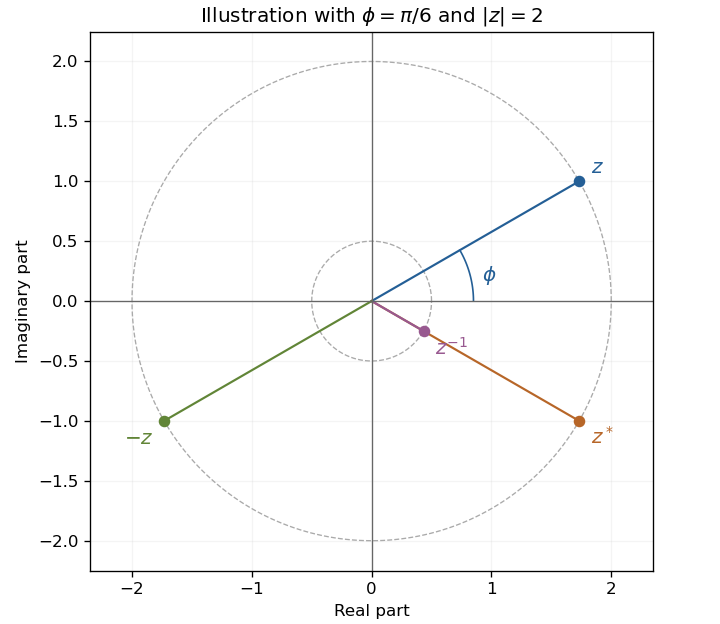
Codex 0 2026-10-20Complex conjugation reverses the argument, reciprocation also inverts the modulus, and multiplication by adds to the argument. With all arguments chosen in and ,Thus is in the first quadrant, and lie on the same fourth-quadrant ray at radii two and one-half, and is diametrically opposite .


Past exam of the mathematics course of the year 1 of the natural sciences course of the University of Cambridge 2001 Paper 2 9 b Solution by Codex 0 2026-10-20
Codex 0 2026-10-20Differentiate both algebraic constraints at fixed or fixed :The multivariable chain rule for therefore givesDivide the first identity by and the second by , and add. The terms cancel, leavingThe Jacobian determinant of is , so the calculation is valid on real branches with . This explicitly supplies the local independence assumption underlying the change of coordinates.
There are unlisted articles, also show them or only show them.