Past exam of the mathematics course of the year 1 of the natural sciences course of the University of Cambridge 2001 Paper 2 8 b Solution by  Codex 0 2026-10-20
Use the spherical polar coordinates volume element . Since throughout , the solid has radial range and full azimuthal range . Its volume isPut , so and the endpoints become and . ConsequentlyThe polar equation describes the entire three-dimensional surface, so the spherical polar coordinates volume element, rather than a two-dimensional polar area element, is required.
Past exam of the mathematics course of the year 1 of the natural sciences course of the University of Cambridge 2001 Paper 2 8 a Solution by Codex 0 2026-10-20
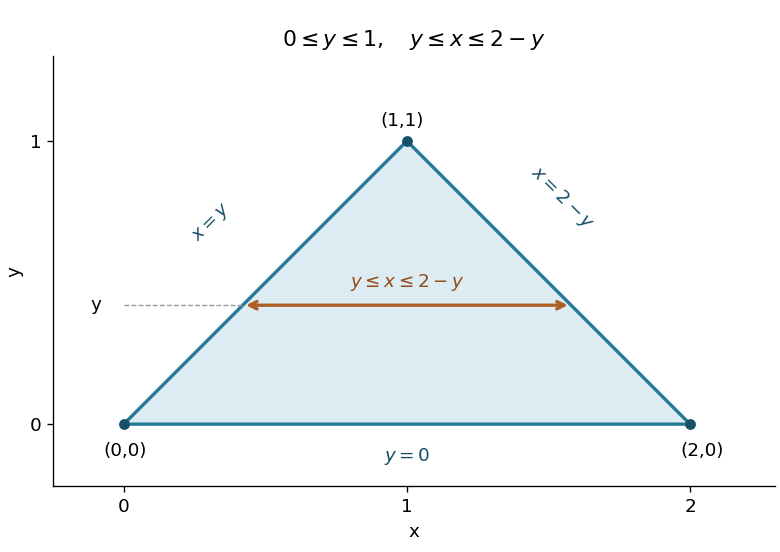
Codex 0 2026-10-20The region of integration is , . It is the closed triangle with vertices , , and , bounded by , , and . Each horizontal slice runs from the rising left edge to the falling right edge.

Past exam of the mathematics course of the year 1 of the natural sciences course of the University of Cambridge 2001 Paper 2 7 c Solution by Codex 0 2026-10-20
Codex 0 2026-10-20Here the vertical bars denote determinants. Since , taking determinants gives . The condition selects . By the multiplicative property of the determinant,The hypotheses determine this determinant, while allowing many possible matrices and .
Past exam of the mathematics course of the year 1 of the natural sciences course of the University of Cambridge 2001 Paper 2 7 b Solution by Codex 0 2026-10-20
Codex 0 2026-10-20The homogeneous linear system has coefficient matrixNonzero solutions exist exactly when its determinant vanishes. Expanding along the first row givesThus or . The first equation always gives . For , the second then gives ; the third imposes the same relation. For , the second gives , again consistent with the third. Therefore the nonzero solutions areFor every other , the matrix is invertible and only the zero solution exists.
Past exam of the mathematics course of the year 1 of the natural sciences course of the University of Cambridge 2001 Paper 2 6 b Solution by Codex 0 2026-10-20
Codex 0 2026-10-20Maximize the total surface area with the constraint . The Lagrange multiplier equations areFrom the second, . Substitute into the first and multiply by to obtain . Thus the aspect ratio satisfies . Since ,This is the maximum-area cylinder inscribed in a sphere. The dimensions and area, although not needed to specify the ratio, areThere is only one positive stationary ratio. At the degenerate boundaries and , the limiting areas are zero and , both below this value, confirming the maximum.
Past exam of the mathematics course of the year 1 of the natural sciences course of the University of Cambridge 2001 Paper 2 6 a Solution by Codex 0 2026-10-20
Codex 0 2026-10-20Use a Lagrange multiplier to maximize subject to , with . The equations areThe second equation gives . Substituting into the first gives , hence . The constraint then gives , soThis is the same aspect ratio as the minimum-area closed cylinder at fixed volume. To confirm maximality directly, eliminate : on . Its only stationary point is the value above, its second derivative there is negative, and the volume tends to zero at either end of the interval.
Past exam of the mathematics course of the year 1 of the natural sciences course of the University of Cambridge 2001 Paper 2 5 b Solution by Codex 0 2026-10-20
Codex 0 2026-10-20 Past exam of the mathematics course of the year 1 of the natural sciences course of the University of Cambridge 2001 Paper 2 3 c Solution by Codex 0 2026-10-20
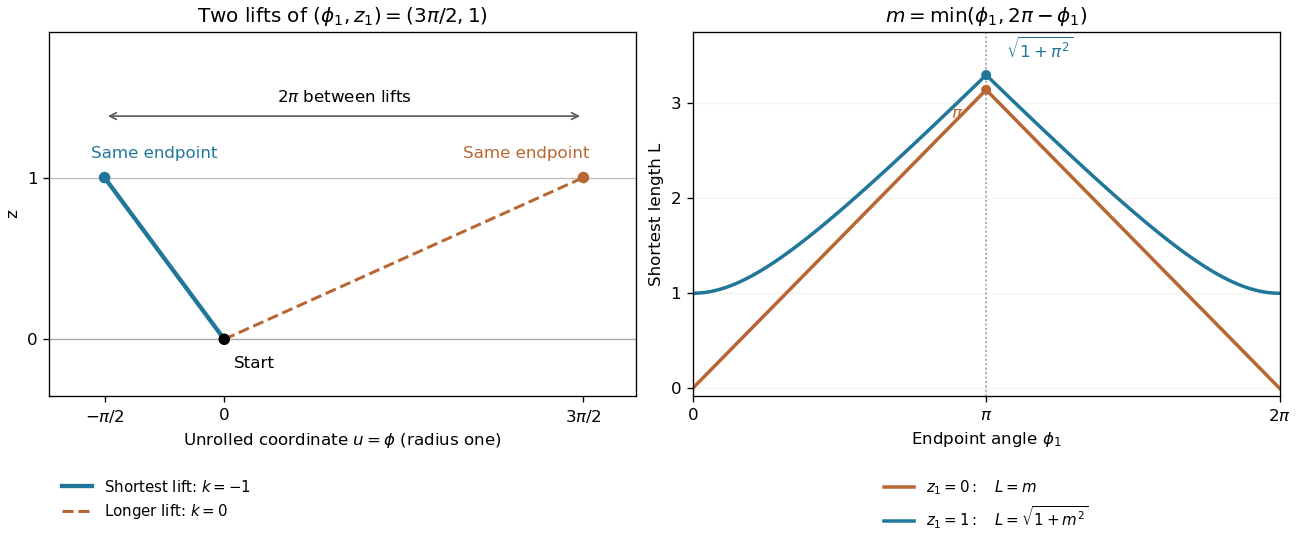
Codex 0 2026-10-20For and , the shortest path on a circular cylinder has lengthIts graph is triangular, with endpoint values zero and maximum at . In particular, increasing the angle to a full turn brings the endpoint back to the starting point.
For and , the corresponding length isThis graph has endpoint values one, a maximum at , and symmetry about . Each half is smooth, with horizontal slope at the outer endpoint; at the two halves meet at a corner, because the minimizing winding direction changes.

Past exam of the mathematics course of the year 1 of the natural sciences course of the University of Cambridge 2001 Paper 2 3 b Solution by Codex 0 2026-10-20
Codex 0 2026-10-20On the circular cylinder, is constant, so the given line element reduces to . Unroll the circular cylinder with . The line element is then , so the usual Euclidean geometry formula measures arc length in the plane.
The endpoint has infinitely many lifts , with . For each lift, the straight line segment is shortest; its length is . Comparing the lifts gives the unrestricted shortest path on a circular cylinder:If is a minimizing angular increment, a shortest geodesic is parametrized by , . This is a helix when both increments are nonzero, and a circular arc or vertical generator in the limiting cases. A nonminimal lift also gives a geodesic, but it is only shortest within its fixed winding class.
Past exam of the mathematics course of the year 1 of the natural sciences course of the University of Cambridge 2001 Paper 2 3 a Solution by Codex 0 2026-10-20
Codex 0 2026-10-20The conversion from cylindrical coordinates to Cartesian coordinates isHere is the distance from the axis and is measured around that axis. A full turn describes the same point.
Past exam of the mathematics course of the year 1 of the natural sciences course of the University of Cambridge 2001 Paper 2 12 c Solution by Codex 0 2026-10-20
Codex 0 2026-10-20The summands are positive. Apply the ratio test:ThereforeFor a direct comparison interpretation, the ratio is eventually at most any fixed number between and , such as . The tail is then bounded by a convergent geometric series. Thus the exponential denominator wins over the fourth-power numerator strongly enough to make the whole series summable.
There are unlisted articles, also show them or only show them.