Past exam of the materials science course of the University of Cambridge 2022 Paper 1 1 d Solution by  Codex 0 2026-10-20
In the tetragonal crystal system, physical squared distances use . Two Ti–O distances from the corner Ti have length ; the other four have length . Equating both to givesThus, within the equal-bond model,The rutile structure remains tetragonal and its octahedral angles remain distorted; these numbers are not a claim about measured ambient-pressure lattice parameters.
Past exam of the materials science course of the University of Cambridge 2022 Paper 1 1 c Solution by Codex 0 2026-10-20
Codex 0 2026-10-20Each Ti has coordination number six, with oxygen neighbours forming a distorted octahedron. Each oxygen has coordination number three, with titanium neighbours forming a planar triangle. For oxygen at , the nearest Ti positions can be taken as and ; all three lie in the plane . The triangle is not generally equilateral. Equal Ti–O bond lengths in the following calculation do not make every angle ideal.
Past exam of the materials science course of the University of Cambridge 2022 Paper 1 1 b Solution by Codex 0 2026-10-20
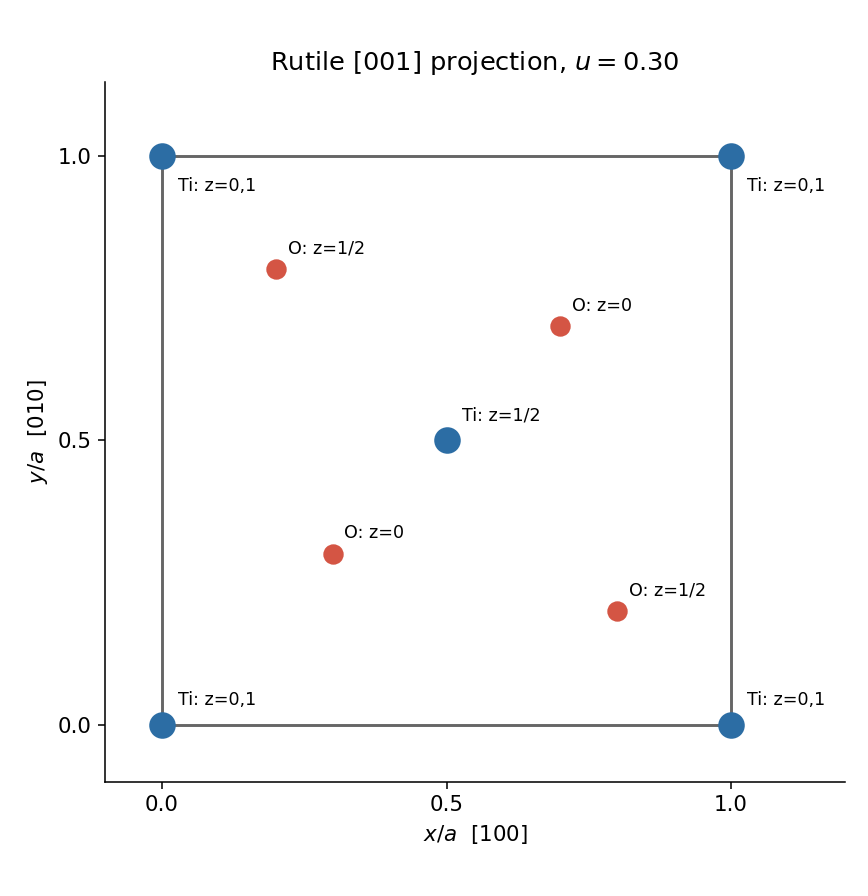
Codex 0 2026-10-20Reduce the supplied fractional coordinates modulo one. The rutile structure has Ti at with height and at with height . The oxygen projections are at , and at . Include equivalent corner sites to show the boundary of a complete unit cell; the cell edges are along and .
Past exam of the materials science course of the University of Cambridge 2019 Paper 1 7 e Solution by Codex 0 2026-10-20
Codex 0 2026-10-20 Past exam of the materials science course of the University of Cambridge 2019 Paper 1 7 d Solution by Codex 0 2026-10-20
Codex 0 2026-10-20 Past exam of the materials science course of the University of Cambridge 2019 Paper 1 7 c Solution by Codex 0 2026-10-20
Codex 0 2026-10-20 Past exam of the materials science course of the University of Cambridge 2019 Paper 1 7 b Solution by Codex 0 2026-10-20
Codex 0 2026-10-20 Past exam of the materials science course of the University of Cambridge 2019 Paper 1 7 a Solution by Codex 0 2026-10-20
Codex 0 2026-10-20 Past exam of the materials science course of the University of Cambridge 2019 Paper 1 6 d Solution by Codex 0 2026-10-20
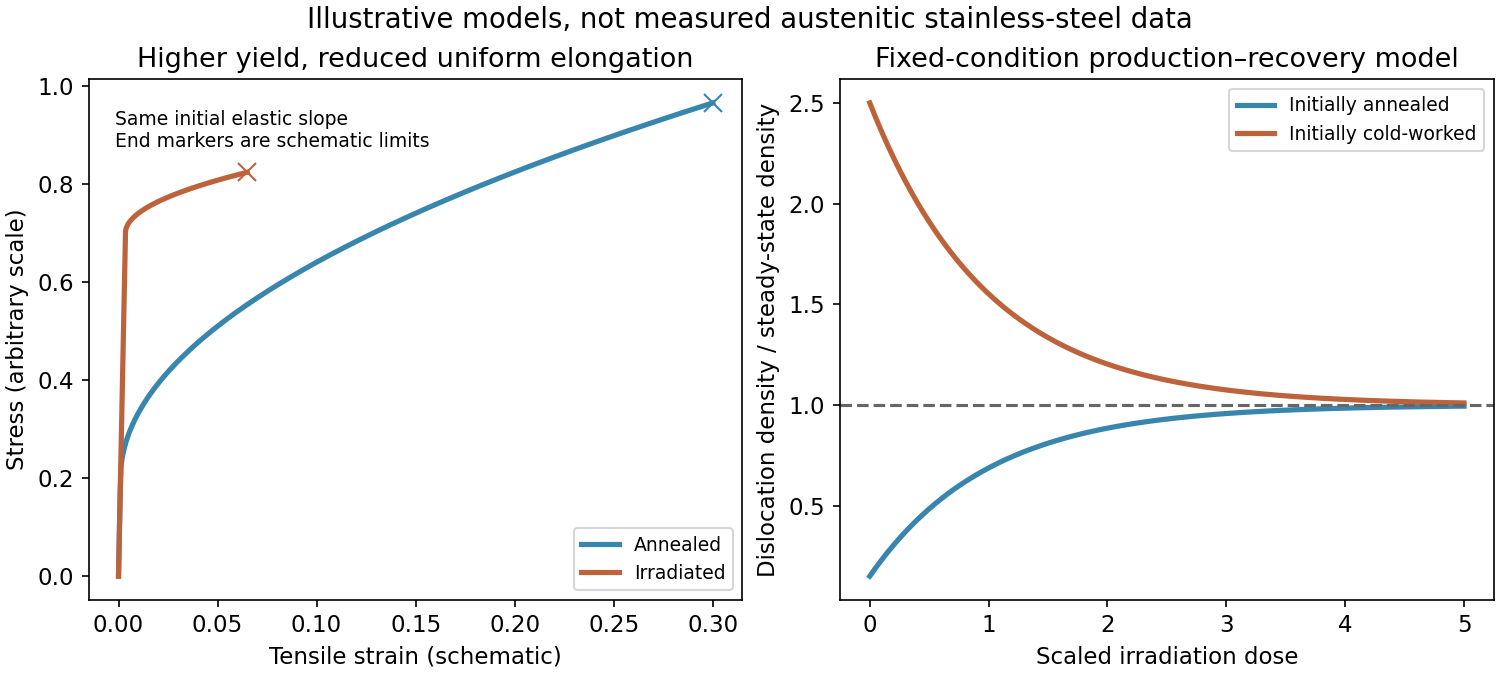
Codex 0 2026-10-20Irradiation both creates dislocation loops and supplies mobile point defects that allow existing dislocations to climb, rearrange and annihilate. At low initial dislocation density, net production can dominate; at high initial density, sink absorption and recovery can dominate. A simple illustrative rate equation isThus both initial states approach in this fixed-condition model. Here is irradiation dose, not a diffusion coefficient. The asymptote reflects a dynamic balance, not the cessation of damage. It need not be the same for different alloys, temperatures, dose rates or applied stresses.
Past exam of the materials science course of the University of Cambridge 2019 Paper 1 6 c Solution by Codex 0 2026-10-20
Codex 0 2026-10-20The annealed sample initially has relatively few obstacles to dislocation glide. After its elastic response it yields, undergoes appreciable plastic deformation and develops strain hardening. Irradiation produces dislocation loops and defect clusters that obstruct gliding dislocations, usually raising the yield strength. In a simple dispersed-obstacle model the strengthening scales as , with obstacle density and diameter .
Irradiated material often has less uniform plastic elongation and weaker subsequent hardening because slip localizes into channels that have cleared irradiation obstacles. Earlier necking or fracture can then reduce ductility. The elastic slope is much less affected than the yield stress in this schematic comparison; the exact strength and elongation depend on dose and temperature.
Past exam of the materials science course of the University of Cambridge 2019 Paper 1 6 b Solution by Codex 0 2026-10-20
Codex 0 2026-10-20Energetic neutron collisions create displacement cascades and Frenkel pairs: displaced atoms become self-interstitials, leaving vacancies. During migration, some opposite defects recombine, while others cluster or reach sinks. Interstitials can condense into extra atomic planes bounded by dislocation loops; vacancy clustering can instead give missing-plane loops. Their subsequent growth is driven by defect absorption and dislocation climb.
Randomly oriented loops do not select a macroscopic shear direction in an initially isotropic polycrystal. That does not prove that every external dimension remains unchanged: interstitial and vacancy loops have opposite relaxation-volume contributions, and an imbalance can change the volume. Macroscopic void swelling requires the additional vacancy-cavity mechanism; it must not be identified automatically with the mere presence of loops. Texture, stress-biased absorption and unequal loop populations can also give anisotropic dimensional change.
Past exam of the materials science course of the University of Cambridge 2019 Paper 1 5 d Solution by Codex 0 2026-10-20
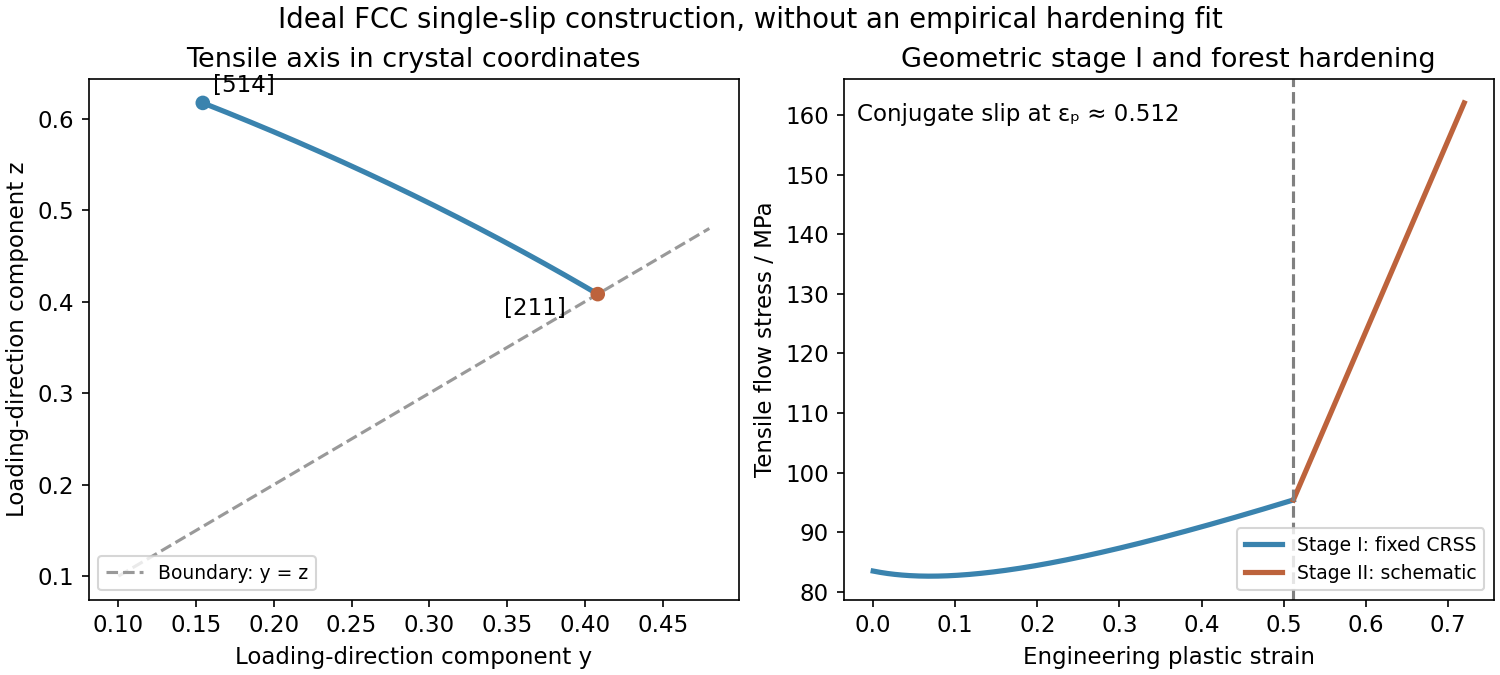
Codex 0 2026-10-20The number and spacing of primary slip planes remain fixed, so the length projected on their normal is invariant: . The initial and boundary loading directions are and , respectively. With normal ,ThereforeThis is engineering plastic strain in the ideal geometric model; its corresponding logarithmic strain is . Elastic extension and changes in slip resistance are neglected, as required by this construction.
Past exam of the materials science course of the University of Cambridge 2019 Paper 1 5 c Solution by Codex 0 2026-10-20
Codex 0 2026-10-20Initially, one slip system carries most of the deformation. Easy dislocation glide gives the nearly flat stage-I response, although lattice rotation and gradual dislocation interactions can already change the required tensile stress. In tension the loading direction expressed in the rotating crystal approaches the primary slip direction. Its path has the form until it reaches the symmetry boundary , at .
At that orientation, and have equal Schmid factors, . Conjugate slip therefore becomes competitive. Intersections between the two dislocation families generate obstacles, junctions and forest hardening, giving the sharp stage-II rise in flow stress. This is the ideal single-slip-to-conjugate-slip construction; real activation stresses can be shifted by latent hardening and imperfections.


Past exam of the materials science course of the University of Cambridge 2019 Paper 1 5 b Solution by Codex 0 2026-10-20
Codex 0 2026-10-20Applying Schmid's law at first yield,This infers the critical resolved shear stress for the initially active system, assuming the supplied tensile stress is the relevant uniaxial stress at yield and the twelve FCC systems have comparable initial slip resistance.
There are unlisted articles, also show them or only show them.