Past exam of the materials science course of the University of Cambridge 2018 Paper 1 7 c Solution by  Codex 0 2026-10-20
Read the coesite–stishovite boundary at approximately and . The slope is thereforeA Celsius temperature difference equals the corresponding kelvin difference. The graph does not justify treating the endpoints as exact measurements.
For stishovite, the tetragonal cell volume divided by two givesFor monoclinic coesite the cell volume is , soUsing and Avogadro's constant, the mass-specific volumes areFor the direction stishovite to coesite,For the reverse, coesite to stishovite, the entropy change is about . Stishovite is the denser phase: a positive boundary slope and its smaller volume imply a lower entropy on the high-pressure side. Stating the direction prevents an otherwise avoidable sign ambiguity.
Past exam of the materials science course of the University of Cambridge 2018 Paper 1 7 b Solution by Codex 0 2026-10-20
Codex 0 2026-10-20For two phases of the same pure substance at equilibrium, their chemical potentials are equal. Along their coexistence boundary,Differentiating the equality givesTherefore the Clapeyron equation isMolar or mass-specific quantities give the same slope if a consistent basis is used. follows from equal Gibbs free energies at coexistence.
Solid phases are relatively incompressible and have modest thermal expansion over many intervals. If their entropy and volume differences vary slowly enough that is approximately constant, the boundary is approximately straight. Straightness is an approximation, not a thermodynamic requirement. Heat-capacity differences, pressure dependence of volume, other transitions and proximity to special points can curve the boundary. The ideal-vapor integrated Clausius-Clapeyron approximation is not appropriate for these two solid phases.
Past exam of the materials science course of the University of Cambridge 2018 Paper 1 7 a Solution by Codex 0 2026-10-20
Codex 0 2026-10-20A displacive transformation changes structure through coordinated atomic displacements, whereas a reconstructive transformation changes the bonding/connectivity arrangement more substantially.
In a displacive change, neighboring atoms move cooperatively without the long-range compositional redistribution characteristic of diffusion-controlled precipitation. The change can preserve many near-neighbor relationships and can occur rapidly when its kinetic conditions are met.
A reconstructive change requires breaking and re-forming the relevant structural connections to establish a different arrangement, often with a larger activation barrier and slower nucleation and growth. It may consequently show substantial kinetic persistence of a metastable phase. The distinction concerns the atomic mechanism, not merely whether the final phase has a different symmetry; neither label by itself supplies a universal transformation rate.
Past exam of the materials science course of the University of Cambridge 2018 Paper 1 6 d Solution by Codex 0 2026-10-20
Codex 0 2026-10-20Within the rubbery regime, viscosity usually decreases as temperature increases, because segmental rearrangement becomes easier. The spring's entropic contribution generally increases approximately with absolute temperature at fixed effective network density, so tends to increase modestly under that assumption.
Consequently decreases. The storage-modulus crossover moves to larger squared frequency,and the high-frequency plateau moves upward if increases. The warmer curve in the figure illustrates those two changes. At intermediate frequencies the reduced relaxation time can lower the storage modulus even though its eventual plateau is higher; there is no requirement that the entire curve move upward.
These trends assume the same rubbery material state and no degradation, crystallization or change in effective network density. Close to other transitions the simple entropic-spring and viscosity picture needs modification.
Past exam of the materials science course of the University of Cambridge 2018 Paper 1 6 b Solution by Codex 0 2026-10-20
Codex 0 2026-10-20Interpret the supplied real quantity as the storage modulus , with the spring modulus in this continuum representation and the corresponding viscosity. Let . ThenAt high frequency, , the response approaches the spring stiffness; at low frequency it becomes much softer:In the series Maxwell model, the spring and dashpot carry the same stress while their strains add. A rapidly changing load allows little viscous flow, so the spring dominates the strain response. Over a long cycle the dashpot has time to deform, giving a small storage modulus and a fluid-like low-frequency response. This is generic viscoelastic mechanics, independent of the biological parts deferred above.
Past exam of the materials science course of the University of Cambridge 2018 Paper 1 5 c Solution by Codex 0 2026-10-20
Codex 0 2026-10-20Let be a characteristic crack depth and its geometry factor. A simple fast-fracture condition isThe crack should penetrate a wall of thickness before reaching the critical size, so the simplified leak-before-break criterion is , with appropriate geometry and stable-through-wall-crack assumptions.
The conventional material-based maximum thickness uses the yield stress as a conservative limiting operating stress:It ensures that the depth required for penetration is subcritical even at the stated limiting stress. Geometrical factors depend on crack shape and orientation; this is an educational screening estimate rather than a full crack-growth or leak-detection analysis. The handbook's fracture formula uses the same stress-intensity and geometry-factor convention.[ref]
Materials Data Book by Cambridge University Engineering Department. 2011 edition revised2019, printed p.6, Fast Fracture; this confirms the formula convention, not the exact2018NST supplied values
There is an important distinction if the actual pressure and radius are fixed while thickness varies. Substituting at penetration givesThat is a lower, not upper, bound on thickness under the fixed-pressure model. Yield avoidance additionally requires . It would be inconsistent to derive the fixed-pressure expression and call it a maximum. The standard maximum quoted above answers a different, yield-limited material-selection comparison.
Past exam of the materials science course of the University of Cambridge 2018 Paper 1 5 b Solution by Codex 0 2026-10-20
Codex 0 2026-10-20Linear elastic fracture mechanics predicts a near-tip tensile stress varying approximately asA ductile material yields near the tip before that mathematical singularity can be realized. Plastic deformation blunts the crack and redistributes stress over a finite process zone, as shown in the right-hand diagram. Constraint can sustain stresses above the uniaxial yield stress, so the schematic plateau should not be interpreted as a universal exactly- cap.
A useful process-zone scale is with a geometry- and constraint-dependent coefficient. Advancing the crack then requires energy for plastic deformation and other irreversible processes as well as forming new surfaces. Consequently the critical energy release rate is much larger than the reversible surface-energy term of a perfectly brittle idealization:In a small-scale-yielding plane-strain description, with . Large-scale yielding requires an elastic-plastic measure rather than treating a linear-elastic stress-intensity criterion as exact. The increased dissipation and crack-tip blunting explain the larger energy requirement.
Past exam of the materials science course of the University of Cambridge 2018 Paper 1 5 a Solution by Codex 0 2026-10-20
Codex 0 2026-10-20Assume a thin cylindrical wall, uniform internal pressure and closed ends carrying the pressure load. The radial stress is small compared with the membrane stresses when .
For an end cap, the outward pressure force is . The wall's axial tensile force is . Equilibrium therefore givesFor a longitudinally split half-cylinder of length , pressure has resultant across the projected rectangular area. Two cut wall sections each carry , soThus hoop stress is twice the closed-end axial stress in this model. An open-ended tube without an external end load does not acquire the same pressure-induced axial membrane stress.
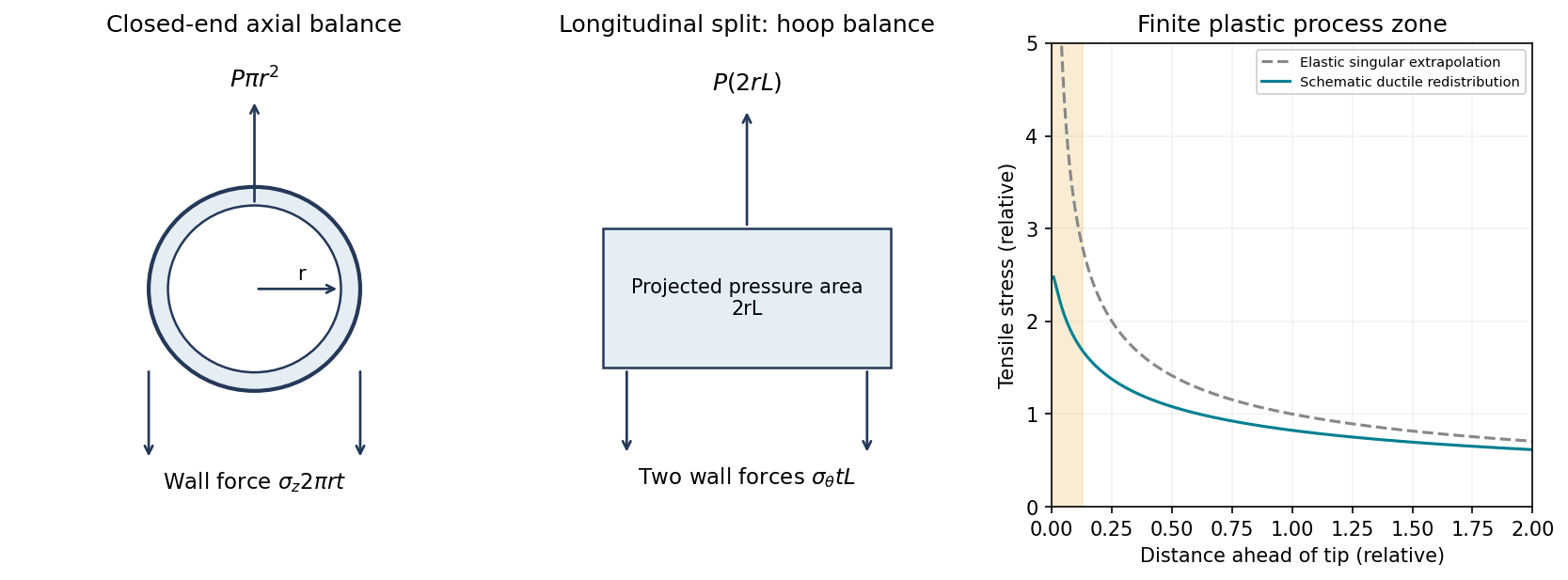
Original thin-pipe force balances and schematic crack-tip stress regularization by plastic deformation; the plastic-zone curve is qualitative
. Details. 
Past exam of the materials science course of the University of Cambridge 2018 Paper 1 4 d Solution by Codex 0 2026-10-20
Codex 0 2026-10-20The danger is identifying an etched height interval with the original planar phase intersection. Preferential ferrite dissolution exposes inclined cementite faces and can produce overhangs. A conventional AFM tip cannot follow a reentrant underside; its finite size also broadens ridge tops and may not enter the intervening troughs. A thresholded height width can consequently differ from both the true plate thickness and its original surface intersection.
A uniform inclination at an ideal flat cut does not itself invalidate a line-fraction estimate: both phases acquire the same geometrical width factor, which cancels in their ratio. The problem is differential relief and probe accessibility after etching, together with uncertain local angles and limited sampling. Using only the apparent ridge occupancy can overestimate cementite. An independently polished section, calibrated probe geometry, several directions and colonies, or another phase-sensitive method is needed to test the inference.
There are unlisted articles, also show them or only show them.