Past exam of the materials science course of the University of Cambridge 2022 Paper 1 6 a Solution by  Codex 0 2026-10-20
The fixed support supplies the end shear force and the largest bending moment, . In elementary beam bending, the greatest longitudinal tensile and compressive stresses lie on opposite outer faces of the section at the fixed end, with zero longitudinal bending stress on the neutral axis. For a downward tip load on a horizontal cantilever, the upper face is in tension and the lower face in compression. Transverse shear stress has a different distribution, largest near the neutral axis for a rectangular section; “highest force” should therefore be interpreted with the stress component specified.
Past exam of the materials science course of the University of Cambridge 2022 Paper 1 5 a Solution by Codex 0 2026-10-20
Codex 0 2026-10-20The exponential in the Peierls stress makes a large core-width-to-Burgers vector ratio favourable for easy dislocation glide. Densely packed slip planes often have wider cores because the shear distortion can spread over more atomic rows, reducing the lattice-periodic barrier. Close-packed directions provide short lattice translations and hence small allowed Burgers vectors; their line energies, approximately proportional to , are also relatively low. These effects favour dense planes and directions, but the relation between packing and core width is a physical argument rather than a consequence of substituting arbitrary independent into the formula. Body-centred cubic metals have densely packed directions without a truly close-packed plane, and their screw-core behaviour can require additional qualifications.
Past exam of the materials science course of the University of Cambridge 2022 Paper 1 4 c Solution by Codex 0 2026-10-20
Codex 0 2026-10-20The lamellae are ferrite and cementite, together forming pearlite. The displayed quantity is surface height in an atomic force microscopy image. Nital preferentially attacks the ferrite, leaving it lower and therefore darker; the narrow raised cementite lamellae appear bright. This is not the same contrast mechanism as brightness in an optical micrograph. Faster cooling that still permits pearlite formation causes transformation at greater undercooling and generally gives finer lamellar spacing. Cooling sufficiently rapidly to bypass diffusional transformation instead produces other products, potentially martensite; it does not merely keep making pearlite indefinitely finer.
Past exam of the materials science course of the University of Cambridge 2022 Paper 1 4 a Solution by Codex 0 2026-10-20
Codex 0 2026-10-20At , . Reading the carbon line gives to graphical accuracy. With , the characteristic diffusion length isIf “distance” means a one-coordinate root-mean-square displacement, use ; the three-dimensional radial root-mean-square is . The graph does not justify precision between these conventions. Equal diffusion distance in equal time requires equal diffusion coefficients. The copper line reaches this diffusivity around , giving , about . Carbon moves interstitially through ferrite, whereas copper self-diffusion is substitutional and vacancy-mediated, with a much higher effective activation barrier.
Past exam of the materials science course of the University of Cambridge 2022 Paper 1 3 c Solution by Codex 0 2026-10-20
Codex 0 2026-10-20Choose an objective aperture around a precipitate superlattice reflection, such as , which is absent from the disordered aluminium matrix. The selected beam then makes precipitates bright in dark-field transmission electron microscopy, while the matrix gives little intensity in that beam. Tilt the grain to place the chosen reflection close to its Bragg diffraction condition and preferably approach a two-beam geometry. This reduces excitation error and can increase precipitate brightness; the exact maximum also depends on foil thickness, strain and dynamical scattering. Selecting a shared fundamental reflection would give much poorer chemical-order selectivity.
Past exam of the materials science course of the University of Cambridge 2022 Paper 1 3 a Solution by Codex 0 2026-10-20
Codex 0 2026-10-20In the kinematic approximation, the face-centered cubic lattice contributes only reflections with all even or all odd. Viewing along selects the zero-order zone , so the nonzero allowed spots within the cutoff are , with the transmitted beam at the centre. The nearest-neighbour separation is in the crystallographic reciprocal-distance convention, or in the angular-wavevector convention. No matrix lattice parameter is supplied, so a numerical matrix spacing would require extra data.
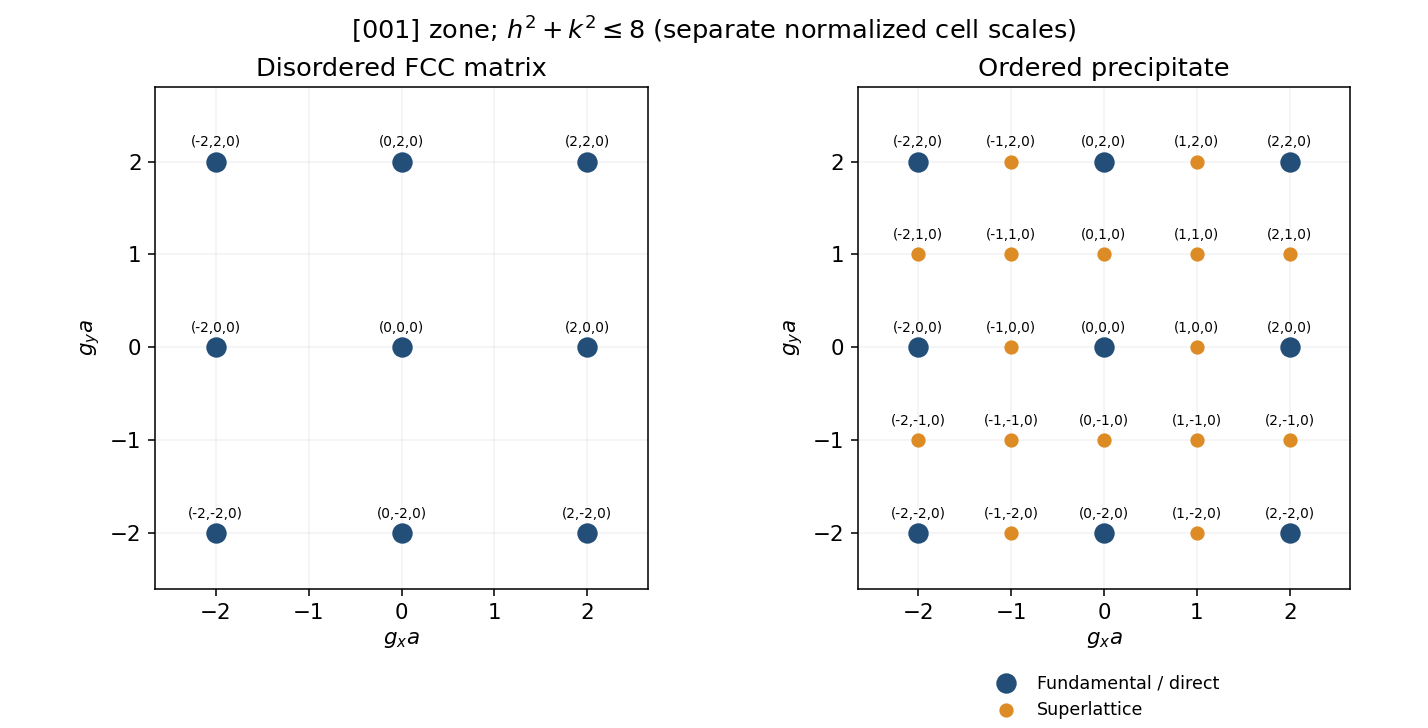
Calculated zero-order diffraction spots before and after chemical ordering
. Original kinematic spot diagrams with reciprocal coordinates normalized by the relevant cubic cell edge. The right panel shows additional superlattice positions; actual intensity also depends on thickness, excitation and scattering factors. Details. Past exam of the materials science course of the University of Cambridge 2022 Paper 1 2 c Solution by Codex 0 2026-10-20
Codex 0 2026-10-20Each missing oxide ion leaves two units of excess positive effective charge, compensated by reducing two Ce ions to Ce. For oxygen vacancies per conventional unit cell, of its four cerium ions must be trivalent: 10% Ce. This assumes the same number of cation sites per unit volume as in the doped calculation and that oxygen loss is compensated entirely by this cerium-valence change. If reduction changes the cell volume appreciably, matching the absolute vacancy density requires correcting the percentage for that change.
Past exam of the materials science course of the University of Cambridge 2022 Paper 1 2 a Solution by Codex 0 2026-10-20
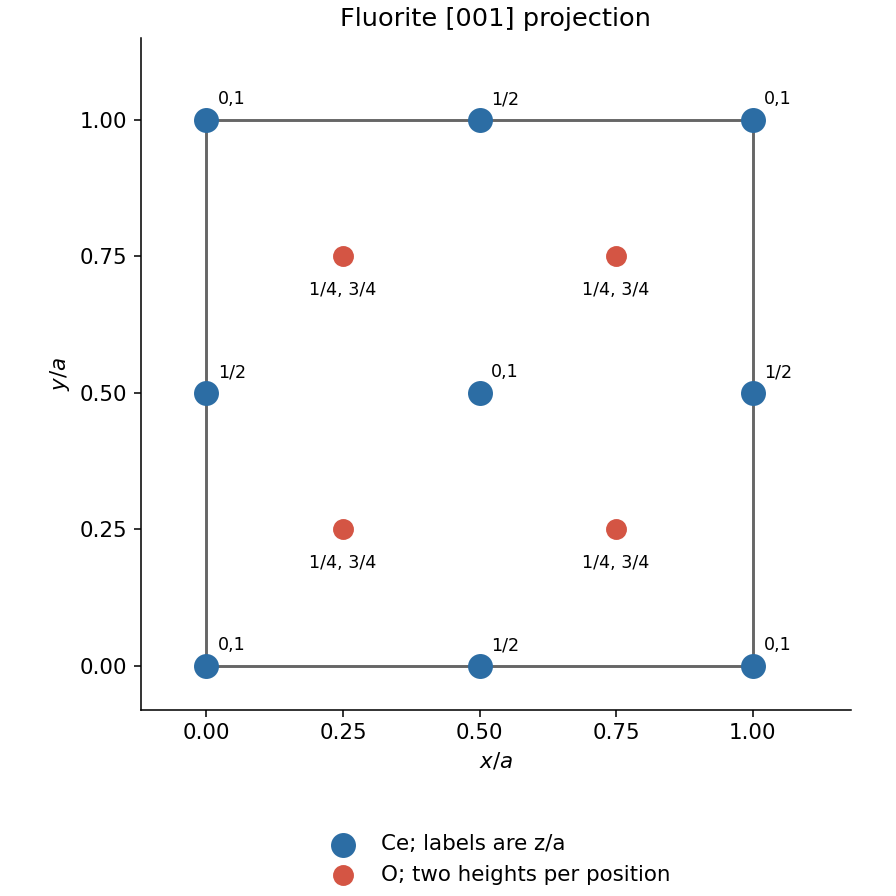
Codex 0 2026-10-20The fluorite structure has Ce on the corner and face-centre sites of a face-centered cubic lattice. Oxygen occupies all eight positions with each coordinate independently or . In projection, there are four oxygen positions , each representing two heights. Accounting for shared boundary sites gives four Ce and eight O per conventional unit cell.


Past exam of the materials science course of the University of Cambridge 2022 Paper 1 1 e Solution by Codex 0 2026-10-20
Codex 0 2026-10-20The Weiss zone law gives and , so a common direction is . Its physical vector is , while is parallel to . Their dot product therefore givesTaking a Euclidean angle directly between the index triples would incorrectly treat the tetragonal axes as equal in length. Reversing the chosen common direction gives the supplementary oriented angle.
There are unlisted articles, also show them or only show them.