Past exam of the materials science course of the University of Cambridge 2019 Paper 1 5 a Solution by  Codex 0 2026-10-20
An FCC crystal slips on . For each slip system, Schmid's law gives , with . Enumerating the twelve systems for gives the maximum atHere and are perpendicular, while , and . Hence . Reversing both directed slip conventions describes the same physical system.
Past exam of the materials science course of the University of Cambridge 2019 Paper 1 4 a Solution by Codex 0 2026-10-20
Codex 0 2026-10-20(Bi) and are Bi-rich and Sn-rich terminal solid solutions, not intermetallic compounds. At the eutectic composition, cooling through givesThe two solids grow together as a fine eutectic microstructure, commonly lamellar or rod-like. Below about , the tin-rich component has an equilibrium tendency to transform from metallic tetragonal white tin to diamond-cubic grey tin, with a substantial volume increase. This is tin pest, which can disrupt the microstructure mechanically. The dashed transition does not transform the Bi-rich phase into tin. Actual transformation can be slow and depend strongly on impurities and nucleation; crossing the line does not guarantee immediate disintegration.
Past exam of the materials science course of the University of Cambridge 2019 Paper 1 3 d Solution by Codex 0 2026-10-20
Codex 0 2026-10-20At a common test temperature and otherwise comparable microstructure, chemical order generally raises the yield strength. An ordinary FCC dislocation displaced by can interchange Au and Cu sublattices, creating an antiphase boundary behind it. This additional energy resists slip; paired dislocations can restore the order after the second member passes. The disordered phase does not pay the same ordering penalty. Comparing specimens actually tested at their different phase-stability temperatures also includes temperature-dependent mobility and recovery, so the ordering argument alone does not predict a unique measured strength ratio.
Past exam of the materials science course of the University of Cambridge 2019 Paper 1 3 b Solution by Codex 0 2026-10-20
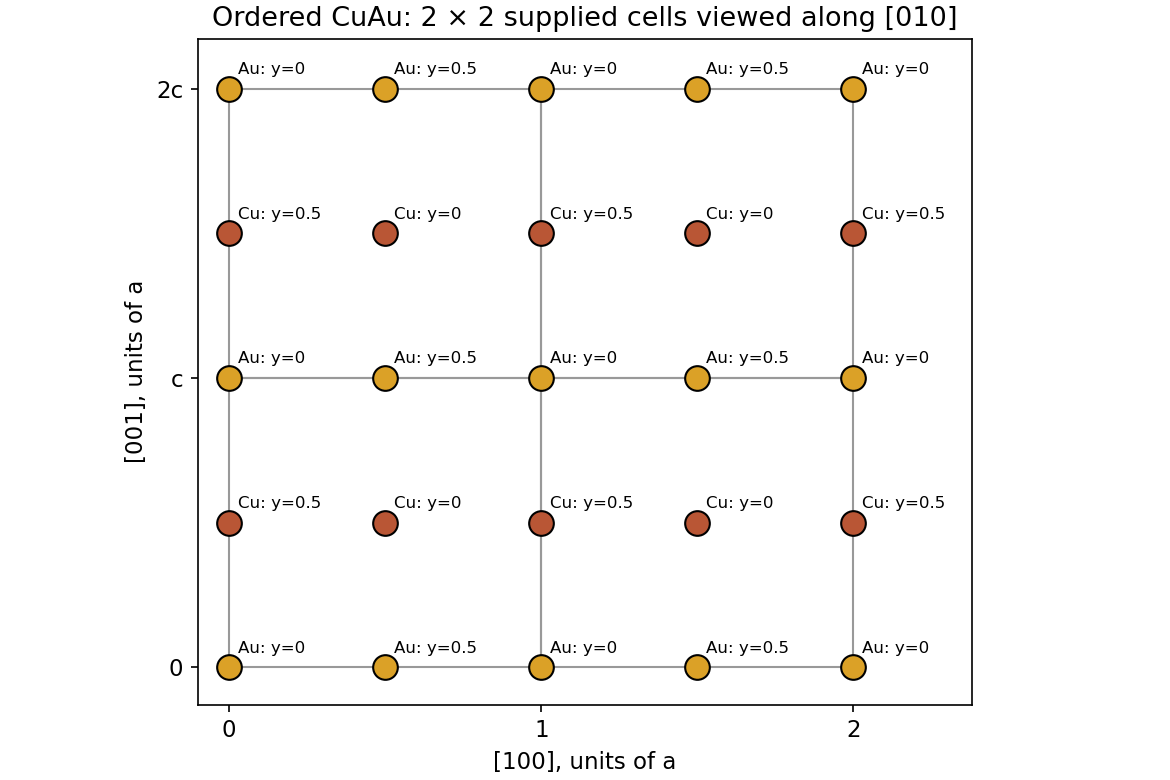
Codex 0 2026-10-20Successive planes normal to are chemically ordered Au and Cu layers. The supplied four-site cell is a convenient doubled description of the primitive tetragonal lattice: valid primitive translations areThey give a square basal cell of side , containing an Au basis atom at the origin and Cu at fractional . That last vector exchanges chemical species and is not a Bravais translation. Thus a face-centred-looking atomic arrangement does not make the chemically ordered material an FCC Bravais lattice. This is the L10 crystal structure; the following indices retain the larger cell specified in the question.
Past exam of the materials science course of the University of Cambridge 2019 Paper 1 3 a Solution by Codex 0 2026-10-20
Codex 0 2026-10-20For a disordered face-centered cubic lattice, equal average scattering factors on the four sites give reflections only when are all even or all odd. Bragg's law also requires . With Fe K wavelength , the upper bound is . The allowed sums are , givingThe next allowed family, , has squared-index sum and cannot satisfy the diffraction condition for this wavelength. This list assumes the full geometrically accessible angular range, rather than an instrument-specific cutoff.
Past exam of the materials science course of the University of Cambridge 2019 Paper 1 2 d Solution by Codex 0 2026-10-20
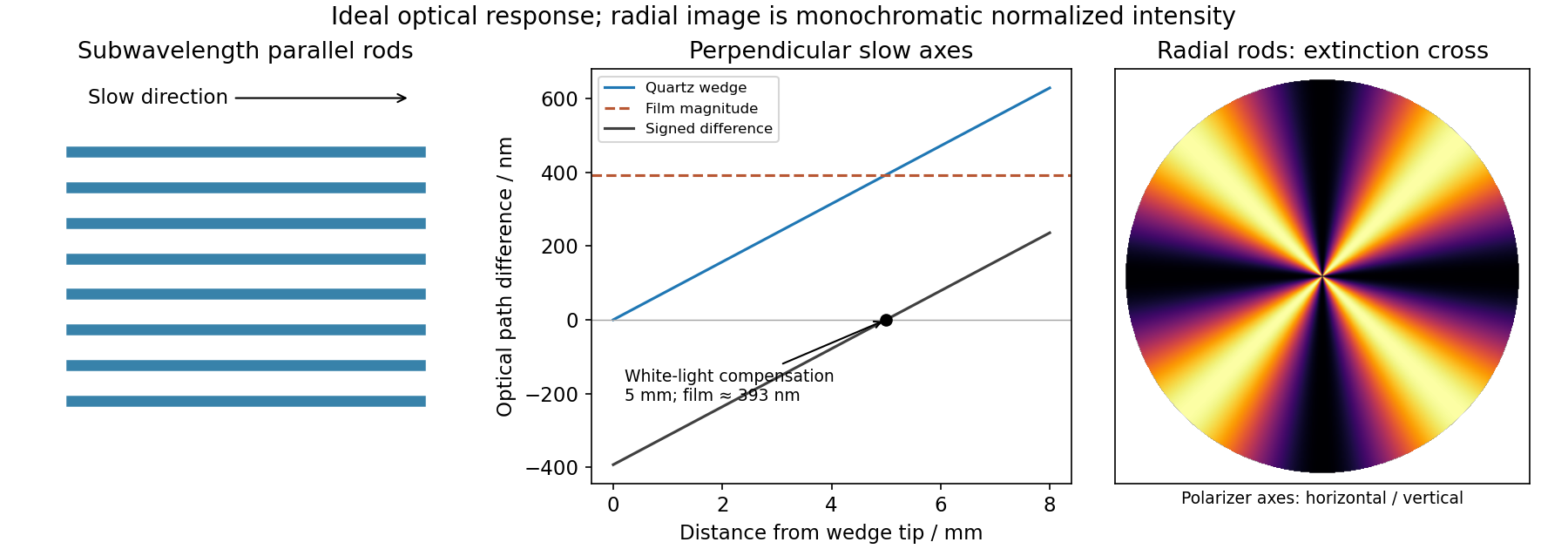
Codex 0 2026-10-20The local slow direction follows the radial rods. Between crossed polarizers, the angular factor is , so radial directions parallel to either polarizer are dark. The pattern is a Maltese cross in polarized-light microscopy, with four bright sectors separated by dark arms parallel to the polarizer directions. Its colours depend on the local optical path difference; tapering rods or changing fill fraction can make this vary with radius. The cross belongs to the local radial-axis pattern and does not imply a conoscopic interference figure.


Past exam of the materials science course of the University of Cambridge 2019 Paper 1 2 c Solution by Codex 0 2026-10-20
Codex 0 2026-10-20At distance from its tip, the wedge thickness is . Its optical path difference is thereforeThe perpendicular slow directions make the two retardances subtract. A white-light black compensation fringe is the zero-order cancellation, so the film retardance has magnitude approximately , with its slow direction along the rods. This interpretation assumes the observed fringe is the white-light compensation fringe; a single monochromatic dark fringe alone would have an integer-order ambiguity. Without the wedge, the wavelength dependence of selectively transmits visible wavelengths and gives the film its interference colour.
Past exam of the materials science course of the University of Cambridge 2019 Paper 1 2 b Solution by Codex 0 2026-10-20
Codex 0 2026-10-20An optically isotropic film changes the phase of both transverse polarization components equally, so crossed polarizers still extinguish the transmitted light. The etched rod-and-gap composite has form birefringence: its effective permittivity depends on the direction of the electric field, even when the constituent material is intrinsically isotropic. In a simple subwavelength lamellar model,The precise effective-medium formula changes with rod geometry, but the anisotropy remains. Resolving incident light along the two principal directions produces a phase retardation. An ideal lossless specimen between crossed polarizers transmitswhere is the intensity after the first polarizer. Extinction occurs when a principal direction follows either polarizer; transmission is strongest near .
Past exam of the materials science course of the University of Cambridge 2019 Paper 1 2 a Solution by Codex 0 2026-10-20
Codex 0 2026-10-20Features only a few tens of nanometres wide lie below the ordinary visible-light diffraction limit, approximately . The microscope cannot resolve individual rods, and unpolarized illumination does not directly reveal the orientation-dependent optical response. Scanning electron microscopy and atomic force microscopy can resolve the surface pattern. Transmission electron microscopy is another possible choice if a suitably thin specimen can be prepared.
Past exam of the materials science course of the University of Cambridge 2019 Paper 1 1 d Solution by Codex 0 2026-10-20
Codex 0 2026-10-20Taking Cu K wavelength , Bragg's law gives . For cubic , and the nearest Zn–S separation is . For ideal wurtzite structure, and the nearest separation is . ThereforeBoth have tetrahedral nearest-neighbour coordination number four, but different further-neighbour stacking and lattice relaxation can shift their equilibrium bond lengths. The hexagonal value assumes ideal and ; a real distorted wurtzite structure can have unequal axial and inclined bonds. One measured spacing alone does not determine every bond length without that structural assumption.
Past exam of the materials science course of the University of Cambridge 2019 Paper 1 1 c Solution by Codex 0 2026-10-20
Codex 0 2026-10-20The solid trace is wurtzite; the dashed trace is zinc blende. The isolated strong dashed peak is the cubic reflection. The solid trace has hexagonal , and reflections in this angular interval; its central peak is the one at , while cubic occurs at . These assignments are consistent with the absence of lower-angle reflections.
In the ideal close-packed model, the cubic and hexagonal reflections probe the same local alternating layer geometry. Their scattering strength per suitably normalized amount of material and their angular factors are therefore very similar, but powder diffraction multiplicity differs: the cubic family has eight directed normals, while hexagonal has two. This explains the approximately fourfold greater intensity of the dashed peak. Comparing unnormalized conventional-cell structure factors alone would be misleading because the cells contain different numbers of formula units. Peak heights additionally depend on line widths; the multiplicity argument applies most directly to integrated intensities.
Past exam of the materials science course of the University of Cambridge 2019 Paper 1 1 b Solution by Codex 0 2026-10-20
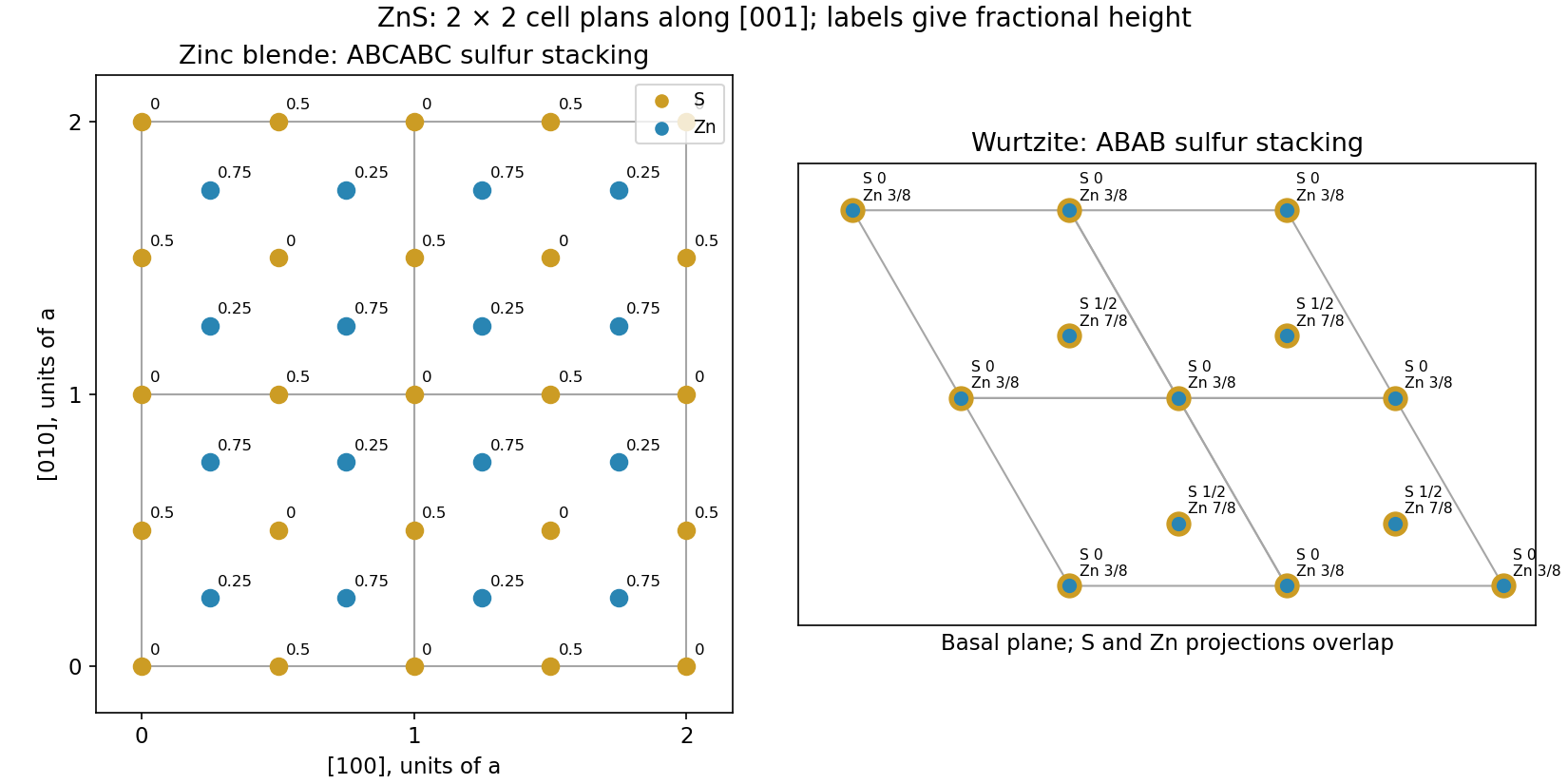
Codex 0 2026-10-20The zinc blende structure has an FCC sulfur sublattice and zinc on half its tetrahedral sites. One conventional unit cell uses S at and Zn at those positions displaced by , reduced modulo one. The wurtzite structure has ABAB sulfur layers, instead of ABCABC layers. One hexagonal-cell convention uses S at and Zn at , with ideal . Looking along superposes S and Zn in that latter coordinate convention; the height labels distinguish them.
Two-by-two zinc sulfide unit-cell projections along the stacking axes
. Original coordinate constructions. Heights are fractional coordinates along the viewing axis. The hexagonal plan uses basal vectors at 120 degrees. Details.
The closest-packed sulfur planes are , with four distinct plane orientations, for zinc blende structure, and , with one orientation, for wurtzite structure. Opposite normals describe the same unoriented plane orientation. Hexagonal four-index notation writes the latter basal family as .
There are unlisted articles, also show them or only show them.