Past exam of the chemistry course of the year 3 of the natural sciences course of the University of Cambridge 2021 Paper 2A Section A 20 Solution by  Codex 0 2026-10-20
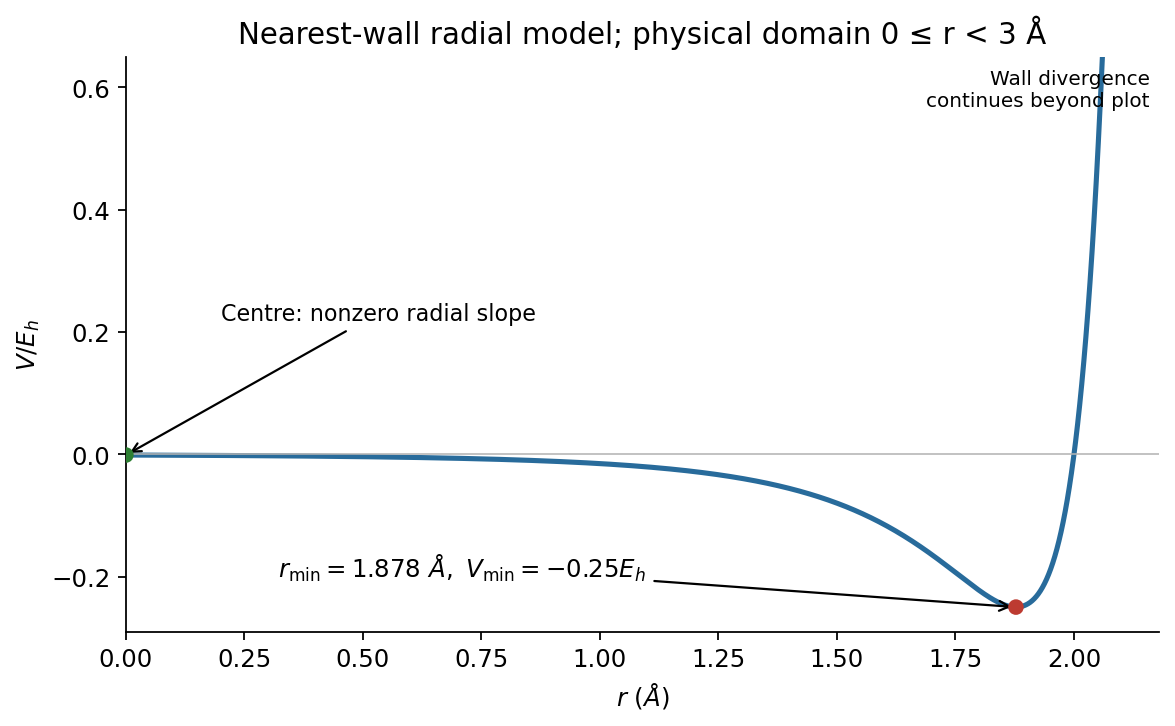
The minimum is at with depth ; the model is not a smooth physical potential at the cage centre. Put and . Thenso is the minimum. ThereforewhileThe positive inverse-twelfth-power term mimics short-range overlap repulsion, while the negative inverse-sixth-power term mimics London dispersion force. These powers are used in the Lennard-Jones potential; they are not a microscopic derivation for an atom inside a carbon cage.
The relevant domain is . As the atom approaches the wall the model diverges positively, which is qualitatively sensible. However, the energy depends only on the nearest radial wall distance and omits all the other cage atoms. More decisively, : a radial function of the Cartesian position must have zero first radial derivative at the centre to be differentiable there. The model produces a cusp and a nonvanishing directional force as the centre is approached. An off-centre minimum is not by itself forbidden, but this centre behaviour is inconsistent with a smooth symmetric cage potential.
Past exam of the chemistry course of the year 3 of the natural sciences course of the University of Cambridge 2021 Paper 2A Section A 19 Solution by Codex 0 2026-10-20
Codex 0 2026-10-20Each site has a pi-electron population , and each adjacent pi bond order is . The two carbon sites supply one pi electron each and the nitrogen lone pair supplies two, giving four electrons in two occupied molecular orbitals. Orthogonality to the given Homo and LUMO fixes the remaining occupied normalized orbital, up to overall sign, asFor doubly occupied orbitals, the Hückel orbital charge density and Hückel pi bond order follow fromThe diagonal sums to four electrons. The negative is an off-diagonal density-matrix element between nonadjacent sites, not an additional directly connected chemical bond.
Relative to neutral pi contributions , the pi-system charges are : electron density has moved from nitrogen toward the two carbon sites. Thus the physical electric dipole moment vector points from the midpoint of the carbon pair toward nitrogen along the molecular symmetry bisector. The conventional chemical dipole arrow, with a crossed positive tail, points oppositely: from nitrogen toward the carbon pair. This is only the pi contribution, not a prediction of the full sigma-plus-pi molecular dipole.
Past exam of the chemistry course of the year 3 of the natural sciences course of the University of Cambridge 2021 Paper 2A Section A 18 Solution by Codex 0 2026-10-20
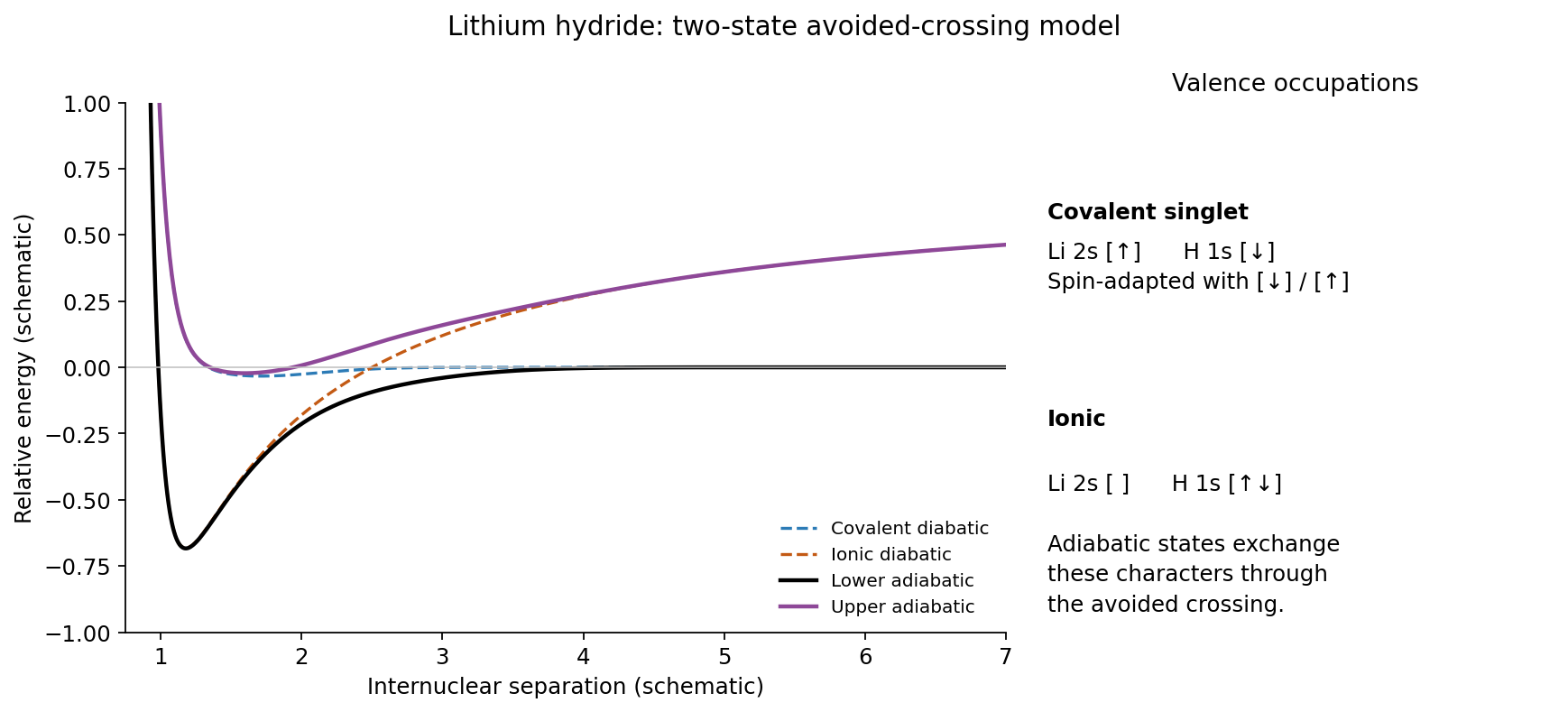
Codex 0 2026-10-20The ionic and covalent diabatic curves cross; coupling replaces the crossing by an avoided crossing of the adiabatic curves. Take the separated neutral atoms as the zero of valence energy. A covalent diabatic state has one electron in a lithium-centred orbital and one in a hydrogen-centred orbital, coupled to an overall singlet. An ionic diabatic state has an empty lithium valence orbital and a doubly occupied hydrogen orbital.
At large internuclear separation , the ionic limit lies above the neutral one by . At smaller , its attractive Coulomb term lowers it; short-range repulsion eventually raises both curves. A two-state Hamiltonian givesWhere the diabatic energies would coincide, nonzero coupling opens a gap . The lower adiabatic state changes continuously from predominantly ionic character near the bond minimum to predominantly neutral covalent character at dissociation. The upper state exchanges character in the opposite direction. Near the crossing both are mixtures, so a sketch assigning a fixed charge pattern to an entire adiabatic curve would miss the important physics.


There are unlisted articles, also show them or only show them.