Past exam of the chemistry course of the year 3 of the natural sciences course of the University of Cambridge 2021 Paper 2A Section A 14 Solution by  Codex 0 2026-10-20
The Stokes vibrational band has O, Q and S branches, with , respectively. Here denotes end-over-end rotational angular momentum; treating electronic fine structure as unresolved gives the usual elementary rotor calculation. The absolute incident wavenumber isand energy conservation for Stokes Raman scattering givesFor the actual ground state, only odd have nonzero nuclear-spin statistical weight. Thus the lowest initial levels are for O and for Q and S. Ignoring the small change in upon vibration, the lines are:
The odd- restriction follows from the zero nuclear spin and exchange symmetry of ; the electronic spin splits each such into several levels without changing this simplified branch-centre calculation.[ref]
O2 A-band line parameters to support atmospheric remote sensing Part II by David A. Long and others. Section 3, manuscript page 4: only odd lower-state N has nonzero statistical weight for oxygen-16 and oxygen-18
If the phrase simplest approximation is instead taken to discard nuclear-spin statistics as well, a fictitious unrestricted rotor gives O at and S at , with Q still at . Those even- lines are not physical ground-state lines.
Past exam of the chemistry course of the year 3 of the natural sciences course of the University of Cambridge 2021 Paper 2A Section A 13 Solution by Codex 0 2026-10-20
Codex 0 2026-10-20Natural broadening is about times narrower than the thermal Doppler width and is negligible for this comparison. The supplied Doppler broadening formula is a half width at half maximum. Using the integer molecular mass ,For an excited-state population lifetime , the radiating amplitude decays as . Its Lorentzian line shape has natural linewidthEquivalently, compare full widths and . Using the same linewidth convention in both expressions matters more than the small isotope-mass correction. This estimate assumes that the lower state's lifetime is long and leaves any pressure broadening as a separate contribution.
Past exam of the chemistry course of the year 3 of the natural sciences course of the University of Cambridge 2021 Paper 1 9 c Solution by Codex 0 2026-10-20
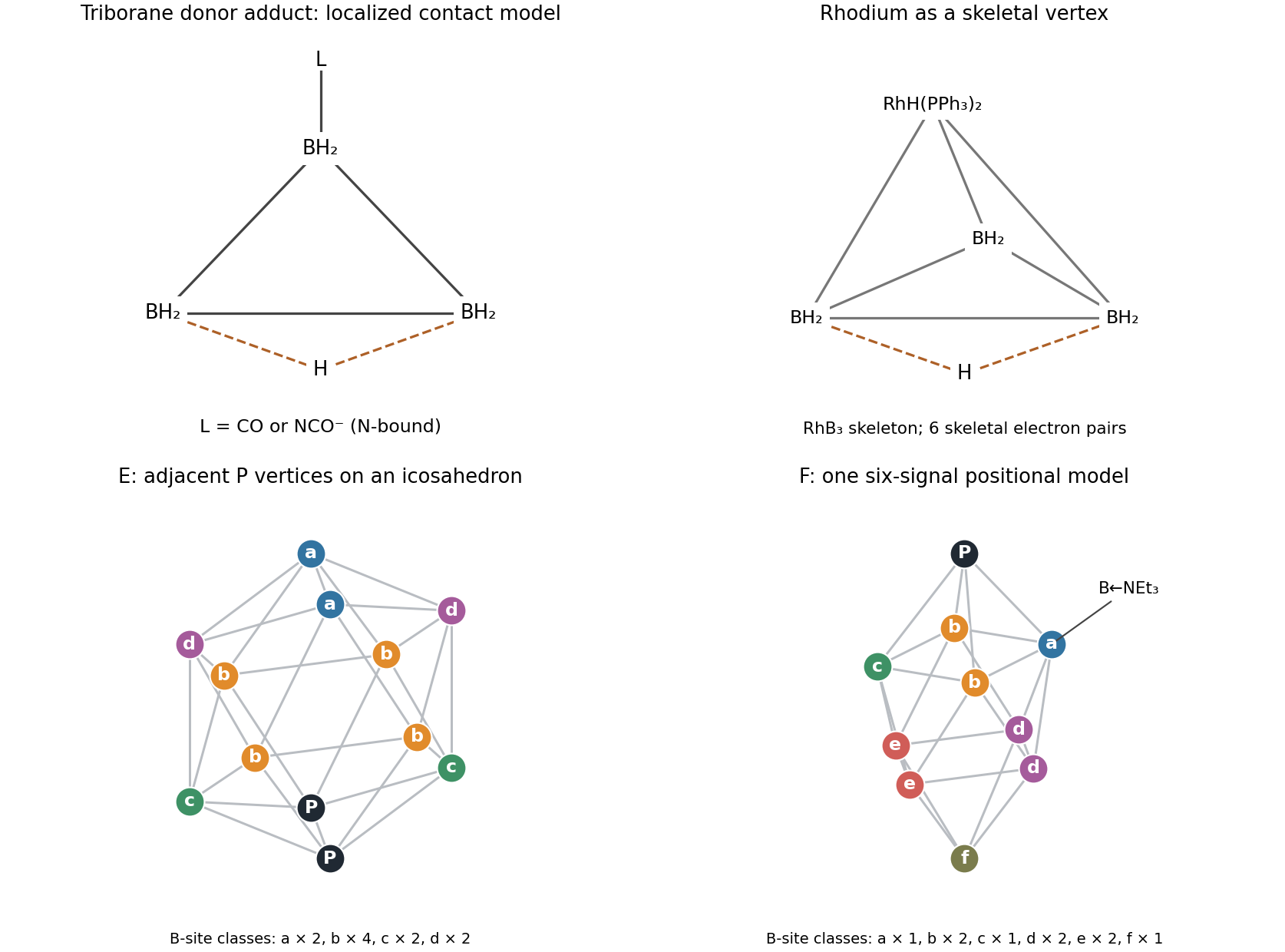
Codex 0 2026-10-20For E, each BH supplies two skeletal electrons and each phosphorus vertex supplies three after retaining a lone pair. Hence electrons, or thirteen pairs, matching a twelve-vertex closo cluster. Place the two adjacent P vertices on a regular icosahedron. The remaining ten boron vertices fall into four symmetry classes: two sites adjacent to both P vertices, four adjacent to exactly one, two adjacent to neither but opposite the common-neighbour pair, and two opposite the P pair. The populations are , so four boron resonances are expected. Interchanging the identical phosphorus vertices is allowed when determining chemical equivalence.
For F, a ten-vertex bicapped square antiprism offers a consistent closo model. There are eight BH vertices, one B vertex bearing the donor instead of H, and one P vertex. Their skeletal contributions are respectively , and , giving 22 electrons, eleven pairs. The donor-bearing B contribution follows from B plus the donated lone pair minus the exoskeletal B–N bond, .
One explicit arrangement consistent with six boron signals puts P at one axial cap and the substituent on one B vertex of the nearer square. The remaining mirror plane through that B, the opposite vertex of its square, and the cap axis leaves three B sites individually fixed: the donor-bearing B, its opposite square vertex and the other axial cap. The other six B sites form three exchanged pairs. Thus the nine borons give three singleton environments and three two-site environments, six signals in all. The original compound has a crystallographically characterized positional assignment; the spectrum alone asks for a compatible structure and does not establish a unique positional isomer. A single-crystal X-ray diffraction determination or assigned heteronuclear correlations would distinguish alternatives.[ref]
Synthesis of polyhedral phosphaboranes: crystal structure of 6-(C2H5)3N·2-PB9H8 by John L. Little and others. 1989, pp.1087–1091, synthesis of diphosphaborane and crystallographic characterization of the amine-containing side product

Past exam of the chemistry course of the year 3 of the natural sciences course of the University of Cambridge 2021 Paper 1 9 a Solution by Codex 0 2026-10-20
Codex 0 2026-10-20For the CO and NCO cases, the added fragment acts as a Lewis base at boron, rather than becoming a new skeletal vertex. Both have a triangular framework. A useful localized drawing has three groups, one B–H–B bridge between two of them, and the donor attached to the third boron. The boron–boron framework includes three-centre two-electron bonds; its edges should not all be read as ordinary independent two-electron single bonds.
For the neutral carbonyl adduct, attach CO through carbon, giving at the donor-bearing site. For the anionic isocyanate adduct, attach through nitrogen, giving a B–N=C=O connectivity and the overall charge. In both drawings the hydrogen count is . Weak or asymmetric additional B–H contacts can distort this idealized drawing; a hydrogen-rich borane is not fully characterized by a polygon alone. The carbonyl triborane structure was established in the original borane study.[ref]
Boranes. XXXVII. Reactions of triborane(7) and the structure of triborane(7) carbonyl by James D. Glore and others. 1973, pp.2175–2178, structural assignment of the carbonyl adduct
The rhodium fragment is instead a skeletal building block. Its neutral electron count is , so it contributes two skeletal electrons, like a BH vertex. Combining it with gives skeletal electrons, or six pairs, for four vertices. A consistent low-vertex structure is a tetrahedral skeleton, with the fragment capping the boron triangle. Keep the terminal Rh–H ligand distinct from the seven hydrogens on the borane portion. The latter can again be represented by three terminal groups and a B–H–B bridge. The total formula then contains eight hydrogens outside the phenyl groups. Treating Rh as a pendant one-centre Lewis base would miss its skeletal role.
Past exam of the chemistry course of the year 3 of the natural sciences course of the University of Cambridge 2021 Paper 1 4 d Solution by Codex 0 2026-10-20
Codex 0 2026-10-20A better controlled route is selective solvent extraction in acid, followed by selective stripping, rather than precipitating everything near overlapping hydrolysis thresholds. Oxidize Ce(III) to Ce(IV) in a controlled acidic nitrate medium, extract its nitrate complexes into an organic donor phase, and separate the phases. Then reduce the extracted Ce(IV) to Ce(III) and back-extract it into an aqueous phase. Trivalent rare earths are less strongly extracted under suitable conditions.
This still needs a thorium separation: tributyl phosphate can coextract Th(IV). One demonstrated strategy deliberately coextracts Ce(IV) and Th(IV), then uses reducing peroxide solution to strip Ce as Ce(III), followed by a separate thorium strip. The appropriate controls are distribution measurements for each ion at the chosen acid concentration, a cerium oxidation-state check, and a complete mass balance over extraction and stripping. Selectivity comes from combining oxidation state and complexation, not from assuming that one extraction removes every contaminant.[ref]
Coextraction and successive selective stripping of cerium(IV) and thorium from monazite leach solutions with tributyl phosphate (TBP) by A. H. Ali. 2017, abstract: coextraction from nitric acid and successive peroxide/water stripping
Past exam of the chemistry course of the year 3 of the natural sciences course of the University of Cambridge 2021 Paper 1 4 c Solution by Codex 0 2026-10-20
Codex 0 2026-10-20A natural feed can contain thorium and uranium, as well as other lanthanides. Th(IV) hydrolyses readily and can accompany the cerium precipitate; uranium speciation depends on its oxidation state and the ligands present. Raising pH too far also precipitates other rare-earth hydroxides. Even before their bulk precipitation thresholds, adsorption and coprecipitation on a high-area hydrated cerium oxide can contaminate the solid. Local high-pH zones during base addition and incomplete Ce(III) oxidation make the separation less reproducible.
Past exam of the chemistry course of the year 3 of the natural sciences course of the University of Cambridge 2021 Paper 1 4 b Solution by Codex 0 2026-10-20
Codex 0 2026-10-20Not as a general aqueous separation reaction for the other lanthanides. Most strongly favour the trivalent state in ordinary water chemistry. Ce(IV) is unusually accessible because it has the empty shell and is strongly stabilized by oxide formation. Some other lanthanides have accessible alternative oxidation states, such as Eu(II), and higher oxides of Pr or Tb can exist under suitable conditions; this does not imply that they undergo the same Ce(III)/Ce(IV) pH-controlled aqueous oxidation.
Past exam of the chemistry course of the year 3 of the natural sciences course of the University of Cambridge 2021 Paper 1 4 a Solution by Codex 0 2026-10-20
Codex 0 2026-10-20The key is coupling redox equilibrium to hydrolysis and precipitation. Ce(IV) has a much greater tendency than Ce(III) to form a hydrated cerium dioxide solid. Raising pH therefore preferentially stabilizes the oxidized form. In the presence of dissolved oxygen a representative net reaction isRemoving drives this reaction towards Ce(IV). Writing the solid as hydrated oxide changes its water content, not this redox argument.
The Nernst equation makes the pH effect explicit. At , the reduction has a pH slope approximately per pH unit at fixed Ce(III) activity. The oxygen/water reduction has slope about per pH unit. Raising pH thus makes oxidation of Ce(III) by oxygen increasingly favourable within the relevant phase-stability region. Conversely strong acid favours soluble Ce(III) relative to the oxide and makes Ce(IV) a stronger oxidizing agent. pH changes the redox driving force; an electron acceptor or donor is still required, and slow oxygen evolution or oxidation kinetics can prevent immediate equilibration.
Past exam of the chemistry course of the year 3 of the natural sciences course of the University of Cambridge 2021 Paper 1 2 c Solution by Codex 0 2026-10-20
Codex 0 2026-10-20The usual qualitative prediction is the carbon-separated isomer. It has four B–C ring edges and one B–B edge, whereas the adjacent-carbon isomer has two B–C, two B–B and one C–C edge. Separating the more electron-rich carbon vertices distributes skeletal electron density more evenly and avoids concentrating both carbon vertices on one edge, a useful carborane stability heuristic.
This is a thermodynamic suggestion, not a consequence of the peak count. hydrogen placement, metal–ring interactions and entropy can affect the ordering. Establishing the preferred isomer experimentally would require reversible interconversion and an equilibrium composition, rather than simply identifying the product formed fastest.
Past exam of the chemistry course of the year 3 of the natural sciences course of the University of Cambridge 2021 Paper 1 2 b Solution by Codex 0 2026-10-20
Codex 0 2026-10-20There are two carbon-placement isomers, represented by the cyclic base sequences and . The carbon vertices are adjacent in the first and separated by one boron vertex in the second. Rotation or reversal of a sequence does not produce another constitutional isomer.
Each arrangement has a reflection symmetry that exchanges a pair of boron sites while leaving the third distinct. Consequently each can give two environments, with site populations , in a proton-decoupled NMR spectrum. This assumes that the hydrogen and carbonyl arrangements preserve, or rapidly average to, the corresponding skeletal symmetry. Two peaks alone neither choose between the two skeletons nor establish a unique hydrogen arrangement; accidental overlap or fluxionality can also reduce the number of observed signals.
Past exam of the chemistry course of the year 3 of the natural sciences course of the University of Cambridge 2021 Paper 1 2 a Solution by Codex 0 2026-10-20
Codex 0 2026-10-20Use Wade's rules with the metal included as a skeletal vertex. Each BH vertex supplies two skeletal electrons, each CH supplies three, and the two additional hydrogen atoms supply two more. The fragment supplies skeletal electrons after the metal's non-skeletal orbitals have been accounted for. ThusThe six-vertex cluster is therefore nido, with a pentagonal-pyramidal skeleton: Ru is the apex, bonded to the five vertices of the planar base, and the three carbonyl ligands project away from that base. This is the six-vertex fragment obtained by removing an equatorial vertex from a seven-vertex pentagonal bipyramid. The five ring atoms carry their terminal B–H or C–H bonds; the two additional hydrogens belong to the hydrogen-rich open-face bonding framework. The skeletal electron count does not, by itself, locate every bridging hydride, so a unique detailed hydrogen arrangement should not be inferred from it.
Past exam of the chemistry course of the year 3 of the natural sciences course of the University of Cambridge 2021 Paper 1 12 b Solution by Codex 0 2026-10-20
Codex 0 2026-10-20The key stereochemical disconnection is the cis-1,3-disubstituted cyclopentane, not a direct functionalization of two arbitrary cyclopentane positions. A Diels-Alder reaction of cyclopentadiene with nitroethylene fixes both ends of the new two-carbon bridge on the same face of the original five-membered ring.
Isolate the useful nitronorbornene adduct, convert its secondary nitro group to a ketone by a Nef reaction, and then hydrogenate the remaining ring alkene to norcamphor. Performing the nitro-to-ketone conversion before catalytic hydrogenation avoids simply reducing the nitro group to an amine.
Use a Baeyer-Villiger oxidation to insert oxygen between the carbonyl carbon and its adjacent bridgehead carbon. Bridgehead migration is favoured over migration of the competing methylene; isolate the required lactone regioisomer if necessary. This opens the way to a hydroxy cyclopentyl side chain without breaking the original five-carbon ring. In the resulting bridged lactone, one original cyclopentadiene terminus is bonded to O and the other bears the segment.
Reduce the lactone selectively with DIBAL to its lactol. Ring opening of that lactol gives the aldehyde equivalent cis-3-hydroxycyclopentyl-. The ring OH and the two-carbon aldehyde side chain are cis because their original attachments were the two ends of the Diels–Alder bridge; neither the migration nor lactol opening inverts those cyclopentane carbons.
Perform a Horner-Wadsworth-Emmons reaction on the lactol/aldehyde equilibrium using , where . Preform the phosphonate anion and allow for consumption of base by the lactol OH. Standard stabilized-phosphonate conditions favour the required E- unit. No further hydrogenation should follow it.
The required ester substituent can be prepared by reducing 4-methylpentan-2-one to 4-methylpentan-2-ol, esterifying with bromoacetic acid, and performing an Arbuzov reaction with triethyl phosphite to make the phosphonoacetate. No absolute configuration is indicated at that alcohol-derived centre.
Bridge-derived cis ring stereochemistry plus E-selective phosphonate olefination gives both specified relationships. Achiral cycloaddition and subsequent reagents give a racemic pair with this relative configuration; isolation of one absolute enantiomer would require resolution or an asymmetric variant. The acid fragment contains nine carbons: five from cyclopentadiene, two from nitroethylene and two from the phosphonoacetate. The ester alkyl group adds six, giving fifteen overall. The atom tracing in the original schematic in question 8 shows why oxygen insertion retains the five-membered ring rather than producing a six-membered carbocycle.
Past exam of the chemistry course of the year 3 of the natural sciences course of the University of Cambridge 2021 Paper 1 12 a Solution by Codex 0 2026-10-20
Codex 0 2026-10-20Disconnect the N–cyclohexyl bond as a late reductive amination of a primary amine with cyclohexanone. Disconnect the exocyclic methylene as a Wittig methylenation of a substituted cyclohexanone. The useful ring precursor is 3-methyl-5-substituted cyclohex-2-en-1-one, accessible by a Robinson annulation. The pendant substituent throughout ring construction should be .
Start with nucleophilic substitution of the supplied bromo ester by cyanide:Reduce the nitrile selectively to the primary amine while retaining the ester, for example by controlled catalytic hydrogenation with Raney nickel in the presence of ammonia, and trap the amine promptly as its Boc carbamate. Avoid heating or concentrating the free amino ester, which can cyclize to a lactam. lithium aluminium hydride would be unsuitable at this stage because it also reduces the ester.
Partial reduction of the protected ester with DIBAL at low temperature gives . The carbon of the original nitrile is now the methylene nearest nitrogen; the original ester carbonyl is the aldehyde carbon. Condense this aldehyde with acetone and dehydrate to .
Now add the enolate of a second acetone molecule in a Michael addition. With , the resulting chain isIntramolecular aldol condensation gives 3-Me-5-R-cyclohex-2-en-1-one. The beta methyl derives from the carbonyl end attacked in the ring closure; the pendant aminoalkyl chain remains at C5. Hydrogenate the ring C=C selectively, retaining the ketone, then methylenate the ketone with preformed . Do the hydrogenation before installing the exocyclic methylene so that it is not hydrogenated away.
Remove Boc under brief mild conditions, checking for acid-induced exocyclic alkene isomerization. reductive amination of the resulting primary amine with cyclohexanone, followed by selective imine reduction, installs the secondary N-cyclohexyl group. Use controlled stoichiometry to suppress tertiary amine formation. The methyl and four-carbon aminoalkyl substituents occupy the required 1,3-related ring positions, with the exocyclic methylene at the former carbonyl. No ring stereochemistry is specified. The target contains eighteen carbons: six ring carbons, one ring methyl, one methylene, four in the linker, and six in the N-cyclohexyl group.
Past exam of the chemistry course of the year 3 of the natural sciences course of the University of Cambridge 2021 Paper 1 11 b Solution by Codex 0 2026-10-20
Codex 0 2026-10-20Disconnect the internal Z alkene by a non-stabilized Wittig reaction:The aldehyde carbon becomes the right-hand internal alkene carbon; the ylide carbon becomes the left-hand one. Both the methyl ester and the remote terminal alkene survive the olefination.
Make the aldehyde from pentanal by Stork enamine reaction: form its pyrrolidine enamine, react at carbon with allyl bromide, then hydrolyse to . The original alpha carbon of pentanal now bears allyl and n-propyl substituents. Control the alkylation to avoid multiple substitutions.
The other branch needs a three-carbon extension of the supplied four-carbon bromo alcohol. Protect the OH of as a tetrahydropyranyl ether. Convert the bromide into an organocuprate and add it conjugatively to methyl acrylate:Here the organocopper formula is shorthand for a suitable cuprate preparation, not a claim that an isolated monomer is necessary. The acrylate contributes two methylenes and the ester carbonyl. Remove the THP group, replace the resulting terminal OH by Br, and react with to form . Deprotonate adjacent to phosphorus to generate the non-stabilized ylide. This proton is much more acidic than the ester alpha protons, but controlled base stoichiometry and low temperature remain important.
Add the allylated aldehyde under conditions favouring the usual kinetic Z-selective Wittig olefination, and separate any E isomer. The result isThe four-carbon starting alcohol plus the three-carbon acrylate backbone supplies the seven-carbon acid-derived chain; the ester Me gives an eighth carbon. Pentanal plus allyl gives the other eight. The total is sixteen carbons, including the terminal alkene. A two-carbon extension would produce the wrong chain length.
Past exam of the chemistry course of the year 3 of the natural sciences course of the University of Cambridge 2021 Paper 1 11 a Solution by Codex 0 2026-10-20
Codex 0 2026-10-20Disconnect the amide into 2-propylhexanoic acid and N-methyl-2-(4-hexylphenyl)ethylamine. This keeps the nitrogen substituents distinct: one is Me and the other is the two-carbon aryl side chain. The acid's alpha carbon must bear both n-butyl and n-propyl groups.
For the acid fragment, esterify the supplied hexanoic acid, form its ester enolate with LDA, and alkylate with 1-iodopropane:hydrolysis gives 2-propylhexanoic acid; conversion with gives the acyl chloride for the final coupling. Limit the alkylating reagent and isolate the monoalkylated ester to avoid overalkylation.
For the aryl fragment, use another portion of hexanoic acid to make hexanoyl chloride. A Friedel-Crafts acylation of bromobenzene with this reagent and gives ortho and para products; isolate the para bromoaryl ketone. A Wolff-Kishner reduction converts into without deliberately hydrogenolyzing the aryl bromide. Acylation followed by carbonyl reduction installs an unrearranged n-hexyl group; direct Friedel–Crafts alkylation is a less reliable way to do that.
Convert the retained aryl bromide into its grignard reagent, open ethylene oxide, and work up to obtain . Oxidize the primary alcohol to under conditions that stop at the aldehyde, then perform reductive amination with methylamine and sodium triacetoxyborohydride. Excess methylamine helps favour the desired secondary amine over further alkylation. Finally acylate that secondary amine with the isolated acyl chloride, using a separate base to capture HCl.
The final amide has an N-methyl group, the para n-hexyl phenethyl group, and the required n-butyl/n-propyl acyl branching. The carbon check is in the acyl fragment plus in the amine fragment, giving overall. No absolute stereochemistry is specified at the acid alpha carbon.
There are unlisted articles, also show them or only show them.