Past exam of the mathematics course of the year 1 of the natural sciences course of the University of Cambridge 2003 Paper 1 6 Solution by  Codex 0 2026-10-20
For a nonzero separated solution , separation of variables gives . The zero Dirichlet boundary conditions force , , with integers ; the time factors are . Expanding the initial profile in this Fourier sine series requires only the two already displayed spatial modes. ThusBoth terms individually solve the heat equation, vanish at the endpoints and give the required initial profile at . The initial function is also on the bar; the later solution stays nonnegative and tends to zero as heat leaves through the fixed-temperature ends.
Past exam of the mathematics course of the year 1 of the natural sciences course of the University of Cambridge 2003 Paper 1 4 Solution by Codex 0 2026-10-20
Codex 0 2026-10-20Use integration by parts with and , giving . The remaining integrand simplifies because :The real formula is valid for every real number .
Past exam of the mathematics course of the year 1 of the natural sciences course of the University of Cambridge 2003 Paper 1 12 Solution by Codex 0 2026-10-20
Codex 0 2026-10-20The region lies in the first quadrant, inside the unit circle and above the positive branch of . In polar coordinates, , so its radial bounds are . Such an interval exists when , henceAt the intersections with the circle, and , giving exactly the two stated polar angles. Their Cartesian coordinates are and the swapped pair.
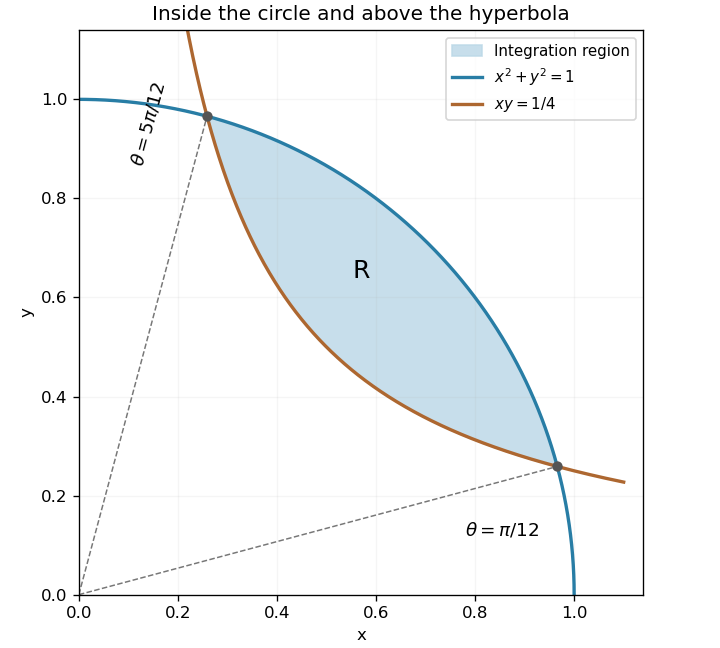

The Jacobian determinant contributes , while . Thus the double integral isIts antiderivative is . Evaluating the bounds gives
Past exam of the mathematics course of the year 1 of the natural sciences course of the University of Cambridge 2003 Paper 1 1 Solution by Codex 0 2026-10-20
Codex 0 2026-10-20For the numerical vectors, and , proving noncoplanarity. The reciprocal basis isReciprocal dot products extract the coefficients of any vector in the original basis. Here , , and , soSubstitution in Cartesian components recovers .
Past exam of the mathematics course of the year 1 of the natural sciences course of the University of Cambridge 2002 Paper 2 9 Solution by Codex 0 2026-10-20
Codex 0 2026-10-20The Taylor expansion about has coefficients given by the successive derivatives at :When is times continuously differentiable on the interval between and , Taylor's theorem gives for an intermediate point . If the remainders tend to zero, this yields the infinite Taylor series . The three functions below are real analytic near zero after taking the continuous extension in part (i).
Past exam of the mathematics course of the year 1 of the natural sciences course of the University of Cambridge 2002 Paper 2 3 Solution by Codex 0 2026-10-20
Codex 0 2026-10-20Use spherical polar coordinates with measured from the positive axis and around that axis:The standard full-space ranges are , , . The factor is the absolute Jacobian determinant and gives the volume element.
There are unlisted articles, also show them or only show them.