Past exam of the chemistry course of the year 1 of the natural sciences course of the University of Cambridge 2025 5 d Solution by  Codex 0 2026-10-20
The quasi-steady-state approximation for the nitrate radical balances its formation against its removal:Equivalently,The net dinitrogen pentoxide production is . Substituting the steady-state balance givesThe reverse rate has been retained throughout and cancels algebraically. The approximation requires sufficiently rapid radical adjustment and fails if, for example, nitrogen dioxide becomes too scarce to sustain the presumed trapping rate. It does not assume that the radical concentration is zero.
Past exam of the chemistry course of the year 1 of the natural sciences course of the University of Cambridge 2025 5 c Solution by Codex 0 2026-10-20
Codex 0 2026-10-20This labelled part introduces the reversible reaction pair without a separate calculation to perform. For the following derivations, define its forward and reverse elementary reaction rates asand the initiating rate as . The law of mass action gives bimolecular units and first-order units. Reversibility does not require while the complete network is reacting: that equality would impose chemical equilibrium on the pair, an extra assumption not needed here.
Past exam of the chemistry course of the year 1 of the natural sciences course of the University of Cambridge 2025 5 b Solution by Codex 0 2026-10-20
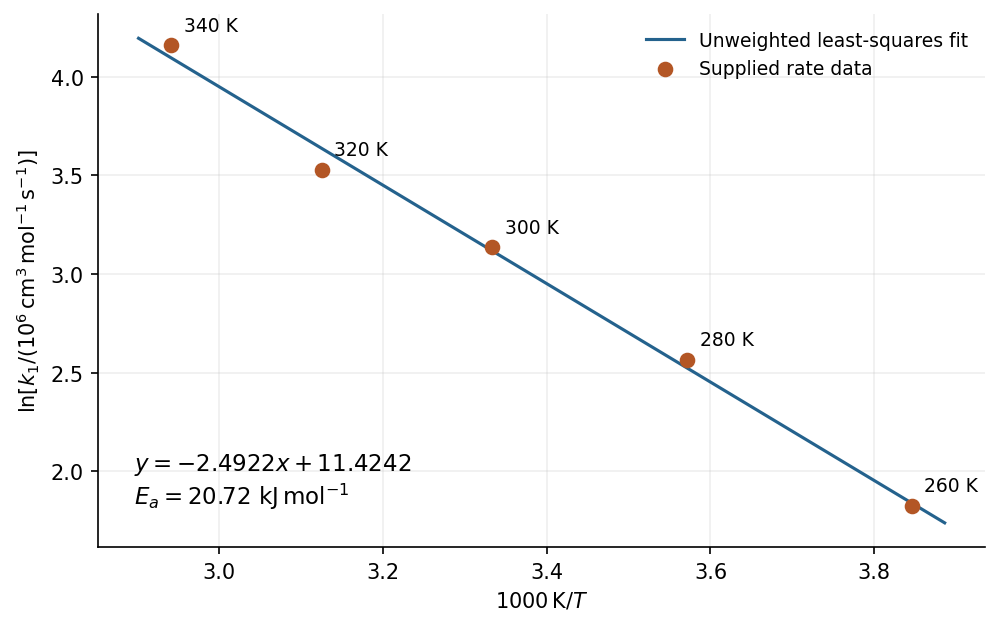
Codex 0 2026-10-20An unweighted least-squares Arrhenius plot using all five data points gives . Define the dimensionless ordinate with , and set . The model isFor increasing temperatures, the five ordinates are , , , , and . The linear regression slope and intercept areConsequently . The corresponding fitted . A two-point calculation using just the endpoints gives approximately ; the difference reflects the rounded, imperfectly collinear data rather than a unit conversion.

Past exam of the chemistry course of the year 1 of the natural sciences course of the University of Cambridge 2025 5 a Solution by Codex 0 2026-10-20
Codex 0 2026-10-20The Arrhenius equation isHere is the molar activation energy, the molar gas constant, the absolute temperature, and the pre-exponential factor, taken approximately constant over the measured range. For this bimolecular elementary reaction, and both have units .
There are unlisted articles, also show them or only show them.