Past exam of the chemistry course of the year 3 of the natural sciences course of the University of Cambridge 2022 Paper 1 6 Solution by  Codex 0 2026-10-20
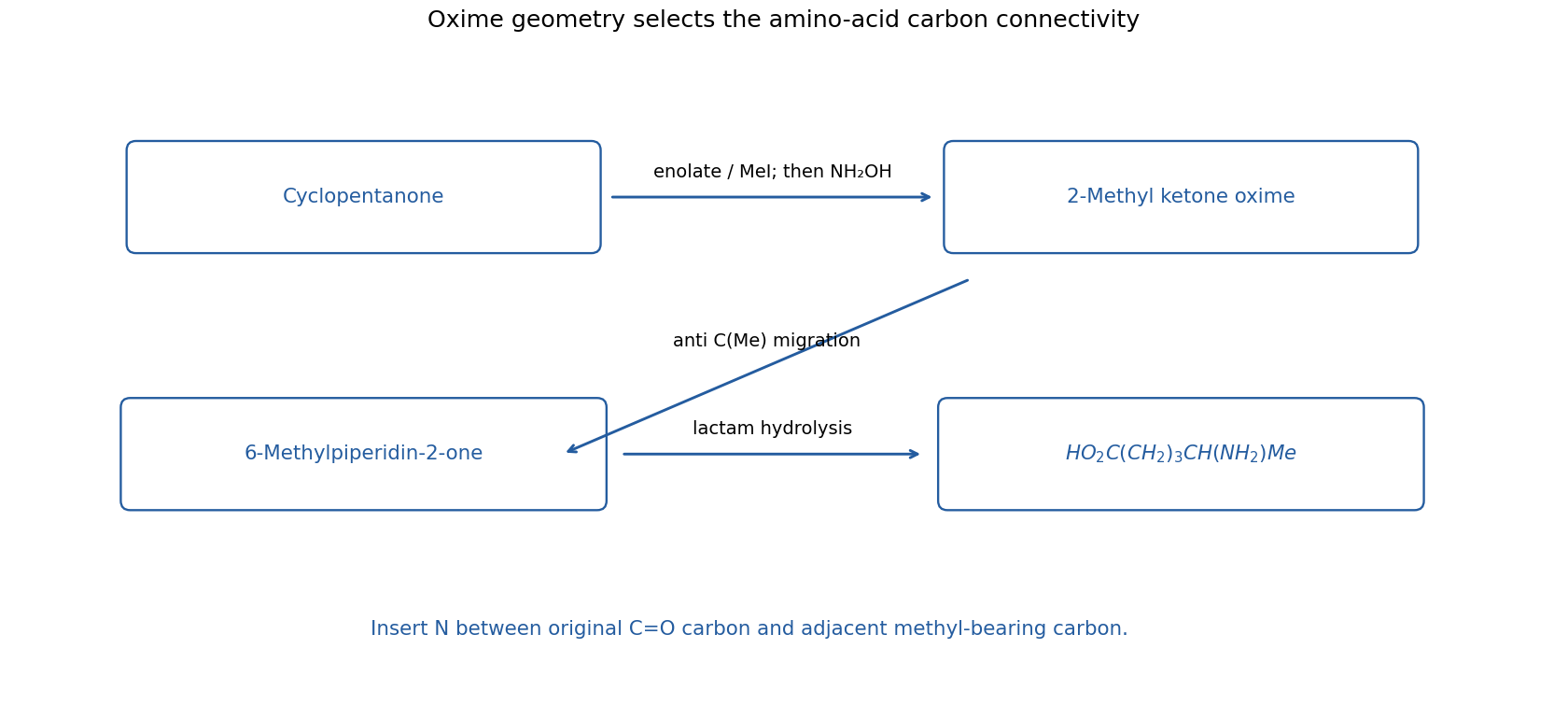
The target is 5-Aminohexanoic acid, . Disconnect its terminal amine/carboxylic-acid relationship through hydrolysis of 6-methylpiperidin-2-one. This six-membered lactam follows from a regioselected Beckmann ring expansion of 2-methylcyclopentanone oxime.
Start with cyclopentanone. Form its enolate with lithium diisopropylamide in dry THF at low temperature, add methyl iodide, then quench to obtain 2-methylcyclopentanone. Control the methyl iodide/base stoichiometry to suppress a second alkylation. React the ketone with hydroxylamine to form its oxime and select the geometrical oxime isomer in which the bond to the methyl-substituted adjacent ring carbon is anti to the departing oxime oxygen group.
Activate the oxime, for example under appropriate acid-promoted Beckmann conditions. The anti methyl-bearing C–C bond migrates onto nitrogen as the N–O-derived leaving group departs, inserting nitrogen between the original carbonyl carbon and the methyl-substituted ring carbon. Hydration/tautomerization gives 6-methylpiperidin-2-one. The opposite oxime geometry would insert nitrogen on the other side and ultimately place methyl at a different position in the amino acid; oxime geometry is therefore an essential part of this proposal.
Hydrolyse the lactam with aqueous acid and heat, then adjust the work-up to the desired acid/ammonium form. Cleavage of its acyl–nitrogen bond opens the ring to after suitable neutralization. All five original cyclopentanone carbons are retained, and the one methyl carbon comes from methyl iodide. A racemic mixture product is appropriate to the stereochemically unspecified target. The reaction sequence is an organic ring-expansion synthesis and requires no biological transformation.
Past exam of the chemistry course of the year 3 of the natural sciences course of the University of Cambridge 2022 Paper 1 5 Solution by Codex 0 2026-10-20
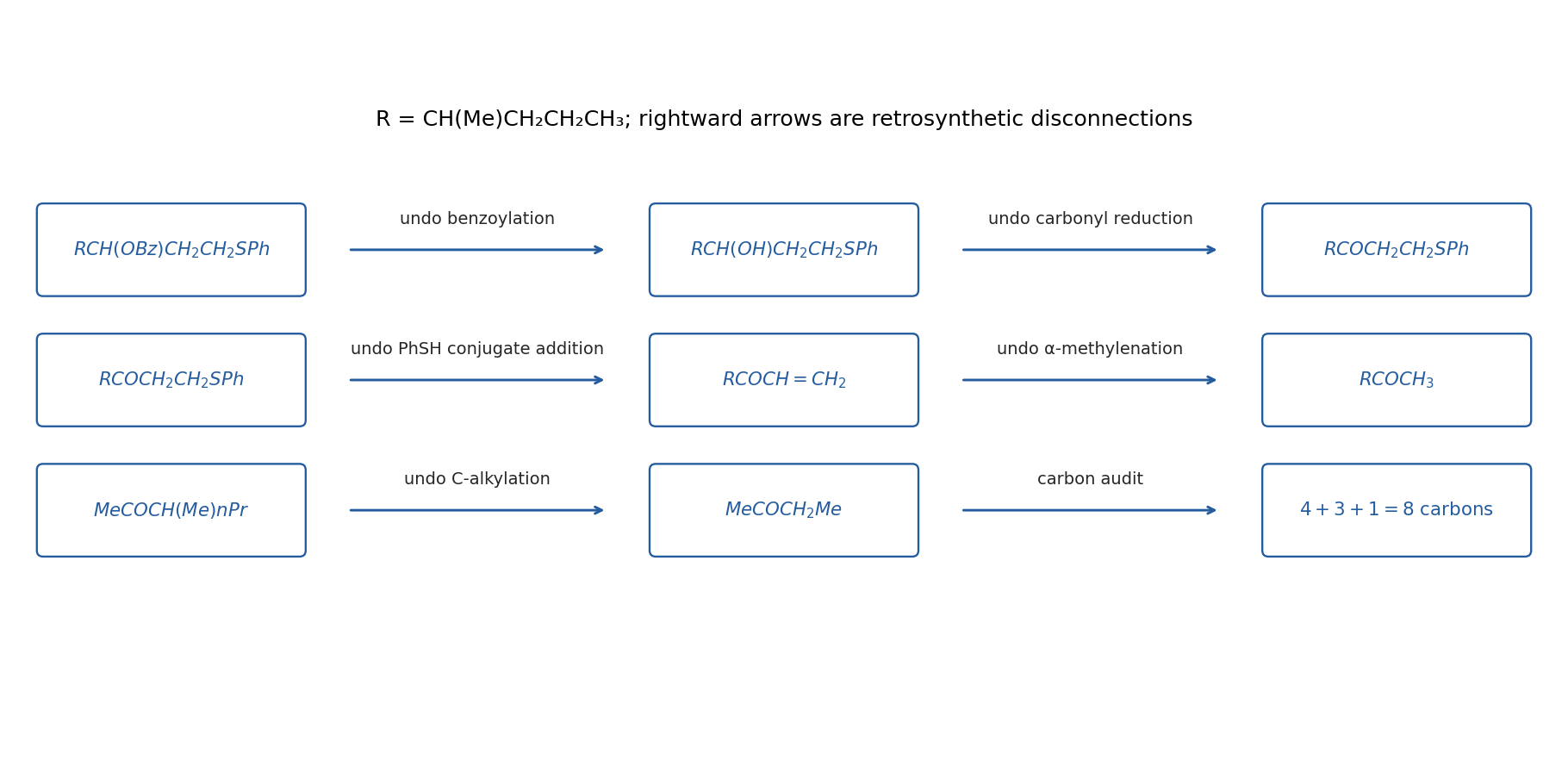
Codex 0 2026-10-20Let . The useful disconnections are benzoate formation, carbonyl reduction and thiol conjugate addition:The sulfur-bearing carbon is the enone beta carbon, so this is a Michael disconnection, not attack of thiophenol on the alcohol-derived central carbon. Reduce the saturated ketone with sodium borohydride after installing SPh, then benzoylate the alcohol with benzoyl chloride and pyridine or a tertiary amine.
Disconnect the enone to and formaldehyde. Kinetic deprotonation on the methyl side of the hindered unsymmetrical ketone, trapping with formaldehyde, and dehydration gives . This order leaves the substituted side unchanged. An alpha-methylenation/Mannich-base-elimination variant is an equivalent way of installing the terminal enone.
Finally, disconnects by alpha alkylation to butan-2-one and 1-iodopropane. Use the more substituted, ethyl-side enolate of butan-2-one for this step, rather than its usual methyl-side kinetic enolate; an equilibrated/regioisomerically selected enolate or enol derivative is required, and the desired monoalkylated ketone should be isolated. Three carbons from propyl iodide and one from formaldehyde increase the original four-carbon ketone to the required eight-carbon alcohol/thioether skeleton. Choosing ethyl iodide here would leave the target short by one carbon.
This is a constitutional synthesis: the target drawing specifies no configuration at either newly formed stereogenic site, so no unproved stereoselective reduction or alkylation is needed. Regioisomeric enolate alkylation and competing overalkylation are the practical selectivity issues to control, rather than something that follows from writing “base”.
Past exam of the chemistry course of the year 3 of the natural sciences course of the University of Cambridge 2022 Paper 1 3 Solution by Codex 0 2026-10-20
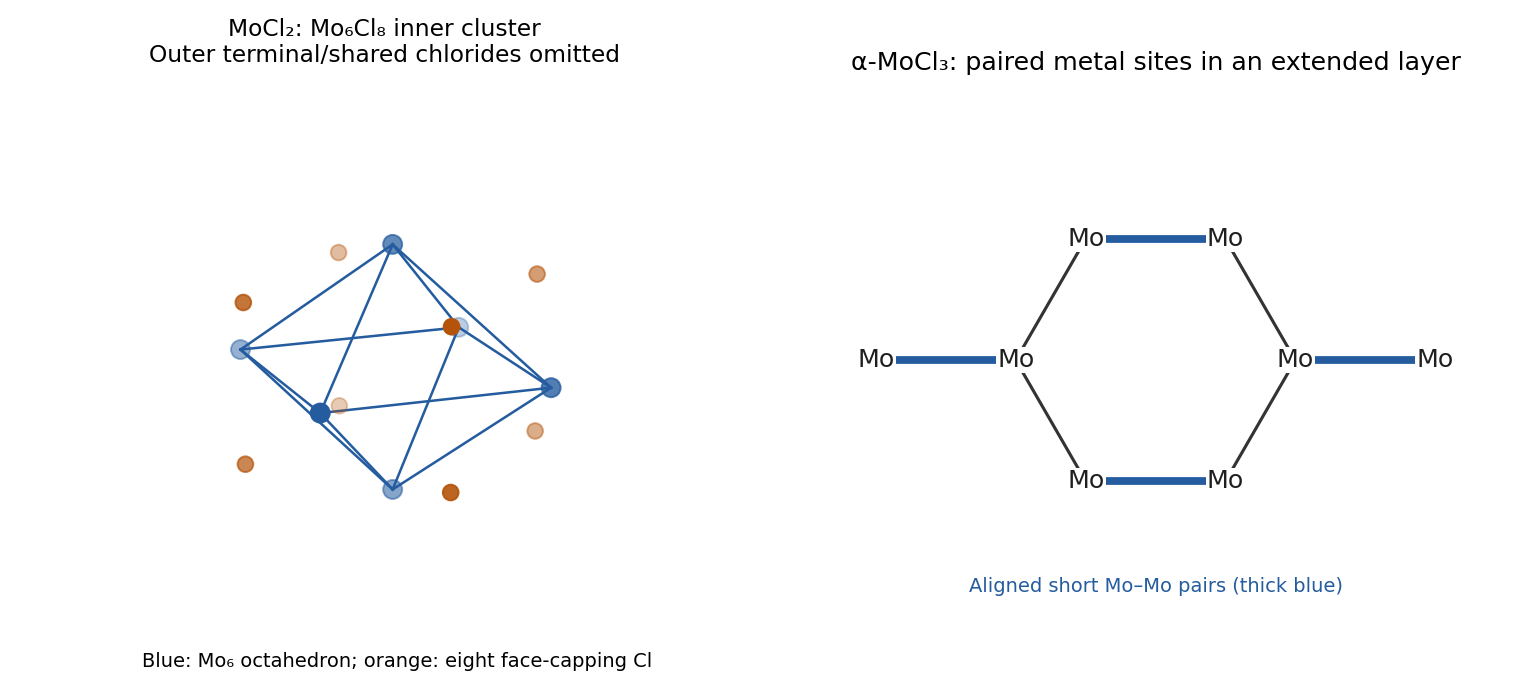
Codex 0 2026-10-20Solid contains octahedral clusters, while - has paired molybdenum centres in a layered chloride lattice. The first material is better represented by than by isolated bent or linear molecules. Eight inner chlorides cap the triangular faces of an octahedral metal core, giving . Outer chloride coordination completes the solid: one useful connectivity notation is , with two terminal outer chlorides and four intercluster-shared outer chlorides per octahedron. The empirical total is chlorides for six metals.
Each Mo(II) is formally , giving 24 metal-based electrons. These support extensive Mo–Mo bonding along the 12 octahedral edges; they are not localized as four free spins on each molybdenum. In -, Mo(III) is in edge-sharing octahedral layers. The metal honeycomb distorts into short Mo–Mo pairs. A localized dimer picture uses the six d electrons to fill one sigma and two pi bonding combinations, producing a formal triple bond and pairing the spins. The bulk crystal remains an extended chloride lattice, rather than a collection of unconnected molecules.
By comparison, has predominantly localized high-spin Cr(II), , in Jahn–Teller-distorted chloride octahedra; has layered Cr(III), , with three locally unpaired electrons. Their magnetic exchange is not evidence for the same strong short multiple bonds as in the molybdenum solids. The greater radial extent of Mo orbitals enables larger metal–metal overlap than the more contracted Cr orbitals. Real structure and magnetism still depend on ligand geometry and phase, so the orbital comparison is a trend rather than a prohibition of chromium–chromium bonds in other compounds. Diffraction and magnetic/spectroscopic studies directly distinguish the dimerized - lattice from .[ref]
Structural and Magnetic Transitions Caused by Dimer Formation in the CrCl3–MoCl3 Solid Solution by Samuel Froeschke and others. Introduction and spectroscopic discussion: paired Mo centres, localized Cr spins and diffraction/magnetic evidence
Past exam of the chemistry course of the year 3 of the natural sciences course of the University of Cambridge 2022 Paper 1 2 Solution by Codex 0 2026-10-20
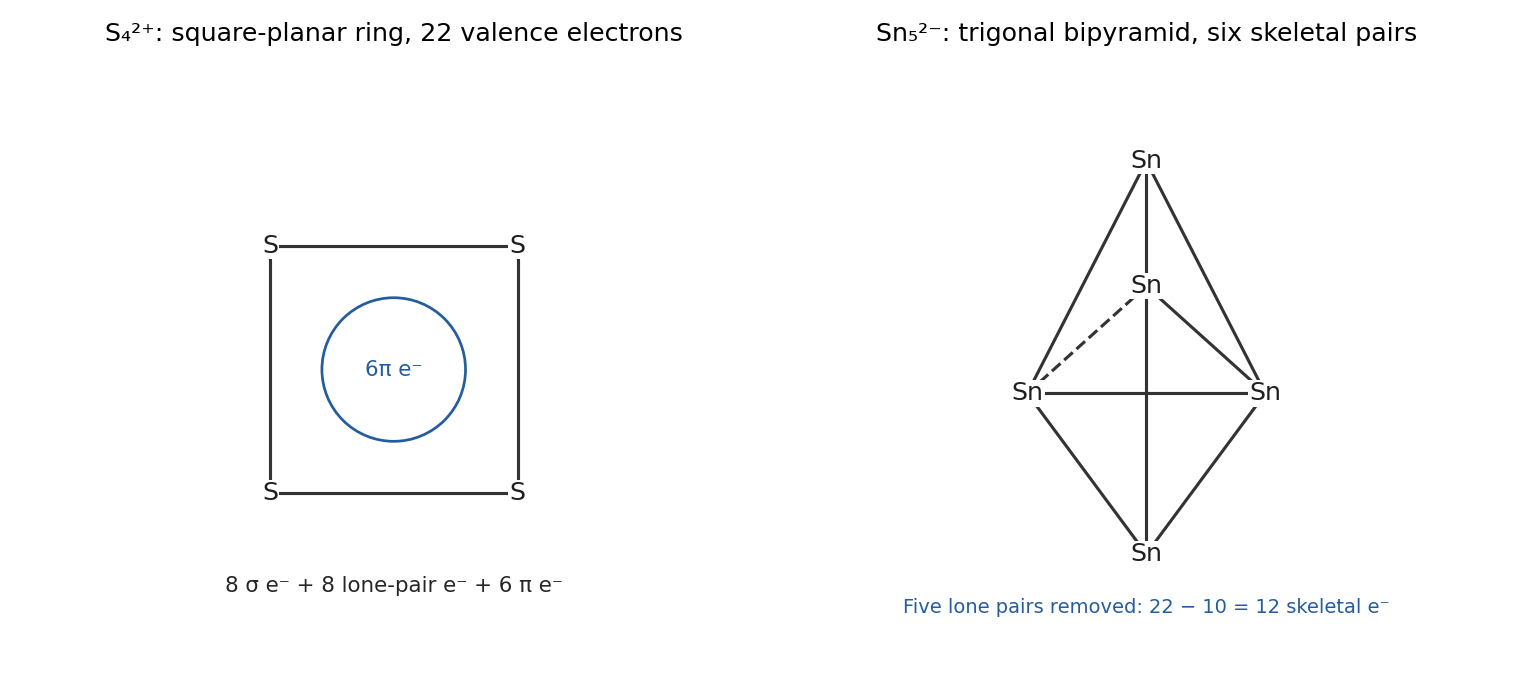
Codex 0 2026-10-20 is approximately square planar; is a closo trigonal bipyramid. Both have 22 valence electrons, and , but their different local orbital requirements prevent inferring identical shapes from this total alone.
For the sulfur ring, four S–S sigma bonds use eight electrons and four in-plane lone pairs use another eight, leaving six electrons in the perpendicular cyclic pi system. The resulting filled bonding and degenerate nonbonding pi levels give a six-pi-electron aromatic description of a four-membered ring, consistent with equivalent S–S links in the ideal square. The out-of-plane p orbitals are retained; this is not a tetrahedral four-vertex closo cage.
For tin, allocate one mainly s-rich lone pair to each atom. The remaining electrons form six skeletal pairs, exactly for . Wade's rules therefore predict a trigonal bipyramid, with three equatorial vertices and two axial vertices. The axial pair is not joined by a polyhedral edge; its bonding is part of the delocalized three-dimensional framework. The contrast is a planar aromatic sigma/pi ring versus a three-dimensional multicentre-bonded Zintl cluster, rather than cationic charge alone imposing planarity or anionic charge alone imposing a polyhedron.


There are unlisted articles, also show them or only show them.