Past exam of the MPhil in micro- and nanotechnology enterprise course of the University of Cambridge 2023 Paper 1 Section A(i) 1 i Solution by  Codex 0 2026-10-20
Moiré fringes arise when two overlapping periodic structures contribute closely spaced reciprocal lattice vectors to the transmission electron microscopy image. Their relative phase varies slowly across the image, producing a coarse modulation with a period much larger than either atomic spacing. The structures may have different lattice spacings, a small relative rotation, or both. The modulation is an interference or beat phenomenon; its spacing is not itself a new atomic-plane spacing. Its orientation is perpendicular to the difference vector of the two contributing projected reciprocal-lattice vectors.
Past exam of the MPhil in micro- and nanotechnology enterprise course of the University of Cambridge 2022 Paper 2 Section B 23 iv Solution by Codex 0 2026-10-20
Codex 0 2026-10-20For an ideal electrolyte with species number densities , valences , solvent permittivity and common temperature,Increasing salt concentration supplies more mobile charge to screen a surface perturbation, so a shorter distance is needed for the potential to decay. At fixed ion composition, permittivity and temperature, .
A fivefold concentration increase therefore givesEquivalently, the inverse screening length grows by . Changing ion valence changes the ionic-strength weighting as well, and highly concentrated electrolytes can depart from this dilute-solution screening model.
Past exam of the MPhil in micro- and nanotechnology enterprise course of the University of Cambridge 2022 Paper 2 Section B 23 iii Solution by Codex 0 2026-10-20
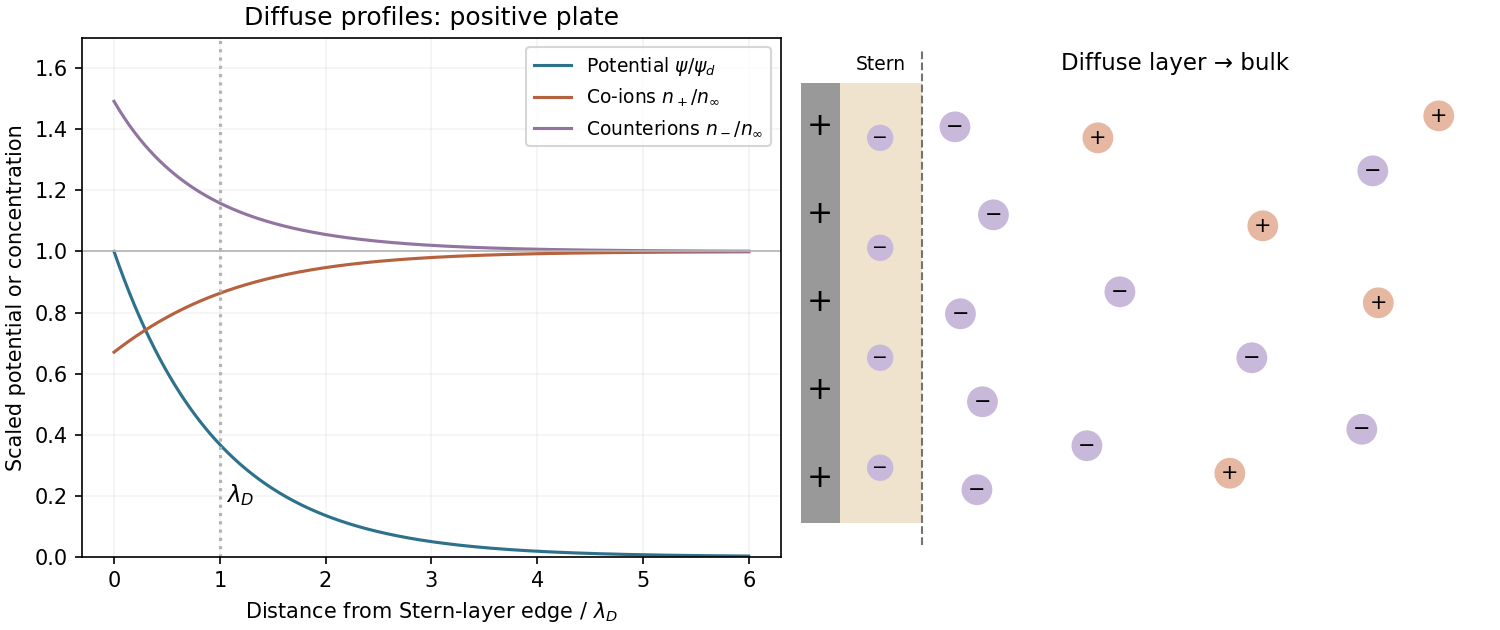
Codex 0 2026-10-20Choose a positively charged plate to match the question's labels for co-ions and for counterions. Let denote the outer edge of its compact Stern layer, and set the bulk potential to zero.
In the weak-potential Debye–Hückel approximation, the diffuse-layer potential isThe key length is the Debye–Hückel screening length. For a symmetric monovalent electrolyte, the Boltzmann distribution givesPositive co-ions are depleted near the positive plate, while negative counterions accumulate. Both approach the same bulk density as the potential decays. Attraction and repulsion by the surface compete with mixing entropy, so diffuse ions do not simply collapse into one plane. The compact Stern layer represents finite closest approach and specifically associated charge; the diffuse continuum begins outside it. For large potentials the linear exponential potential needs the nonlinear Poisson-Boltzmann equation, though the far-field screening scale remains the same in this simple electrolyte.
Past exam of the MPhil in micro- and nanotechnology enterprise course of the University of Cambridge 2022 Paper 2 Section B 23 ii Solution by Codex 0 2026-10-20
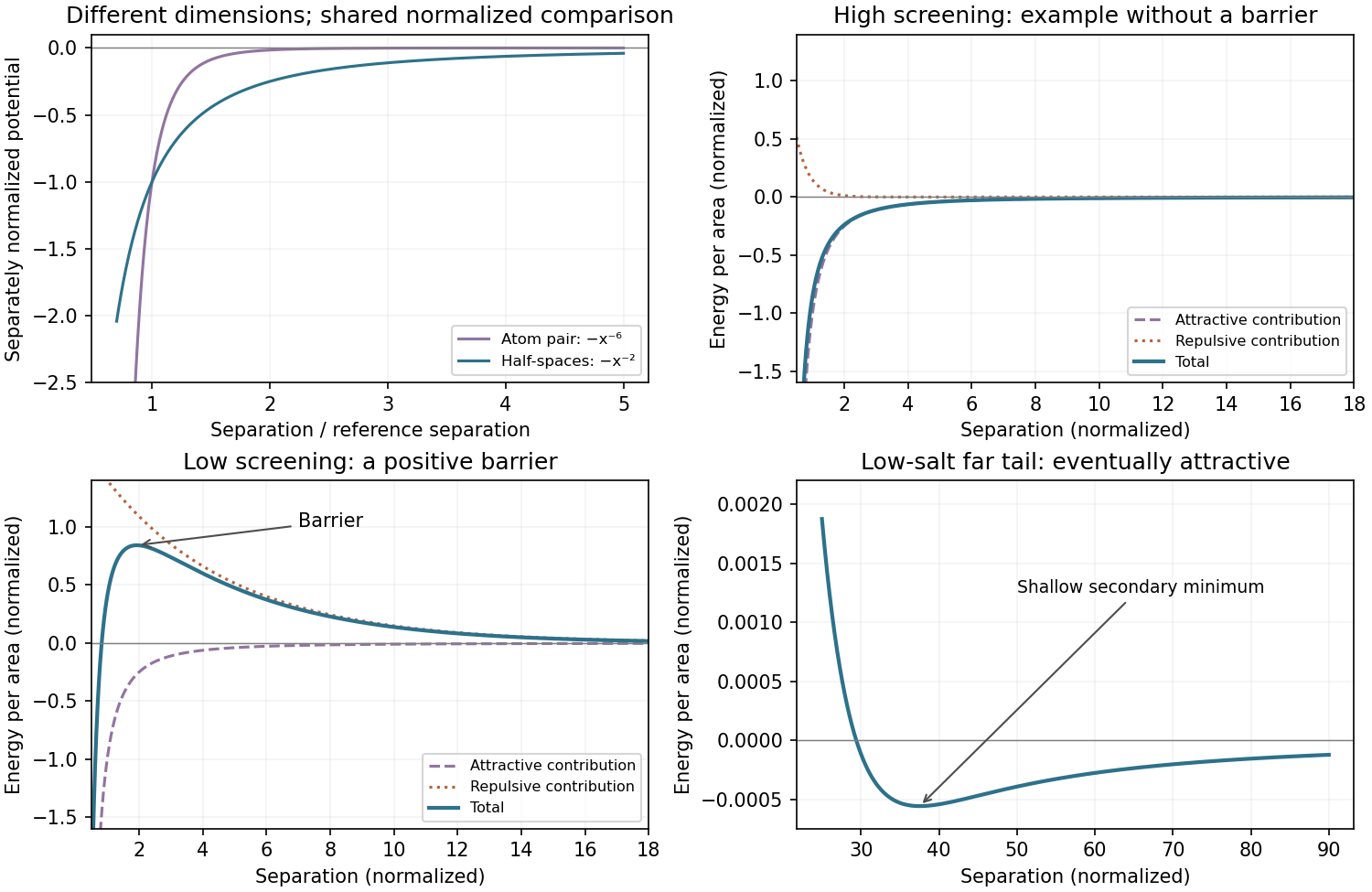
Codex 0 2026-10-20The microscopic pair potential falls as , whereas integrating over two half-spaces gives an interaction energy per area . The plate attraction therefore decays much more slowly with distance because many pairs contribute. The quantities have different dimensions, so the shared sketch uses separately normalized energies at a reference separation rather than pretending that joules and joules per square metre are directly comparable.
The attractive pressure isAt and the supplied effective ,The minus sign denotes decreasing separation. A total force cannot be calculated without the interacting area: for area in square metres, . This uses the supplied nonretarded half-space model; finite film thickness, geometry and retardation at larger distances can change it.


Past exam of the MPhil in micro- and nanotechnology enterprise course of the University of Cambridge 2022 Paper 2 Section B 23 i Solution by Codex 0 2026-10-20
Codex 0 2026-10-20 and count the microscopic interacting units in bodies 1 and 2. Their positions are and ; the difference vector gives their pair separation. The positive coefficient specifies an attractive nonretarded pair energy and has units .
Hamaker summation approximates a macroscopic interaction from Van der Waals forces by adding these microscopic pair energies. For homogeneous continua, sums are replaced by integrals over the two body volumes with number densities and . Integrating the geometry changes the distance dependence and produces a Hamaker constant for the stated simple model.
The approximation assumes pairwise additivity, uniform material properties, a known geometry and a separation large enough to use a continuum but small enough for the chosen nonretarded interaction law. It neglects many-body electrodynamic screening, chemical bonding, atomic roughness and short-range repulsion. A medium changes the effective interaction strength; an effective measured across water need not equal a vacuum value inferred from isolated atom pairs.
Past exam of the MPhil in micro- and nanotechnology enterprise course of the University of Cambridge 2022 Paper 2 Section B 22 iv Solution by Codex 0 2026-10-20
Codex 0 2026-10-20 Past exam of the MPhil in micro- and nanotechnology enterprise course of the University of Cambridge 2022 Paper 2 Section B 22 iii Solution by Codex 0 2026-10-20
Codex 0 2026-10-20 Past exam of the MPhil in micro- and nanotechnology enterprise course of the University of Cambridge 2022 Paper 2 Section B 22 ii Solution by Codex 0 2026-10-20
Codex 0 2026-10-20 Past exam of the MPhil in micro- and nanotechnology enterprise course of the University of Cambridge 2022 Paper 2 Section B 22 i Solution by Codex 0 2026-10-20
Codex 0 2026-10-20 Past exam of the MPhil in micro- and nanotechnology enterprise course of the University of Cambridge 2022 Paper 2 Section B 21 i Solution by Codex 0 2026-10-20
Codex 0 2026-10-20One consistent five-postulate formulation is the following; different textbooks group the same content differently.
- State. A pure state is a normalized vector in a complex Hilbert space, with ; vectors differing only by an overall phase represent the same state. For a spinless particle in position representation, is its wavefunction.
- Observables. A physical observable A is represented by a self-adjoint operator . In a Cartesian position representation, and , with .
- Outcomes and probabilities. Allowed ideal measurement outcomes are spectral values of . The Born rule gives , where projects onto the corresponding eigenspace; continuous spectra require the analogous spectral probability measure. The expectation is .
- Ideal measurement update. Conditional on a nonzero-probability outcome , an ideal projective measurement leaves . For a nondegenerate result this is its eigenstate. This is the ideal projection rule, not a description of every general measurement apparatus.
- Time evolution. Between measurements a closed system evolves by the Schrödinger equation, , with Hamiltonian . For time-independent , this gives unitary evolution .
The position-dependent probability density is , and its flux is the probability current. These distinguish the wave amplitude from the measurable particle flow in the following scattering problem.
Past exam of the MPhil in micro- and nanotechnology enterprise course of the University of Cambridge 2022 Paper 2 Section B 20 v Solution by Codex 0 2026-10-20
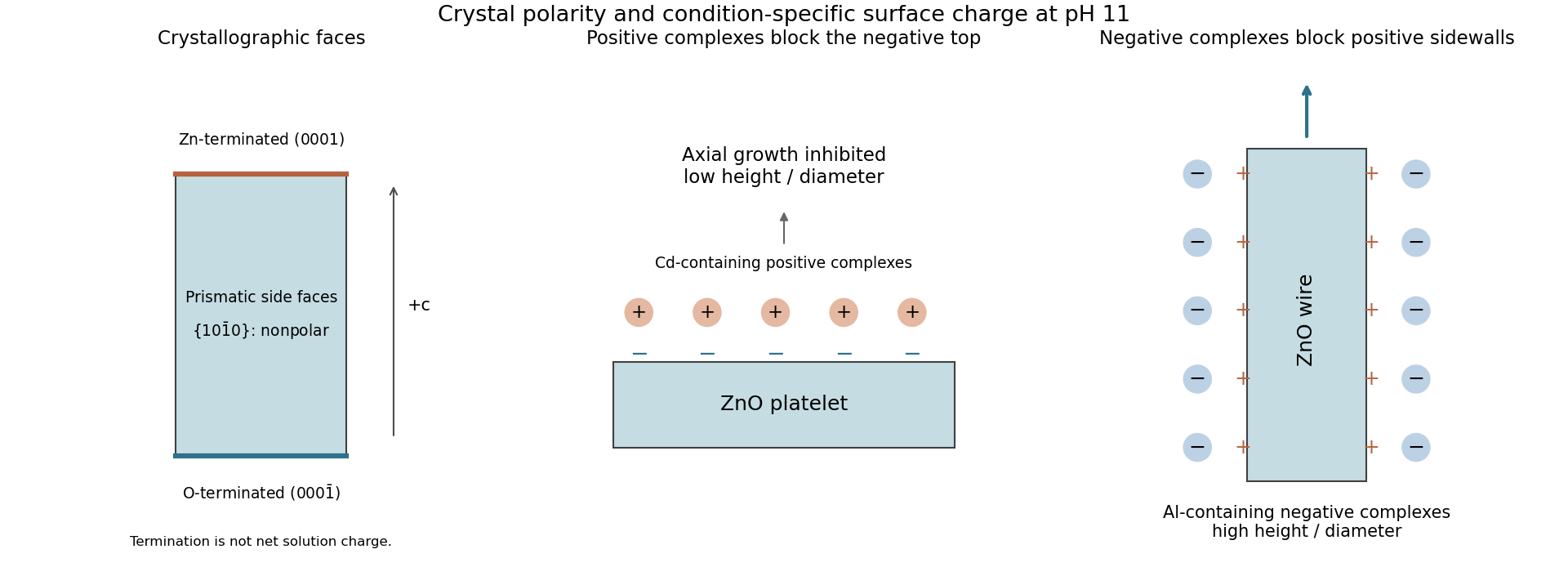
Codex 0 2026-10-20A c-axis wurtzite ZnO wire has crystallographically polar basal ends, conventionally Zn-terminated and O-terminated , and approximately nonpolar prismatic side facets such as . Crystallographic polarity is not identical to net surface charge in a growth solution: protonation, adsorbates and ionic speciation can change the latter.
For face-selective electrostatic growth inhibition, an oppositely charged additive adsorbs preferentially to a particular face and obstructs incorporation there. Blocking the axial end lowers axial growth relative to radial growth and yields a smaller aspect ratio; blocking sidewalls suppresses radial growth and favours long thin wires.
A primary hydrothermal experiment at pH 11 found negatively charged basal top surfaces and positively charged sidewalls. Positively charged Cd-containing complexes inhibited the top and favoured platelets; negatively charged Al-containing complexes inhibited sidewalls and favoured large aspect ratios. These signs are condition-specific, not fixed by the formal Zn/O termination alone.[ref]
Face-selective electrostatic control of hydrothermal zinc oxide nanowire synthesis by Jaebum Joo and others. 2011, Fig. 1 and pH-dependent complex-ion and surface-charge discussion
Facet-selective adsorption changes axial and radial ZnO growth
. Original facet-termination diagram and schematic of the cited pH-11 effective surface-charge example. The signs in the adsorption panels denote solution-condition-dependent surface charge, not a universal assignment of charge to crystallographic facets. Details.
There are unlisted articles, also show them or only show them.