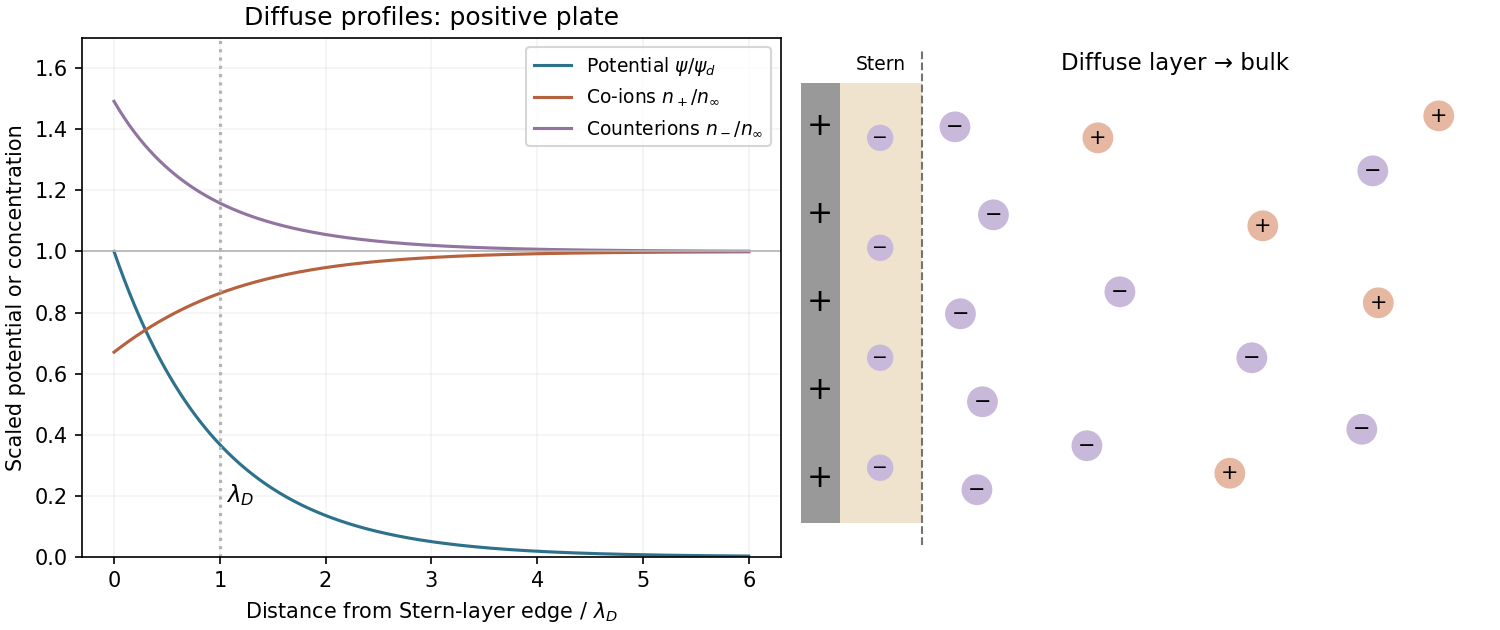
Choose a positively charged plate to match the question's labels for co-ions and for counterions. Let denote the outer edge of its compact Stern layer, and set the bulk potential to zero.
In the weak-potential Debye–Hückel approximation, the diffuse-layer potential isThe key length is the Debye–Hückel screening length. For a symmetric monovalent electrolyte, the Boltzmann distribution givesPositive co-ions are depleted near the positive plate, while negative counterions accumulate. Both approach the same bulk density as the potential decays. Attraction and repulsion by the surface compete with mixing entropy, so diffuse ions do not simply collapse into one plane. The compact Stern layer represents finite closest approach and specifically associated charge; the diffuse continuum begins outside it. For large potentials the linear exponential potential needs the nonlinear Poisson-Boltzmann equation, though the far-field screening scale remains the same in this simple electrolyte.

Articles by others on the same topic
There are currently no matching articles.