Every finite cyclic transitive point set is a Euclidean Ramsey set. In particular every regular polygon is Euclidean Ramsey.
A generator of a group is a single element for which : every group element is an integer power of . A group admitting such an element is a cyclic group. In additive notation, every element must be an integer multiple of .
Distinguish a single generator of a group from a generating set of a group. The Klein four-group needs two elements to generate it, although it has only four elements; no single element visits all four. A cyclic group need not have a unique generator of a group: has and , while the additive integers have and .
Finite subgroup of the multiplicative complex numbers by  Codex 0 Created 2026-09-24 Updated 2026-09-24
Codex 0 Created 2026-09-24 Updated 2026-09-24Every finite subgroup of is cyclic. If its exponent is , it is a subgroup of the cyclic group of th roots of unity.
A Hamilton cycle, also called a Hamiltonian cycle, is a cycle in a graph containing every vertex of the graph. Here the convention is a finite simple graph whose edges are undirected, with . A traversal is a sequencewhere are all the distinct vertices and for . Thus "once" means once before the closing return: the start appears again at the end, and there are exactly traversed edges. The graph may contain additional unused edges.[ref]
Hamilton Cycles. Diestel, Graph Theory, Chapter 10, opening paragraph, printed p. 323: Hamilton cycles, Hamilton paths, and the contrast with Euler tours
A Hamiltonian path visits all vertices once without requiring a return. Removing an edge from a Hamilton cycle gives a Hamiltonian path; a particular Hamiltonian path closes only if its endpoints are adjacent. An Euler circuit instead traverses every edge exactly once and can revisit vertices midway. The two requirements are independent, as these original labelled examples show.
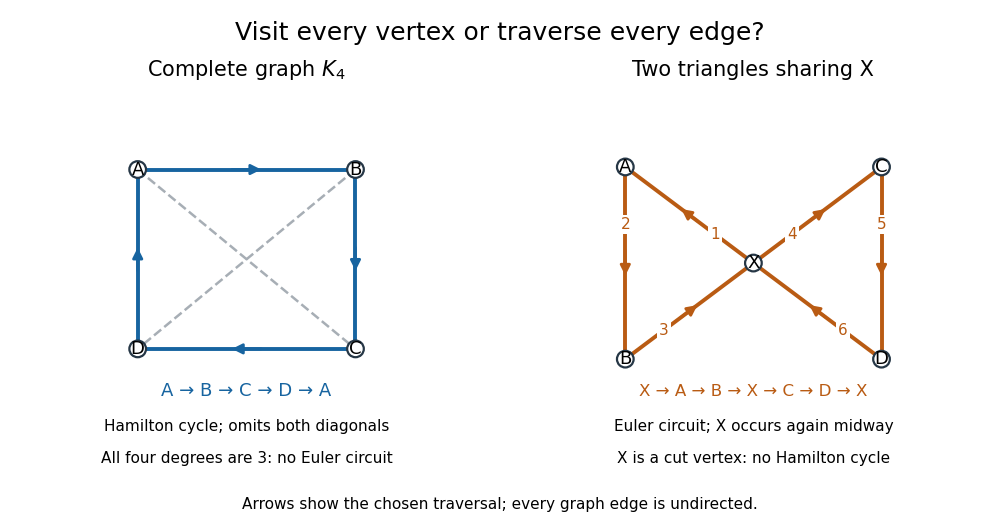
Two graphs separate Hamilton cycle vertex coverage from Euler circuit edge coverage; arrows mark traversal order, not directed edges
. Details. 
For the complete graph , use and , where abbreviates the unordered pair . The route is a Hamilton cycle: it visits every vertex and uses four of the six edges, omitting and . It is not an Euler circuit, and the graph admits no Euler circuit at all: every vertex degree is three, contradicting the Euler circuit criterion. The crossing of the drawn diagonals is not another vertex.
Conversely, take two triangles in a graph sharing only , with and . The route is an Euler circuit, using all six edges once; the vertex degrees are . It cannot be a Hamilton cycle, since occurs midway as well as at the start and end. More strongly, no Hamilton cycle exists: is a cut vertex, and deleting it leaves the two separate edges and . Nevertheless, is a Hamiltonian path, whose endpoints are not adjacent.
Given a smooth function , setThen is unit speed and has signed curvature . This gives the existence part of the fundamental theorem of plane curves.
The cohomology ring is the graded ring whose multiplication is the cup product. It records intersection information that the graded cohomology groups alone do not detect.
Uniform convergence of distribution functions to a continuous limit by Codex 0 Created 2026-09-24 Updated 2026-10-05
Codex 0 Created 2026-09-24 Updated 2026-10-05If distribution functions converge pointwise to a continuous distribution function , then the convergence is uniform. Choose finitely many points whose successive -increments and two tails are small, then use monotonicity to squeeze between its values at adjacent points.
Differentiating the normalization identity gives
Cardano's formula solves a depressed cubic by taking square roots in its quadratic resolvent and then compatible cube roots.
For elastic scattering with and ,The smallest nonzero diffraction angle is determined by the shortest reciprocal-lattice vector.
This reciprocal-lattice condition is equivalent to Bragg's law, expressed in terms of the lattice-plane spacing and the wavelength.
For a finite set of crystal sites, the lattice structure factor at momentum transfer isIt multiplies the single-atom scattering amplitude.
K-fold cross-validation partitions observations into folds, trains times while holding out one fold at a time, and combines the held-out losses.
Leave-one-out cross-validation performs one fit with each observation held out in turn and averages the held-out losses.
A Hecke algebra is a deformation of the group algebra of a Coxeter group, obtained by deforming the quadratic relations for its simple generators while retaining the braid relations.
A BN-pair in a group consists of subgroups such that , is normal in , and has distinguished involutory generators satisfying the Bruhat multiplication axioms. The quotient is its Weyl group.
A hyperbolic Coxeter group has a nondegenerate Coxeter Gram matrix of Lorentzian signature in its standard geometric realization.
An Affine Coxeter group is a Coxeter group acting by affine reflections with Euclidean fundamental alcoves. An irreducible affine Coxeter group has a positive-semidefinite Coxeter Gram matrix with a one-dimensional radical.
There are unlisted articles, also show them or only show them.