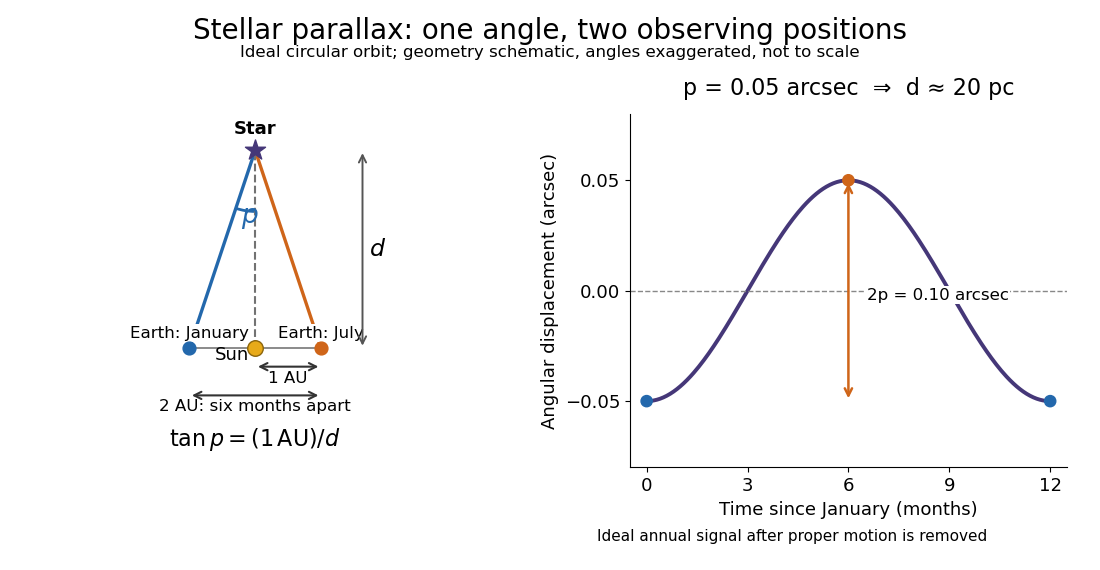
Stellar parallax is the apparent change in a star's viewing direction caused by the observer's changing position. Nearby stars shift more against a distant reference background. In an ideal circular Earth orbit, the conventional annual stellar parallax uses a baseline of one astronomical unit, approximately the Earth-Sun distance. Two opposite observing positions, about six months apart, are separated by approximately two astronomical units. Their maximum angular separation is , so is half that excursion, not the full January-to-July shift. The observed excursion depends on the projected baseline and observing dates. [ref].
For the perpendicular baseline in the diagram, a right triangle giveswhere in the final expression is in radians. Combining the small-angle approximation with the parsec convention givesThus arcseconds implies parsecs, while the ideal six-month excursion is arcseconds. Geometry supplies this distance without assuming a luminosity or a particular stellar atmosphere.
In practical astrometry, many observations separate the annual stellar parallax signal from proper motion, the star's own changing sky position. The Gaia DR3 catalogue reports stellar parallax and its uncertainty in milliarcseconds: arcseconds. A catalogue angle is a fitted measurement with measurement error. [ref].
For a positive stellar parallax with small standard deviation , first-order propagation gives . Thus with gives parsecs with parsecs, assuming systematic offsets are negligible. This linear estimate requires ; a reciprocal is nonlinear and does not generally preserve symmetric uncertainty intervals.
The parsec is a distance unit defined by the exact conventionThe astronomical unit is exactly ; one arcsecond is exactly radians. The IAU resolution explicitly records the parsec convention. A megaparsec is one million parsecs. [ref]. [ref].
The familiar description "the distance giving one arcsecond of stellar parallax" uses the small-angle approximation. Exact right triangle geometry instead gives , slightly shorter than the conventional parsec. The relative difference is approximately . This is negligible for the examples here, but distinguishing an exact unit convention from an approximate geometric interpretation prevents a misleading equality.

