Proper motion describes the change in a celestial object's direction on the sky due to its motion relative to the observer. Its angular velocity differs from the annual stellar parallax signal caused by the observer's orbit.
Thus proper motion is an angular velocity, rather than a speed in kilometres per second. It describes the relative transverse motion of source and observer in a specified reference frame. A star moving towards us can have little proper motion, while a nearer star can show larger proper motion than a faster but more distant one. In the example above, the observed coordinate actually decreases over the first half-year, although is positive: the annual stellar parallax excursion temporarily outweighs the steady drift. A short observed displacement alone therefore need not estimate proper motion well.
Real catalogues give two proper motion components. For right ascension and declination , the angular velocities in perpendicular directions on the local sky areThe cosine factor accounts for the shorter east-west arc associated with a given right ascension increment away from the celestial equator. ESA's Gaia DR3 fields
pmra and pmdec already contain these two components; pm is their total proper motion. Do not multiply pmra by another cosine. Components of and , for example, give total proper motion . [ref]https://gea.esac.esa.int/archive/documentation/GDR3/Gaia_archive/chap_datamodel/sec_dm_main_source_catalogue/ssec_dm_gaia_source.html. ESA Gaia DR3: Proper-motion columns and conventions
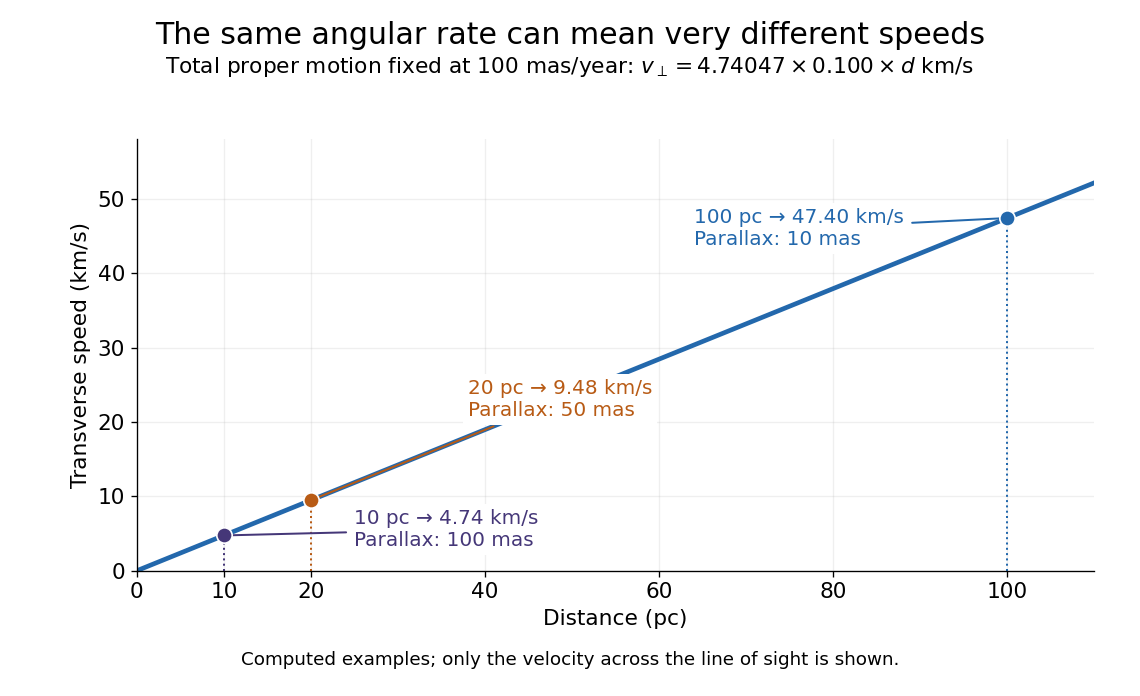
.For nearby stars in the ordinary nonrelativistic approximation, Euclidean distance converts total proper motion into transverse speed :The small-angle approximation gives transverse speed as Euclidean distance times angular velocity in radians per unit time. With arcseconds and parsecs, the parsec convention turns their product into astronomical units per year. One astronomical unit per Julian year of days is approximately . The coefficient is a unit conversion, rather than a property of a particular star.
Taking the model's as the total proper motion, with the other component zero, gives . At the same total proper motion, Euclidean distances of , and parsecs instead give transverse speeds of , and , respectively. Their stellar parallax values are , and . The same annual angular displacement can therefore describe quite different journeys through space.
The transverse speed still omits the line-of-sight velocity, which can be measured through the Doppler effect in spectral lines. Combining these measurements permits a three-dimensional velocity estimate in a consistent reference frame. [ref].
Historically, Edmond Halley's 1718 paper compared contemporary and ancient stellar directions and argued that some supposedly fixed stars had moved. Its title, "Considerations on the change of the latitudes of some of the principal fixt stars", captures the conceptual surprise: long-separated measurements could reveal motion invisible in an ordinary night's watching. Modern astrometry retains that insight, using repeated precise measurements to turn the apparently static sky into a record of changing positions. [ref]
https://archive.org/details/paper-doi-10_1098_rstl_1717_0025. Halley: Original Royal Society paper, pages 736-738
. [ref]https://www.esa.int/Science_Exploration/Space_Science/Gaia/How_does_Gaia_study_the_Milky_Way. ESA: Halley's 1718 comparison
. Articles by others on the same topic

Proper motion is the apparent angular motion of a star or other celestial object across the sky, as observed from a specific location over time. It is measured in arcseconds per year and represents the object's movement perpendicular to the line of sight from the observer. Proper motion is a consequence of the object's actual motion through space relative to the observer, combined with the effects of the observer's position (like being on Earth) and the object's distance.

