For small measurement errors, write . Its partial derivatives and first-order propagation of uncertainty areHere the values are standard deviations used to describe uncertainty, and is the covariance. Independent carrier-reading errors give ; correlated readings require the term . Averaging repeated independent pairs reduces the random component of the uncertainty of the mean, but does not remove calibration or model errors.
As a stipulated uncertainty calculation, let , , and , with all three input errors independent. Then , , and . The result would be with this standard uncertainty in the stipulated thin lens model; these numbers are not a measured uncertainty budget. A small neglected principal-plane separation gives an additional first-order bias , distinct from that random budget.
Bessel lens displacement method: merging settings and focal length sensitivity
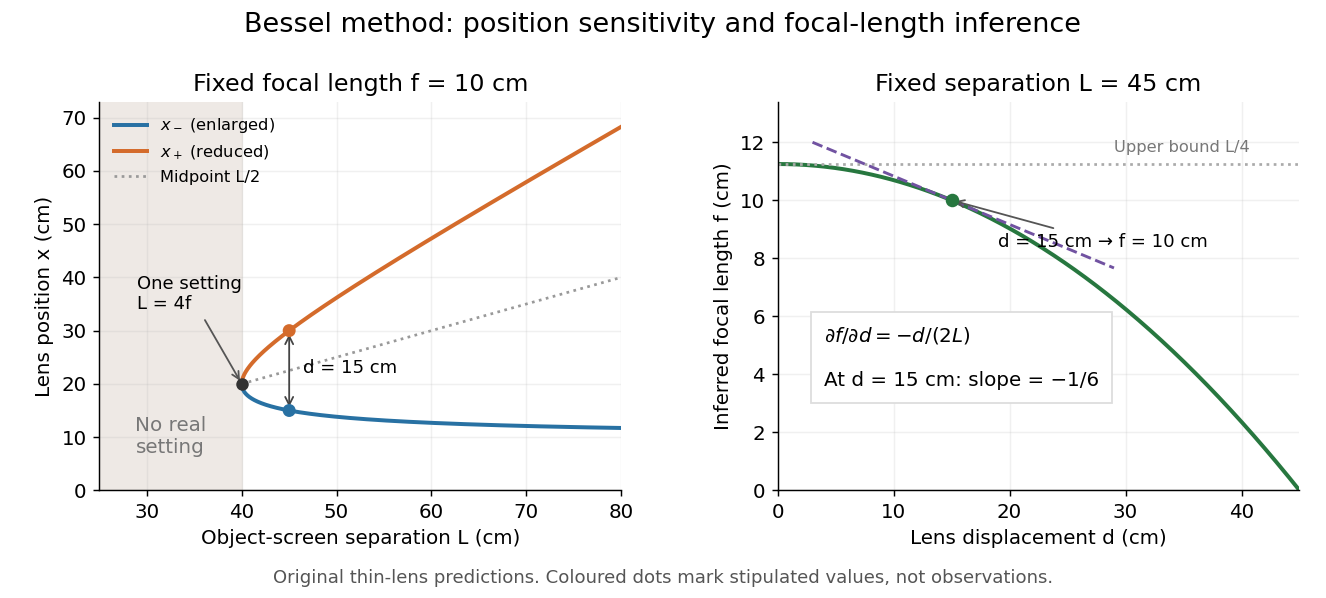
. Original ideal-model curves. Left: settings versus object-screen separation for fixed ; below there is no real setting on the fixed screen. Right: inferred focal length versus measured displacement at fixed , with its tangent at the stipulated . The curves are predictions, not experimental points. Details.
The two kinds of sensitivity must be distinguished. At fixed focal length,These derivatives diverge as approaches from above: a small change in object-screen spacing strongly changes the separation of the two settings. Yet the inferred focal length's displacement sensitivity tends to zero. That does not make coalescing settings easy to measure. For fixed , define the axial mismatch between the predicted real image and the screen as , for . At a focused setting,Near , moving the optical lens changes this mismatch only weakly, making visual discrimination of the two settings difficult. At the example's settings and , so equal carrier motion produces different axial defocus responses. This is an axial mismatch calculation, not a full prediction of perceived image sharpness.
Choose sufficiently above to separate the two accepted focusing ranges, while retaining both real images on the available screen and rail. There is no universal best : focusing uncertainty itself depends on aperture, transverse magnification, optical aberrations and the target. Close to , the nonnegative measured separation and the quadratic term in also make first-order propagation of uncertainty unreliable if its error is comparable to its value. Repeatability, controls and the principal plane correction determine whether the elegant two-distance formula is an adequate measurement model.
Articles by others on the same topic
There are currently no matching articles.