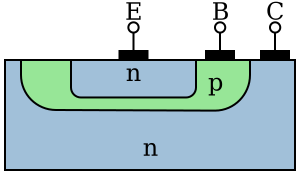
A bipolar junction transistor has two p-n junctions sharing a thin base region, arranged n-p-n or p-n-p. In its forward amplification regime, the emitter junction injects minority carriers; many cross the base before electron-hole recombination and reach the reverse-biased collector junction.[ref]
Transistor technology evokes new physics by William Shockley. Printed pp. 368–370, Figs. 11–12
William Shockley's proposal used transport through the bulk of a semiconductor, rather than coupling between two surface points. The base must be thin enough for injected minority carriers to reach the collector. Two separately wired diodes do not supply that shared transport region. The proposal was a design principle; producing a working device required further control of material properties.[ref]
Transistor technology evokes new physics by William Shockley. Printed pp. 368–370
Articles by others on the same topic

A Bipolar Junction Transistor (BJT) is a type of transistor that uses both electron and hole charge carriers. It is a fundamental component in electronic devices and has three regions of semiconductor material, which are respectively called the emitter, base, and collector. The operation of a BJT is based on the principle of controlling a large current through the collector-emitter path with a smaller current at the base-emitter junction.

By William Shockley in 1948 also at Bell Labs Murray Hill.