Stereoscopy supplies depth because different cameras see different projections of the same track. A functional reconstruction first matches the same interaction vertex and track segments across views. A calibrated lens and window model maps each measured image coordinate back to a ray inside the liquid. Refraction at the windows must be included. Intersecting the rays, or finding their closest agreement when measurements have errors, estimates three-dimensional coordinates. Several points then determine a trajectory, rather than only a projected arc.
An original ideal-camera model makes the geometry explicit. Take two parallel pinhole cameras with centers and , focal length , and optical axes along . Use virtual image planes in front of the pinholes so that image coordinates have the same orientation as the scene. A point then givesSubtracting the horizontal image coordinates gives disparity , henceFor stipulated , , , and , the reconstructed point is . These are ideal optical inputs, not dimensions of Alvarez's apparatus. This model omits refraction and lens distortion; actual calibration replaces its simple ray geometry. Since , the same disparity error gives worse depth precision for distant points.
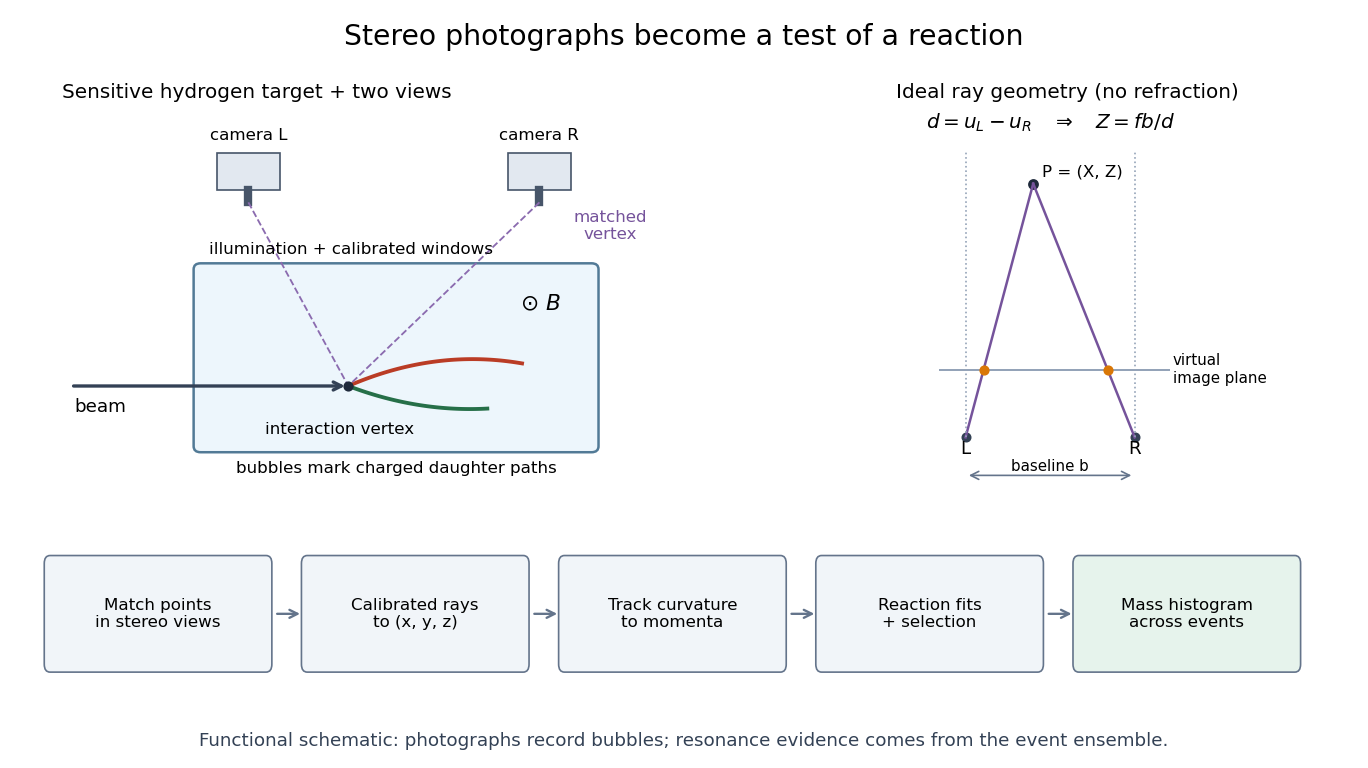
From stereo bubble photographs to coordinates, momenta and an event ensemble
. Original functional diagram. The chamber, camera positions and tracks are schematic, not a historical mechanical drawing. The parallel-camera ray construction illustrates an idealized model without refraction. Details.
The Lorentz force then supplies a momentum scale. With magnetic field uniform and negligible stopping power over a fitted segment, bubble-chamber track readout gives . The local three-dimensional helix tangent supplies the missing direction: if is its angle to the field, . In practical units,Here is the elementary charge and the speed of light. A short, almost straight arc poorly constrains its radius of curvature; a visually sharp track can therefore have poor momentum precision.
Articles by others on the same topic
There are currently no matching articles.