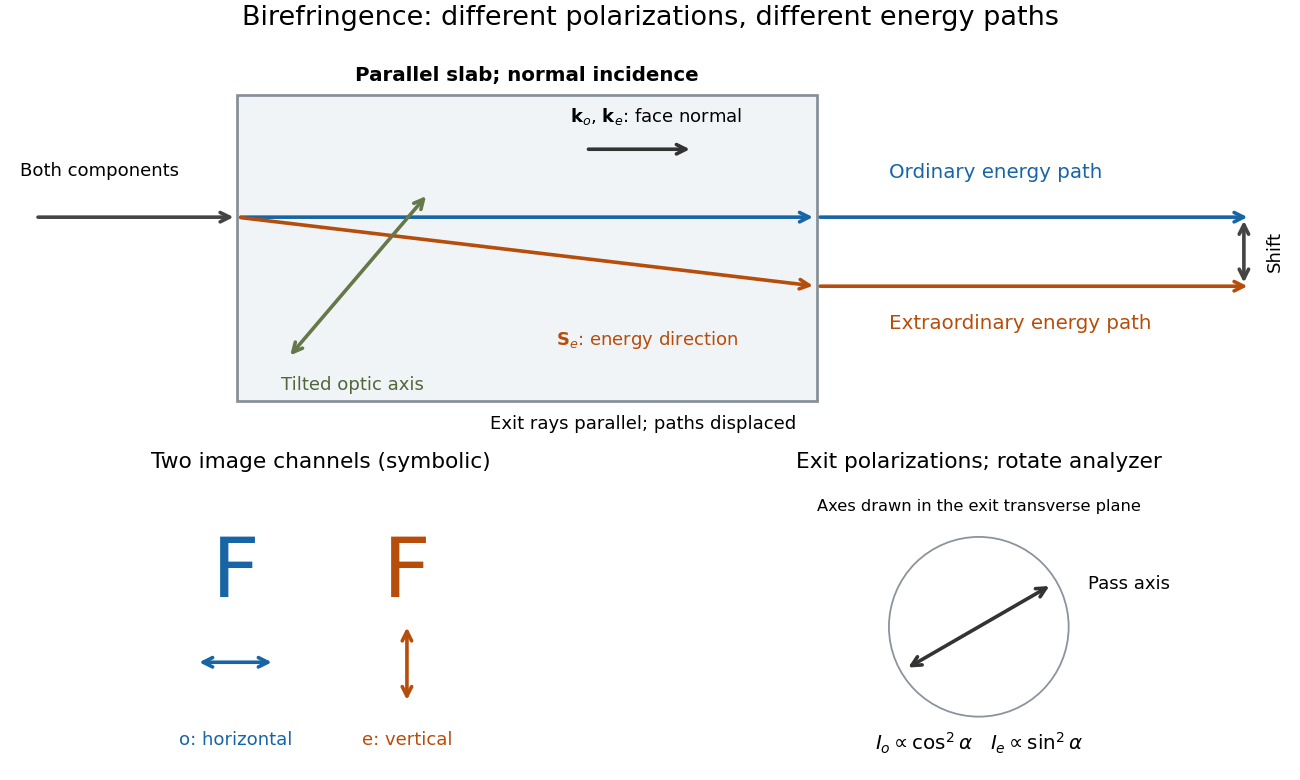
Place a clear calcite specimen on a transparency bearing printed words on an overhead projector. The projected readout is two copies of the lettering. Put a rotatable linear polarizer after the specimen: suitable orientations suppress one copy or the other. These are the actual apparatus and observations in the University of Iowa demonstration.[ref]
Polarization - Calcite & Iceland Spar by University of Iowa, Department of Physics and Astronomy. Demonstration 6H35.15, Equipment and Procedure: crystals, polarizers, printed overhead transparency, two sets of words and selective extinction; final note on natural defects
For a useful control, remove the specimen while keeping the transparency, projector and screen fixed: the doubling should disappear. Replace it, hold it stationary and rotate only the polarizer; complementary brightness changes distinguish two linear polarizations from an accidental duplicate transparency. These are suggested controls, rather than additional reported measurements. Ideally the two copies obey complementary Malus's law curves, and , with angle measured from the exiting ordinary wave's linear polarization. Unequal maxima do not invalidate the test. Finite polarizer extinction, poor focus and specimen defects limit visibility; image separation alone does not determine either refractive index without the specimen geometry.

Articles by others on the same topic
There are currently no matching articles.