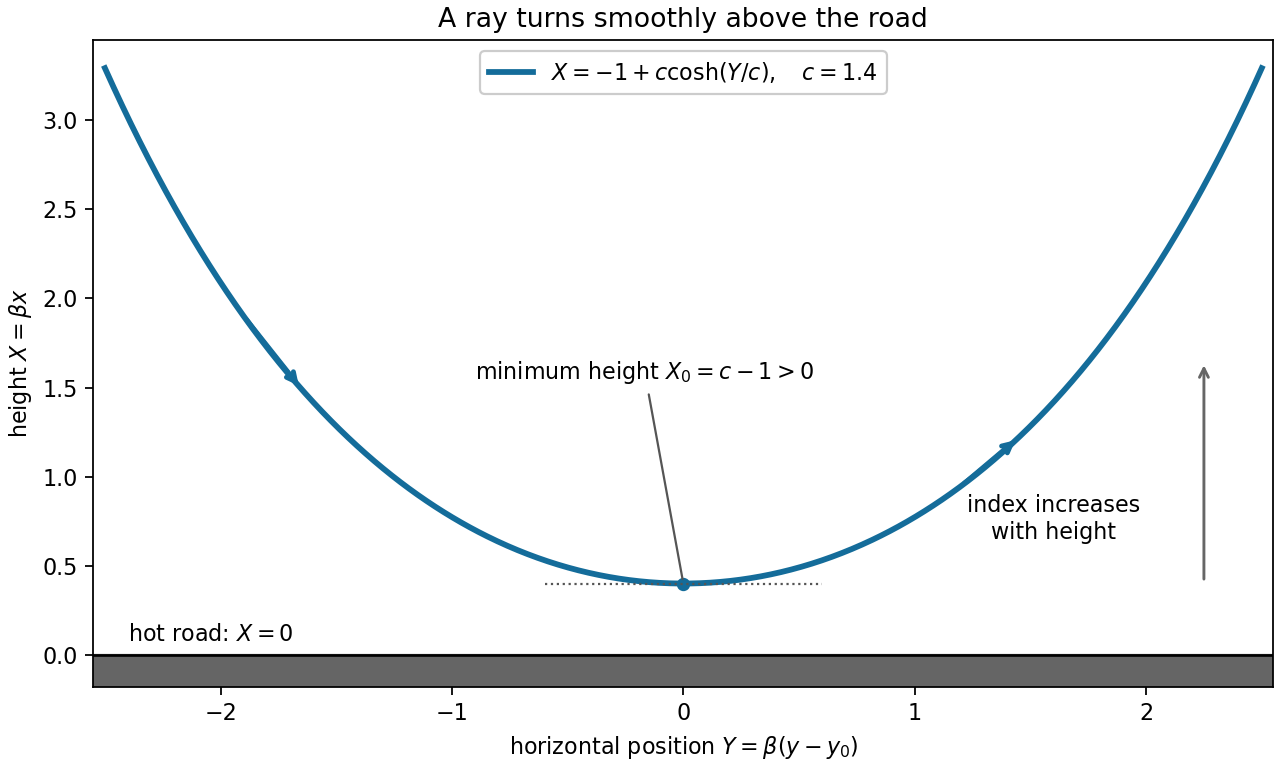
For height and horizontal position , Fermat principle in a positive index profile , , conserves on a graph . For positive magnitude of the horizontal optical momentum, integration gives the displayed catenary. Its minimum height is , at . Thus produces a smooth turning ray wholly above a road at . The two graph branches have opposite signs of ; continues smoothly through their common horizontal tangent. For a signed negative graph constant, use in the prefactor; gives a vertical ray separately.

For speed in , Fermat principle gives the elapsed-time integrand . Its symmetric stationary light rays through are the displayed catenaries. Set . The endpoint equation is . This function decreases and then increases, with unique minimum where . Thus above the minimum there are two stationary rays, at the minimum one, and below it none. The travel time on either ray is , and its minimum height is .
For and , one solution is , with . A second has , with . Hence these endpoints do not uniquely specify the ray. Stationarity is distinct from global minimization: paths descending almost to have limiting travel time , below either stationary value in this example.
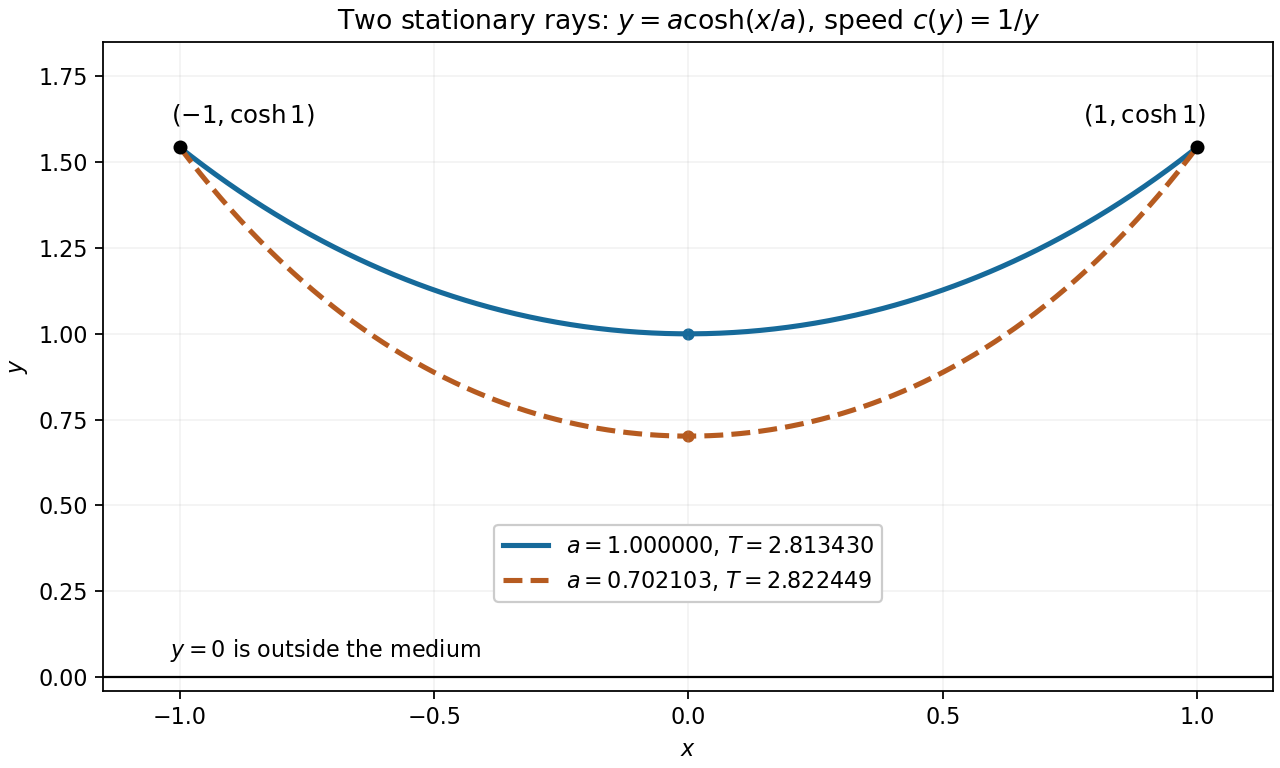
Two stationary catenary rays connect the same endpoints
. For speed , the endpoints and admit stationary light rays with minimum heights and . Their different travel times illustrate that Fermat principle is a stationarity condition. Details.
Articles by others on the same topic
There are currently no matching articles.