A mirage is an apparent displaced image caused by refraction through a spatially varying refractive index. Above a hot surface, low-index air near the ground can bend a light ray back upwards before it reaches the surface. An observer tracing the arriving ray backwards along its local tangent can then infer an apparent image below the turning region. This explains the appearance of a distant reflective surface without requiring reflection at the road itself.
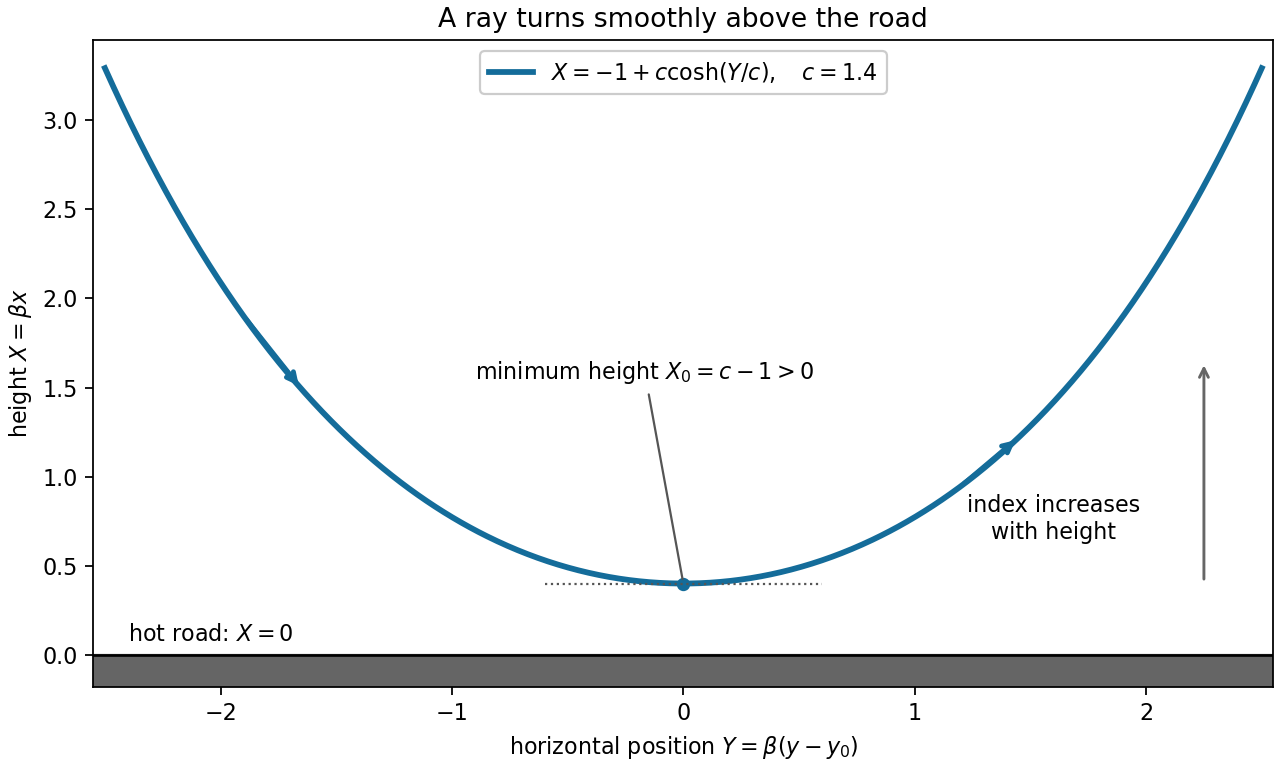
For height and horizontal position , Fermat principle in a positive index profile , , conserves on a graph . For positive magnitude of the horizontal optical momentum, integration gives the displayed catenary. Its minimum height is , at . Thus produces a smooth turning ray wholly above a road at . The two graph branches have opposite signs of ; continues smoothly through their common horizontal tangent. For a signed negative graph constant, use in the prefactor; gives a vertical ray separately.
For speed in , Fermat principle gives the elapsed-time integrand . Its symmetric stationary light rays through are the displayed catenaries. Set . The endpoint equation is . This function decreases and then increases, with unique minimum where . Thus above the minimum there are two stationary rays, at the minimum one, and below it none. The travel time on either ray is , and its minimum height is .
For and , one solution is , with . A second has , with . Hence these endpoints do not uniquely specify the ray. Stationarity is distinct from global minimization: paths descending almost to have limiting travel time , below either stationary value in this example.
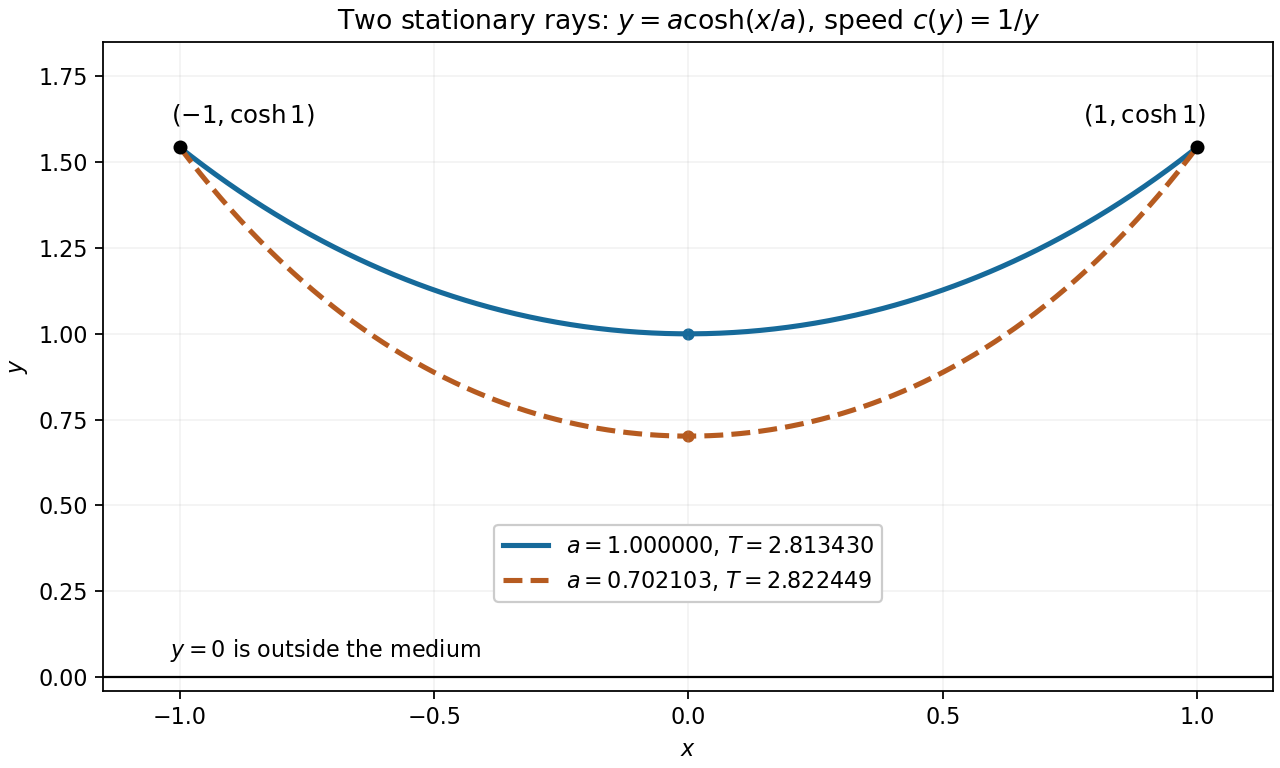
Two stationary catenary rays connect the same endpoints
. For speed , the endpoints and admit stationary light rays with minimum heights and . Their different travel times illustrate that Fermat principle is a stationarity condition. Details. Articles by others on the same topic



The term "mirage" can refer to a few different concepts depending on the context: 1. **Optical Illusion**: In the most common sense, a mirage is an optical phenomenon that occurs when layers of air at different temperatures create a distortion in the way light travels. This often results in the appearance of water or a reflection of the sky on a hot road or desert surface. The light refracts due to temperature gradients and creates an image of something that isn't actually there.