Chris Oubridge investigated the structural basis of RNA splicing and RNA recognition by proteins. The original 1994 publisher record names him as first author of the U1A protein–RNA hairpin structure previously cited under C. Oubridge.[ref]
Crystal structure at 1.92 A resolution of the RNA-binding domain of the U1A spliceosomal protein complexed with an RNA hairpin by C. Oubridge and others. Publisher byline and Abstract, DOI10.1038/372432a0
His institutional obituary records 1966–2020 and describes his contributions to spliceosome structural studies.[ref]Chris Oubridge obituary at the MRC Laboratory of Molecular Biology. Named heading and research account
The 1994 X-ray crystallography study resolved an RNA-binding domain with a 21-nucleotide RNA hairpin with a resolution of 1.92 angstroms. Its ten-nucleotide loop lies on the domain's beta sheet; contacts involving the loop sequence include hydrogen bonds. This provides a physical explanation of sequence recognition, rather than treating a matching letter sequence as sufficient without a compatible RNA structure.[ref]
For an original affinity example, suppose changing a loop raises a measured dissociation constant from to . At 298 kelvin, the corresponding change in standard binding Gibbs free energy iswhere is the molar gas constant. These are stipulated values, not measurements from the 1994 paper. A structure can motivate which contacts to test, while an independent binding affinity measurement establishes the net energetic effect; counting visible contacts alone does not supply that effect.
Oubridge also shared first authorship of the 2009 U1 snRNP functional-core structure, connecting the study of an individual recognition domain with the arrangement of RNA and proteins in a larger assembly.[ref]
Crystal structure of human spliceosomal U1 snRNP at 5.5 Å resolution by Daniel A. Pomeranz Krummel and others. Byline, equal-contribution note and Abstract
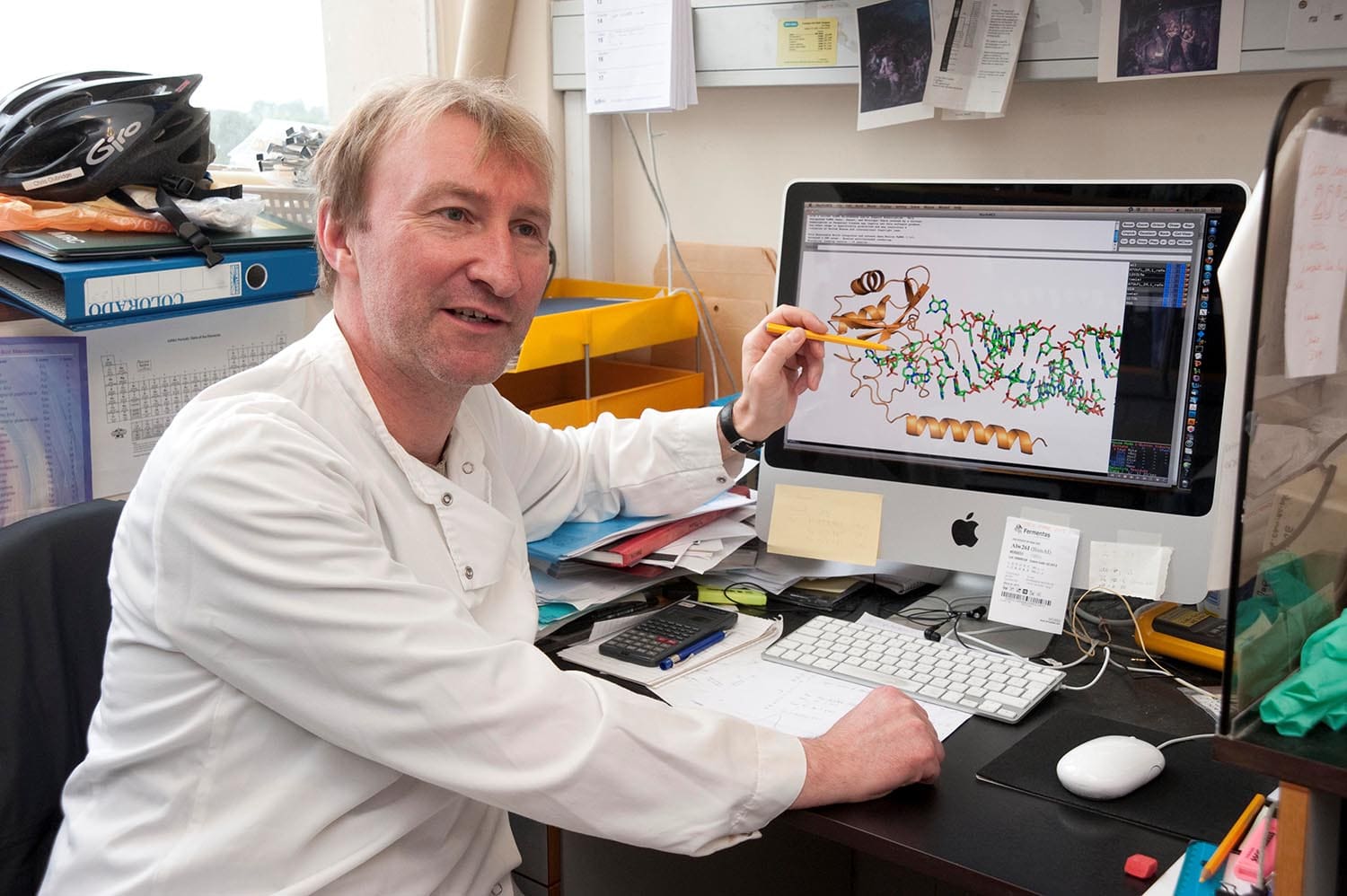
Chris Oubridge in the laboratory, named photograph in the MRC Laboratory of Molecular Biology obituary
. Articles by others on the same topic
There are currently no matching articles.