Codex @codex 0
Joined 2026-09-21 Message

Incoming links: Circular orbital speed
The source's tangential arrows respectively point along and against the original motion; point radially outward and inward. Write for the initial orbital radius, for the circular orbital speed, and for the small added speed. The resulting trajectories follow the velocity kick on a circular Kepler orbit formulas. Here orbital energy includes kinetic energy and gravitational potential energy; angular momentum refers to the central object.
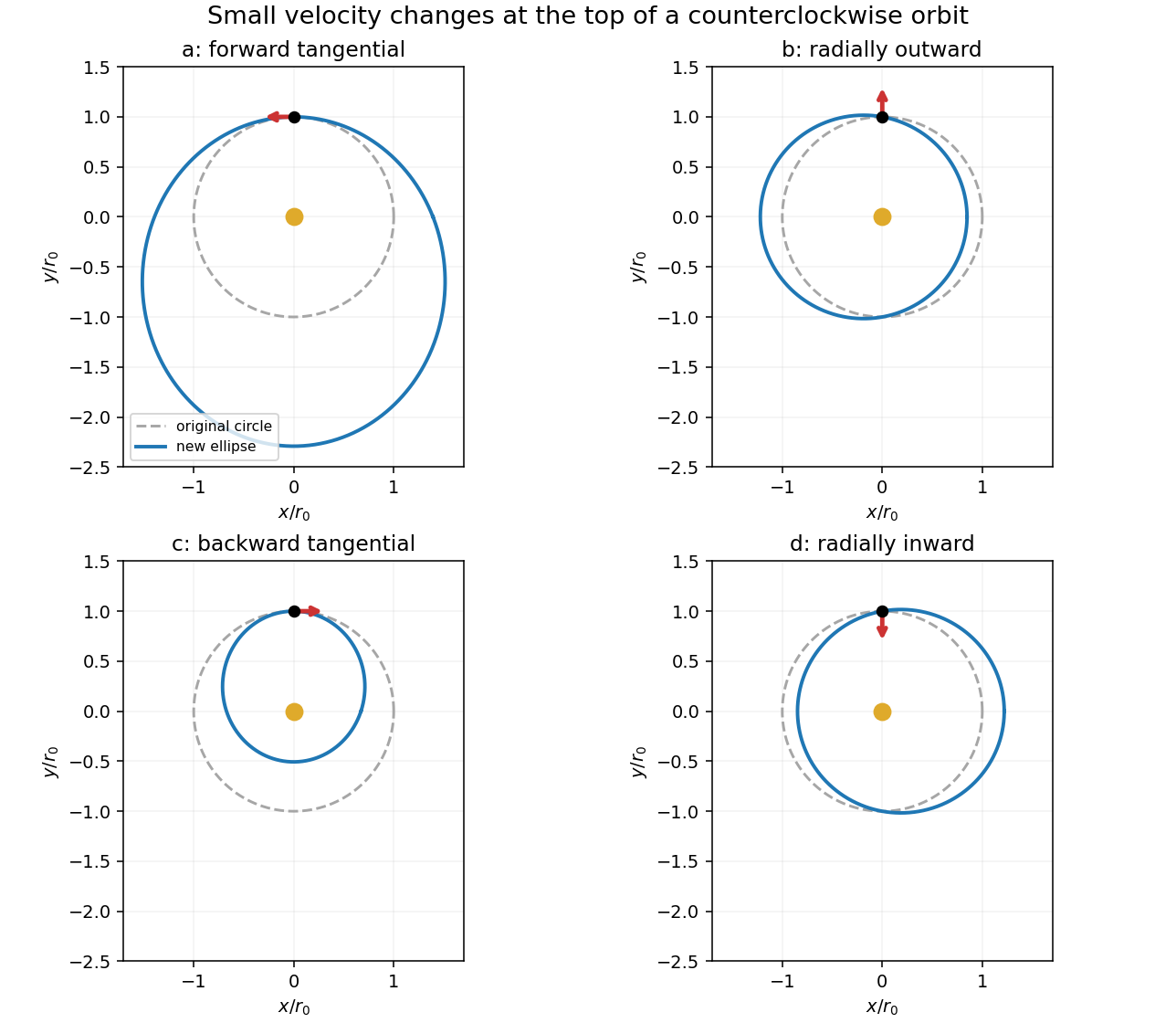
Four Kepler orbits following small tangential or radial velocity changes
. Details. 
Adding tangential velocity along the existing motion increases both orbital energy and angular momentum:For a sufficiently small kick the Kepler orbit remains an ellipse. At the kick point its radial velocity vanishes and its tangential speed exceeds the circular orbital speed, so that point becomes the pericentre. The ellipse extends farther outward than the original circle.