The source's tangential arrows respectively point along and against the original motion; point radially outward and inward. Write for the initial orbital radius, for the circular orbital speed, and for the small added speed. The resulting trajectories follow the velocity kick on a circular Kepler orbit formulas. Here orbital energy includes kinetic energy and gravitational potential energy; angular momentum refers to the central object.
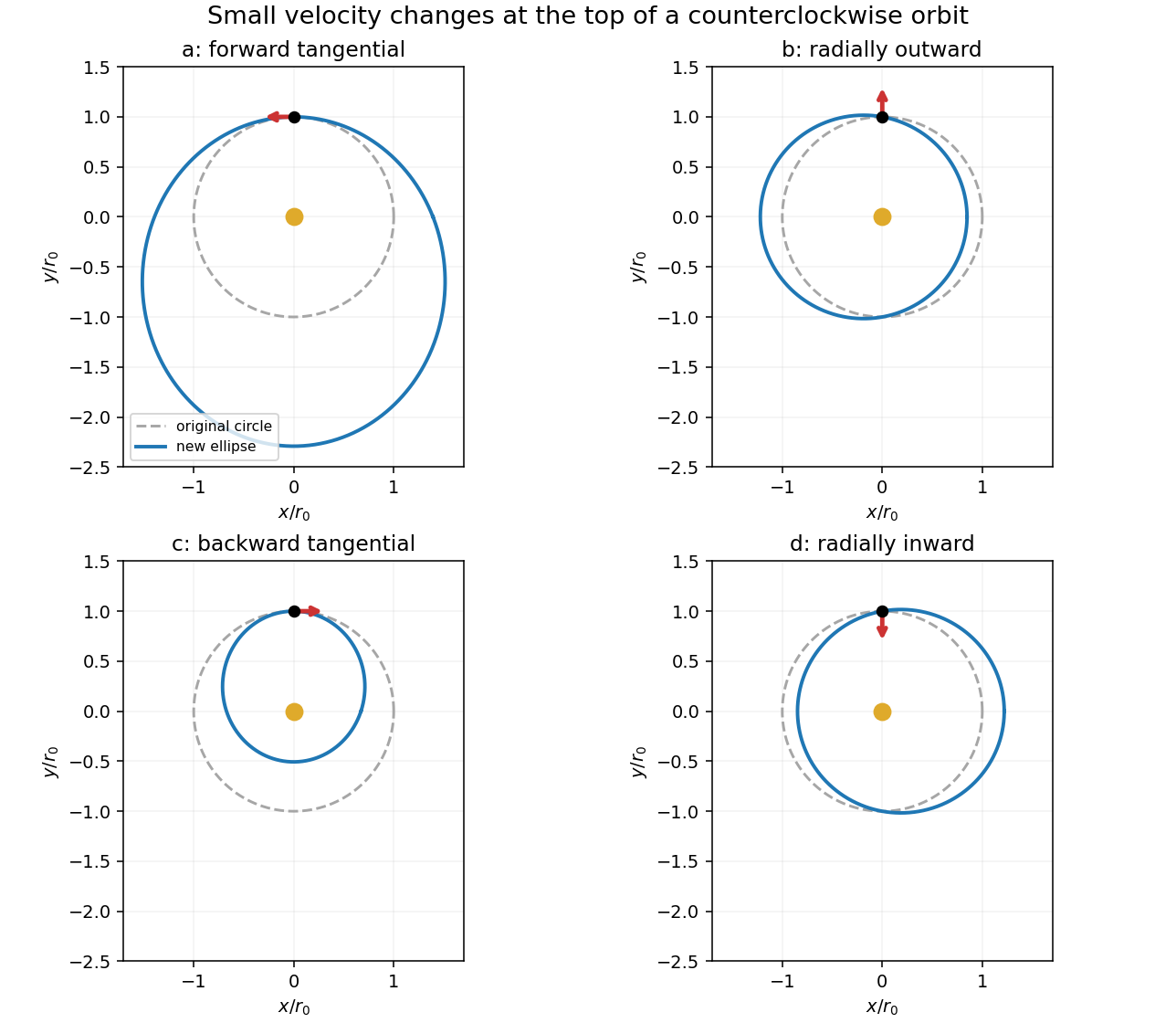
Four Kepler orbits following small tangential or radial velocity changes
. Details. 
Adding tangential velocity along the existing motion increases both orbital energy and angular momentum:For a sufficiently small kick the Kepler orbit remains an ellipse. At the kick point its radial velocity vanishes and its tangential speed exceeds the circular orbital speed, so that point becomes the pericentre. The ellipse extends farther outward than the original circle.
A radial outward kick has no angular impulse about the centre. ThereforeThe initial position is on the outward-moving portion of a bound elliptic Kepler orbit, between pericentre and apocentre, rather than at either turning point. The eccentricity is and the semilatus rectum remains . The orbital energy change is second order: it vanishes to first order in the impulse but is positive for any nonzero kick.
For a small opposing tangential kick,The new tangential speed is less than the circular orbital speed, so the kick point is the apocentre of an ellipse. The orbit falls inward from the original circle. The signs assume ; a large velocity reversal is outside the stated small-impulse regime.
The inward radial kick also leaves angular momentum unchanged and increases orbital energy by . Its eccentricity and semi-major axis equal those in case , but the orientation of its eccentricity vector is reflected about the initial radius. The satellite initially moves inward on its ellipse, toward pericentre. Neither radial kick decreases the orbital energy.
Articles by others on the same topic
There are currently no matching articles.