Work in the material's rest reference frame, with constant speed of sound . For one-dimensional propagation, choose the positive direction along the travelling wave from its emission point toward the receiver. Define and as the signed source and receiver velocities along that same axis. Both use the same sign convention: positive moves the source toward the receiver ahead, whereas positive moves that receiver away from the incoming wave. Assume and , constant velocities, and no source-receiver crossing during the interval considered. Then
To derive this, let be the emission wave period. During , one wave crest travels while the source advances . Successive wavefronts along the chosen direction therefore have wavelengthThey overtake the receiver at relative speed , so counting wave crests gives . This separates the source's effect on wavelength from the receiver's effect on crossing rate. Even with a moving source, a stationary receiver obeys because the wave speed through the material remains .
For a stationary receiver and a source approaching at speed , set and : . For recession choose the positive axis along the departing wave toward the receiver again, so the source has : . For the deliberately chosen values , and , the two predictions areThe corresponding wavelengths are and , compared with for a stationary source. These are calculations for chosen parameters, not reported measurements.
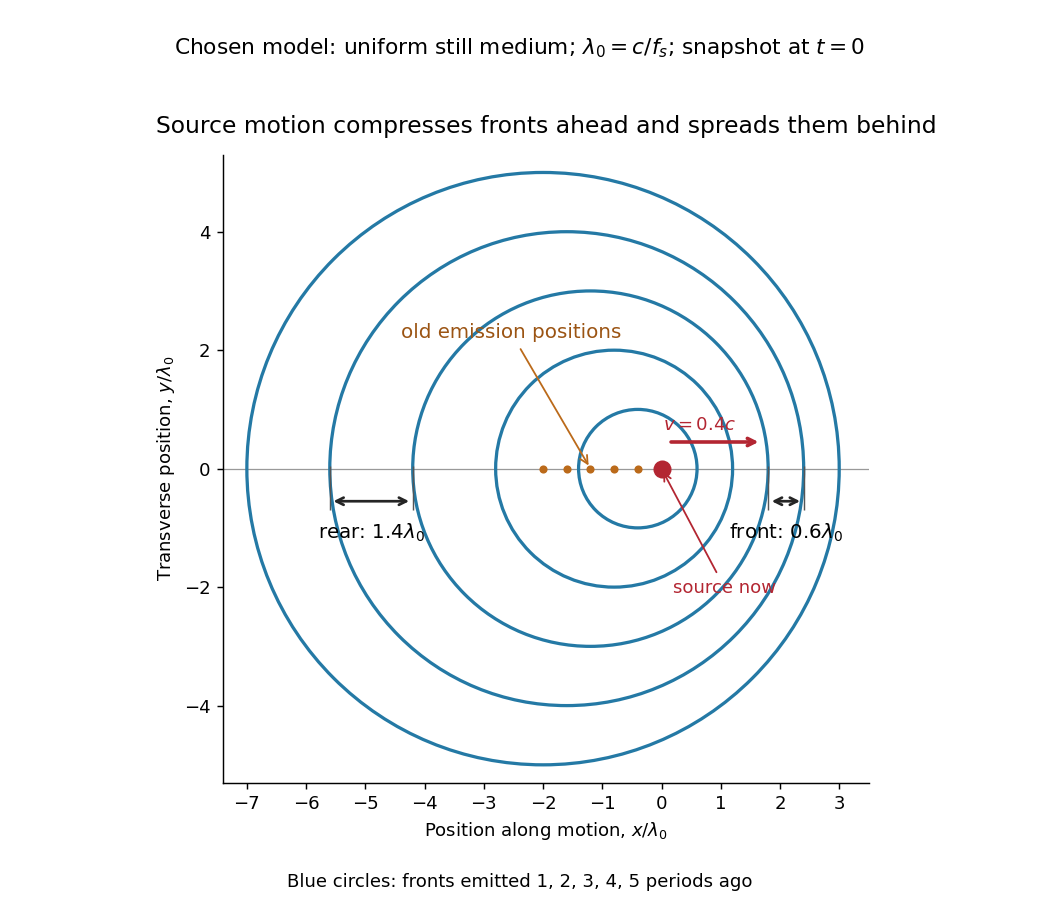
Moving-source wavefront spacing in the classical Doppler effect for sound
. Original linear acoustics model at , with a deliberately enlarged speed ratio for readability. Lengths are measured in . Successive circles are sections of spherical wavefronts emitted one wave period apart; their centres stay at the old emission positions. The forward spacing is and the rear spacing . These chosen parameters differ from the worked example. Details.
A receiver approaching a stationary source at instead has , , giving . Moving away gives . The equal closing speeds do not make these equal to the moving-source values. If both source and receiver move together with , however, the numerator and denominator cancel and . For speeds small compared with , the first-order shift is ; the difference between moving-source and moving-receiver experiments appears beyond this first order.
Articles by others on the same topic
There are currently no matching articles.