FIRAS compared sky radiation with an adjustable internal blackbody using an interferometer and cold bolometers. An external blackbody could cover the sky entrance for measurement calibration. The team adjusted the internal temperature to minimize the difference signal.[ref]
Nobel Lecture: From the Big Bang to the Nobel Prize and beyond by John C. Mather. §III.D, pp.1337–1338; §V.A, p.1341
Comparisons across detectors and mirror strokes tested instrumental errors; sky mapping separated Milky Way emission. John C. Mather's lecture reports a final root-mean-square spectral departure of 50 parts per million of peak brightness. This is neither the preliminary 1990 precision nor a relative error in every spectral bin. Calibration drift and nonideal reference emission required correction.[ref]
Nobel Lecture: From the Big Bang to the Nobel Prize and beyond by John C. Mather. §V.A, p.1342: calibration checks and final spectrum
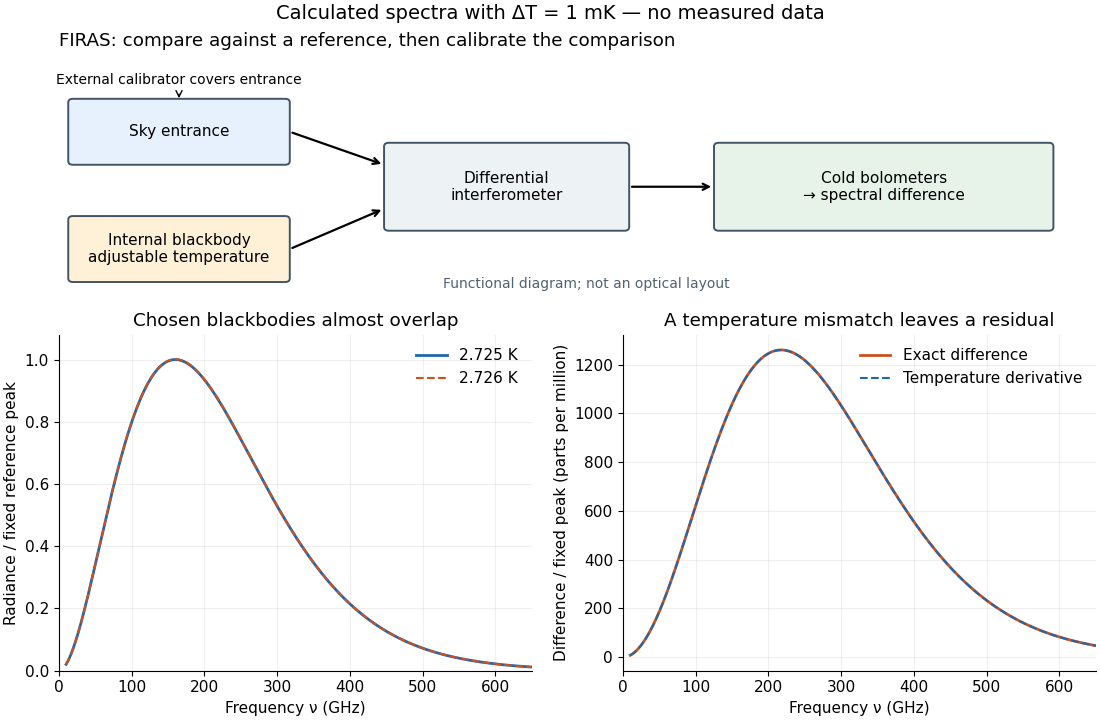

The advantage of a null measurement is that a small difference can be resolved without assigning the same absolute precision to a large detector output. Nevertheless, matching an internal reference is meaningful only after its relation to an independently calibrated blackbody has been tested. A bound on departures from a Planck spectrum constrains energy redistribution after thermal equilibrium; it does not require the cosmic microwave background to have exactly the same temperature in every direction.
For a Planck function expressed as spectral radiance per frequency interval, is the Planck constant, the speed of light and the Boltzmann constant. Differentiating at fixed frequency givesThe proof uses and the chain rule. At low frequency, the multiplier tends to one, recovering the Rayleigh-Jeans law. At high frequency it grows approximately as : the same fractional temperature change has a larger fractional brightness effect on the declining spectral tail.
For an original example choose and . At , , so the first-order fractional residual is . At , , it is . Both spectra are exact blackbodies: this residual is a temperature mismatch, not evidence of a nonthermal spectrum. Fitting temperature before assessing remaining spectral residuals therefore removes a physically distinct degree of freedom. The figure divides by a fixed peak brightness rather than by the rapidly vanishing high-frequency tail.
Articles by others on the same topic
There are currently no matching articles.