Comb self-referencing compares two parts of one optical frequency comb. Coherent broadening supplies an octave, a factor of two in frequency. Second-harmonic generation doubles a red tooth; a photodiode detects its beat with an original blue tooth.[ref]
Introduction to Self-reference Comb Laser by Comblaser Laboratory, Department of Physics, National Central University. Introduction to Self-reference Comb Laser, Fig.1 explanation
Applying the tooth formula givesThe doubled branch carries , while the original high-frequency branch carries : their difference retains exactly one offset.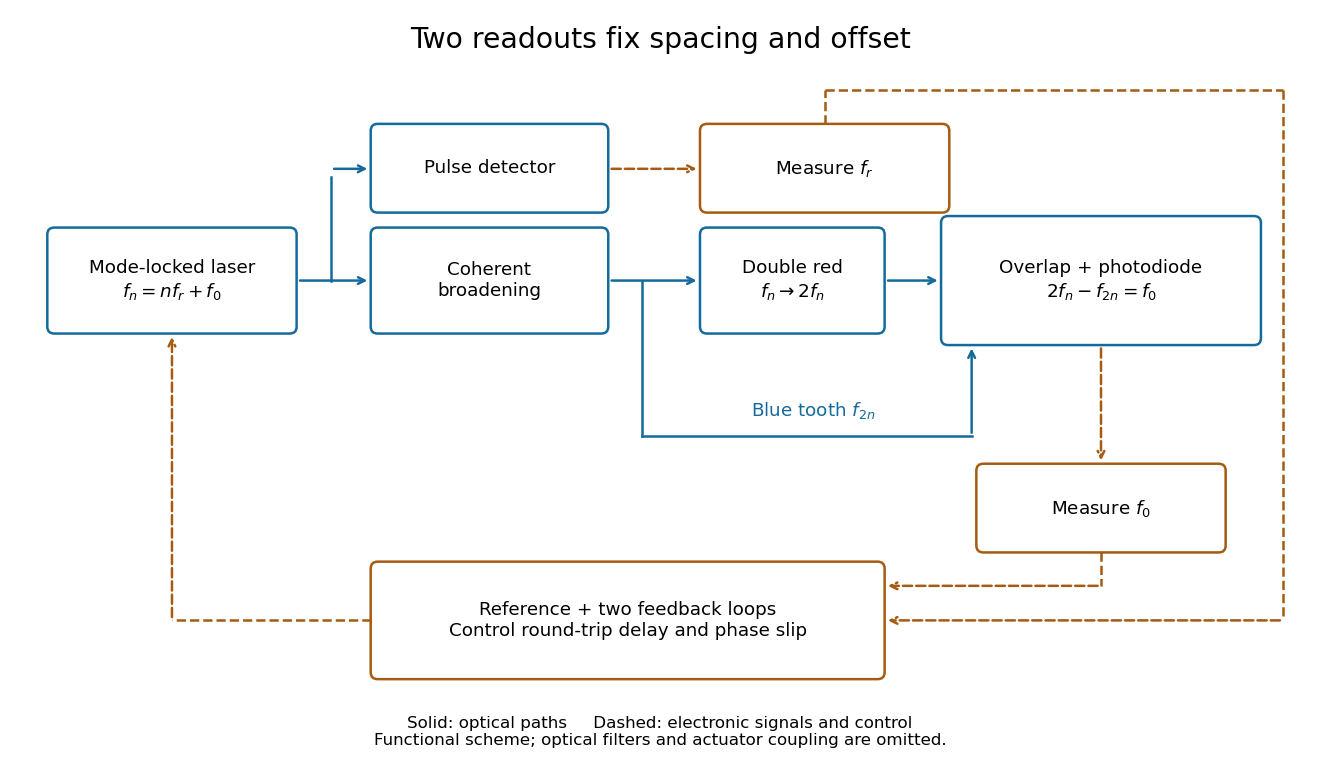
Read the tooth spacing and offset through separate electronic signals
. Original functional comb self-referencing scheme. Solid optical paths bring doubled red light and original blue light to one detector. Dashed electronic paths connect both readouts to a common reference and feedback controls. Actuators can affect both parameters. Details.
The displayed difference uses the order doubled tooth minus original tooth. An ordinary electronic frequency counter returns a nonnegative beat magnitude; spectral selection and known electronic shifts must identify whether it represents , , or a shifted version. Coherent broadening, overlapping photon polarization, spatial alignment and temporal overlap are required. Merely producing a broad patch of colored light does not establish a usable offset signal.
The 2000 experiment prepared optical pulses with a mode-locked laser and broadened them in an air-silica microstructure optical fiber. A wavelength-selective beam splitter separated red and blue light. A nonlinear crystal doubled the red branch; the blue branch received a known acousto-optic shift. A filter selected recombined light for an avalanche photodiode, supplying an electronic beat. Mirror translation controlled repetition frequency; mirror tilt controlled offset with coupled effects. Separate delayed-pulse interference tested programmed phase changes. Alternative envelope fits and unmatched optical reflections were examined as checks and limitations.[ref]
These readouts answer different questions. The electronic beat closes a feedback loop; changing its setpoint and checking the delayed-pulse phase tests whether that control reaches the optical waveform. Neither readout alone establishes the accuracy of an unknown optical frequency. That additionally requires a calibrated time reference, the correct tooth number and beat sign, and checks for missed cycles and drift. The ideal unshifted diagram above omits the experiment's known acousto-optic shift; its actual raw detector frequency must be corrected for that shift before identifying .
Articles by others on the same topic
There are currently no matching articles.