An optical frequency comb has evenly spaced optical spectral lines, or teeth. A mode-locked laser supplies short optical pulses at repetition frequency , the tooth spacing. The carrier-envelope offset frequency positions the whole ruler:Only teeth within the emitted optical spectrum are present; the extrapolated intercept need not be an emitted tooth.[ref]
Passion for Precision by Theodor W. Hänsch. Passion for Precision, p.157: tooth relation
The achievement associated with John L. Hall and Theodor W. Hänsch is a practical bridge between optical frequencies and countable electronic frequencies. Instead of constructing a separate chain of lasers for each optical measurement, a broad comb supplies many linked reference teeth. Stable lasers, short optical pulses and strong nonlinear optics in optical fibers came together around 1999–2000.[ref]
Nobel Lecture: Defining and measuring optical frequencies by John L. Hall. Nobel Lecture: Defining and measuring optical frequencies, pp.1288–1291: chains and comb development
Mode locking fixes relative phases between longitudinal normal modes of a laser, allowing short optical pulses. The same optical spectrum with wandering relative phases would not supply that stable pulse train.[ref]
Passion for Precision by Theodor W. Hänsch. Passion for Precision, p.157: coupled modes
Here is an original finite-mode model, with the convention that a positive frequency has time dependence :These field coefficients follow a Gaussian function and have aligned phases at . Choose and write . Since for every integer ,The pulse light intensity repeats every although the field needs four periods to repeat. At the pulse centers, , , and . A detector of light intensity alone therefore cannot distinguish this offset from zero. This model has far fewer teeth than a practical optical comb; its normalized time and frequency scales are chosen to make the carrier oscillations visible.
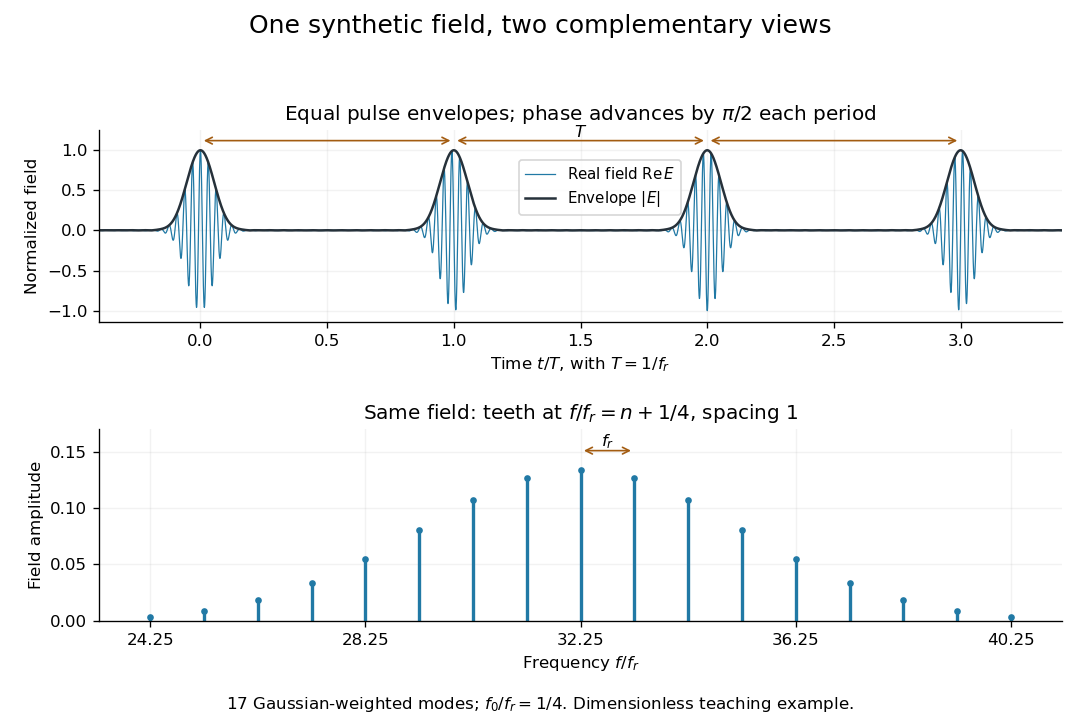

A short proof of the converse uses the Fourier series. If , then is periodic with period . Its Fourier series has frequencies ; restoring the removed factor shifts every tooth by . A finite observation time broadens the spectral peaks; it does not change this ideal infinite-train relation.
The carrier-envelope offset frequency expresses the carrier's pulse-to-pulse phase slip relative to its envelope. Fixing the repetition frequency leaves this slip undetermined.[ref]
Defining and Measuring Optical Frequencies: The Optical Clock Opportunity – and More by John L. Hall. Defining and Measuring Optical Frequencies: The Optical Clock Opportunity – and More, p.131: offset
With the positive-exponential convention derived above, modulo . Changing translates every tooth equally; differentiating at fixed givesThus at , a chosen change in spacing moves that tooth by if stays fixed. The large multiplier is why a stable-looking pulse train is insufficient for accurate optical metrology.Comb self-referencing compares two parts of one optical frequency comb. Coherent broadening supplies an octave, a factor of two in frequency. Second-harmonic generation doubles a red tooth; a photodiode detects its beat with an original blue tooth.[ref]
Introduction to Self-reference Comb Laser by Comblaser Laboratory, Department of Physics, National Central University. Introduction to Self-reference Comb Laser, Fig.1 explanation
Applying the tooth formula givesThe doubled branch carries , while the original high-frequency branch carries : their difference retains exactly one offset.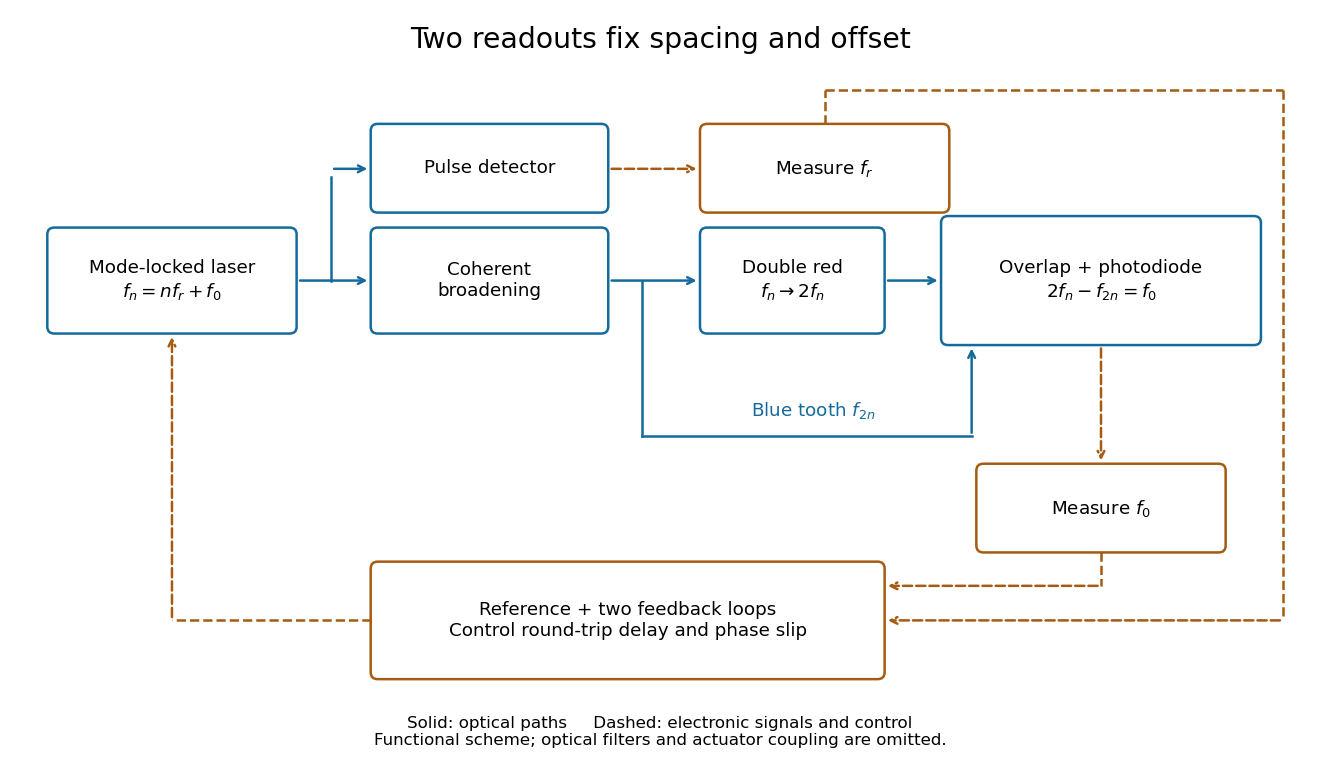
Read the tooth spacing and offset through separate electronic signals
. Original functional comb self-referencing scheme. Solid optical paths bring doubled red light and original blue light to one detector. Dashed electronic paths connect both readouts to a common reference and feedback controls. Actuators can affect both parameters. Details.
The displayed difference uses the order doubled tooth minus original tooth. An ordinary electronic frequency counter returns a nonnegative beat magnitude; spectral selection and known electronic shifts must identify whether it represents , , or a shifted version. Coherent broadening, overlapping photon polarization, spatial alignment and temporal overlap are required. Merely producing a broad patch of colored light does not establish a usable offset signal.
The 2000 experiment prepared optical pulses with a mode-locked laser and broadened them in an air-silica microstructure optical fiber. A wavelength-selective beam splitter separated red and blue light. A nonlinear crystal doubled the red branch; the blue branch received a known acousto-optic shift. A filter selected recombined light for an avalanche photodiode, supplying an electronic beat. Mirror translation controlled repetition frequency; mirror tilt controlled offset with coupled effects. Separate delayed-pulse interference tested programmed phase changes. Alternative envelope fits and unmatched optical reflections were examined as checks and limitations.[ref]
These readouts answer different questions. The electronic beat closes a feedback loop; changing its setpoint and checking the delayed-pulse phase tests whether that control reaches the optical waveform. Neither readout alone establishes the accuracy of an unknown optical frequency. That additionally requires a calibrated time reference, the correct tooth number and beat sign, and checks for missed cycles and drift. The ideal unshifted diagram above omits the experiment's known acousto-optic shift; its actual raw detector frequency must be corrected for that shift before identifying .
Mix an unknown single-frequency laser with a nearby comb tooth on a photodiode. Define the signed beat , soThe beat arises from the cross term in light intensity:An electronic detector can follow this slow difference even though it cannot resolve either optical oscillation. The square-law expression also shows why a real-valued intensity trace by itself loses the sign of . A small known upward shift of the chosen tooth decreases when the unknown lies above it and increases when it lies below, provided the tooth assignment remains unchanged.
For an original example, stipulateThen and . Choosing the opposite sign would give instead. The stipulated optical frequency is countable because the large optical value is expressed using the integer and three electronic frequencies; the diagram's two controls establish the comb, and this additional beat places the unknown against it.
Both comb readouts use one calibrated microwave reference. Feedback fixes and , determining each tooth once is identified. A frequency counter measures the slow beat, transferring the calibration to the optical frequency.[ref]
One beat magnitude does not tell us the integer . In the example, every proposed optical frequency produces the same signed beat with its corresponding tooth. A coarse independent optical measurement can select the integer: once the beat sign is known, an error bound below suffices if the candidate is selected by nearest distance.
There is also a useful two-spacing check. Keep the unknown laser and fixed, track the same tooth continuously, and increase by a stipulated . Its frequency rises by , so the signed beat falls from to . HenceThis inference fails if the unknown drifts appreciably, the offset changes unnoticed, the beat sign is lost, or the tracker jumps to another tooth. The assumed tooth motion stays well below half the spacing in this example. If also changes by a measured amount, use .
For a fixed verified tooth number, the first-order frequency error is . Errors in these readings can be correlated because they share a reference. A small beat uncertainty therefore does not imply the same absolute optical accuracy: the reference's calibration and the factor remain in the error budget. A wrong tooth number is a separate discrete error, not a small correction. The beauty of the comb is that two controlled parameters organize millions of optical reference points, while the unknown's position is read electronically.
Articles by others on the same topic
There are currently no matching articles.