Let , where the ambient topological space is Hausdorff and is compact in its subspace topology. Then is a closed set in : the complement is an open set in . The ambient space need not be compact. For example, is a compact closed interval in the non-compact Hausdorff real line.[ref]
The ambient Hausdorff hypothesis matters even when itself is Hausdorff. In the Sierpiński space , the open sets are , so the closed sets are . Thus is compact and Hausdorff in its one-point subspace topology, but is not closed in : its complement is not an open set. Every open neighborhood of contains , so separation from fails. In contrast, the discrete topology on the same underlying set is Hausdorff and makes both singletons closed.
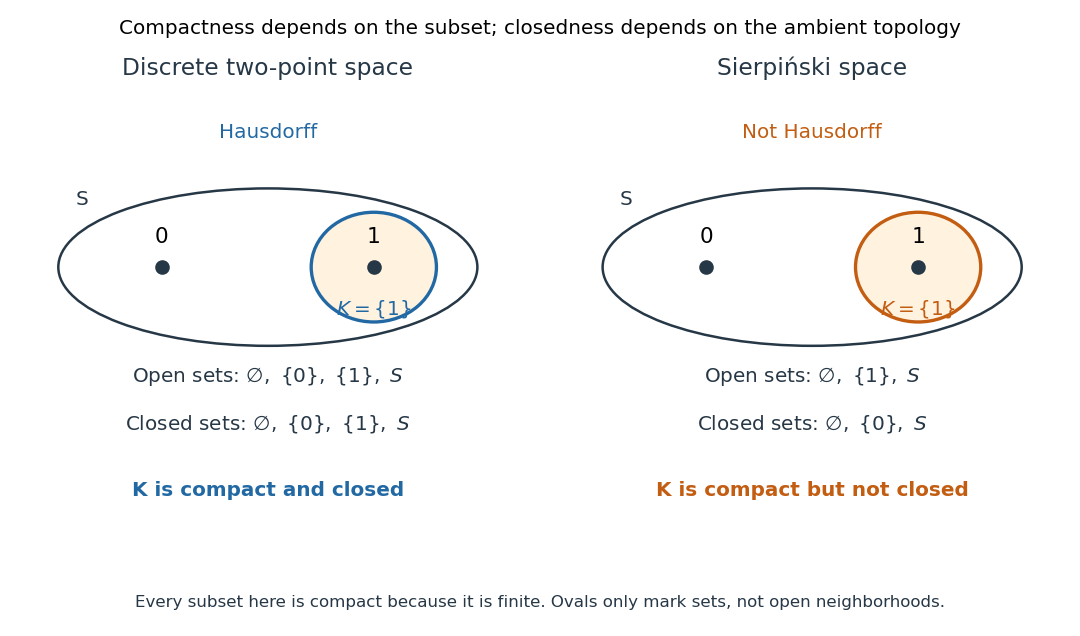
A compact subset is closed in the two-point discrete space but need not be closed in the Sierpiński space
. Details. 
The diagram lists every open set and closed set, so the distinction can be checked directly. All subsets in both panels are compact: for any open cover of a finite set, choose one covering open set per point, obtaining a finite subcover. Compactness alone therefore cannot distinguish the two panels.
Here is the finite-selection mechanism in the general proof. For and each , the Hausdorff property gives disjoint open neighborhoods of and of . The give an ambient open cover of . Select a finite subcover and setThen , , and . The finite intersection makes an open set; an infinite intersection would not guarantee this. Thus every point of has an open neighborhood contained in that complement, proving that is closed. The empty set is already closed.
This theorem combines with the continuous image of a compact space theorem to make every continuous map from a compact space to a Hausdorff space a closed map: a closed subset of its domain is compact, and its image is compact and hence closed in the target. This is the reason the inverse in the compact-to-Hausdorff continuous bijection theorem is continuous. The converse implication, from closed to compact, needs additional hypotheses: the real line is closed in itself but not compact; in a compact space, every closed subset is compact.
Articles by others on the same topic
There are currently no matching articles.