Use local east, north, and up unit vectors , with . In a spherical-Earth approximation at geographical latitude , the angular velocity has components . Expanding the cross product for relative velocity givesThese are Coriolis acceleration components, not the total acceleration. For horizontal motion, the horizontal part is , where the Coriolis parameter is . Thus northward motion in the northern hemisphere has an eastward Coriolis acceleration, to the right of its velocity; in the southern hemisphere the horizontal turning is to the left. At the equator , but the full Coriolis acceleration need not vanish: vertical or eastward motion still couples through .
For a numerical example, take the Earth rotation rate , geographical latitude , and an initially northward relative velocity . Then
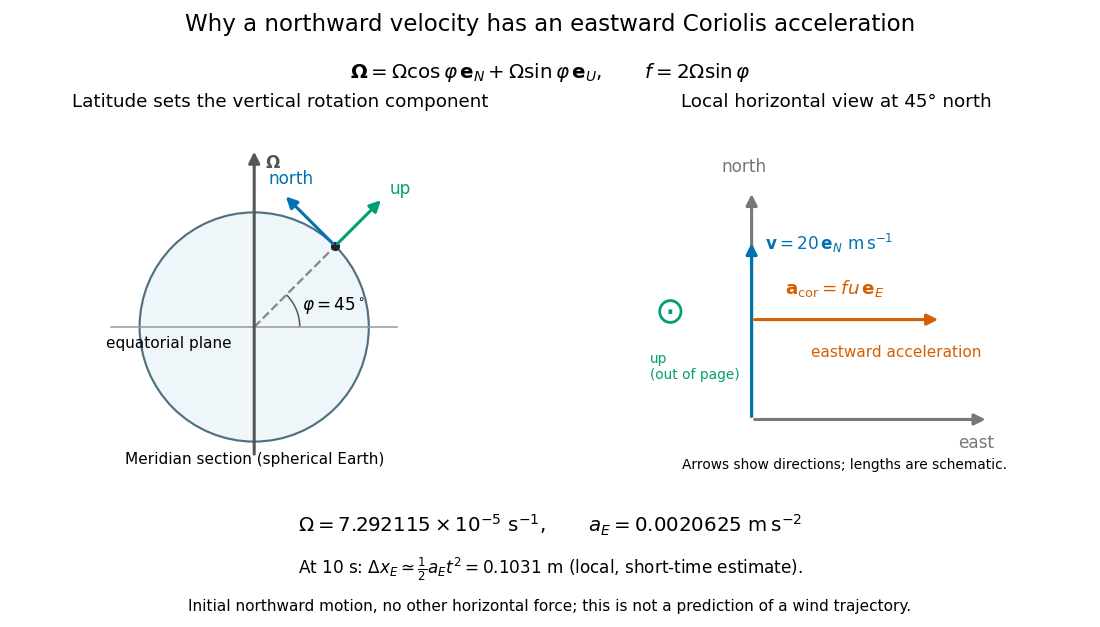
Latitude, local rotation geometry, and the scale of eastward Coriolis acceleration for northward motion
. Details. 
For a local, short-time estimate with no other horizontal force and zero initial eastward velocity, hold the initial northward velocity in the leading term: . At this gives about eastward. It assumes nearly fixed local axes and geographical latitude, negligible changes of height, and . It is not a complete wind trajectory: pressure gradients, friction, and evolving velocity must enter an atmospheric equation of motion. The effective gravity in a rotating frame already combines ordinary gravity with the steady terrestrial centrifugal acceleration.
At first order in Earth's rotation, vertical velocity gives east acceleration . A launch returning to its initial height lands westward, while a drop from the launch's maximum height lands eastward with one quarter the displacement magnitude. These results assume constant effective gravity, no air drag and no horizontal velocity in the Coriolis term. The northern component vanishes at this order.
Articles by others on the same topic
There are currently no matching articles.