A coupling of probability distributions is a pair of random variables with those marginal distributions. On a finite set, and more generally on a standard Borel space, the least achievable mismatch isA maximal coupling attains the minimum; maximal here refers to agreement. An arbitrary coupling can have a much larger mismatch.[ref]
Markov Chains and Mixing Times, second edition by David A. Levin and others. §4.2, Example 4.6 and Proposition 4.7, printed pp. 49–52: finite-state coupling and common-mass construction
For the four-outcome example, assign the following joint probability mass: gets , gets , gets , and gets . The remaining must have ; place on and on . Row sums give , column sums give , and the diagonal contains . Agreement can reach 70%; mismatch cannot fall below 30%.
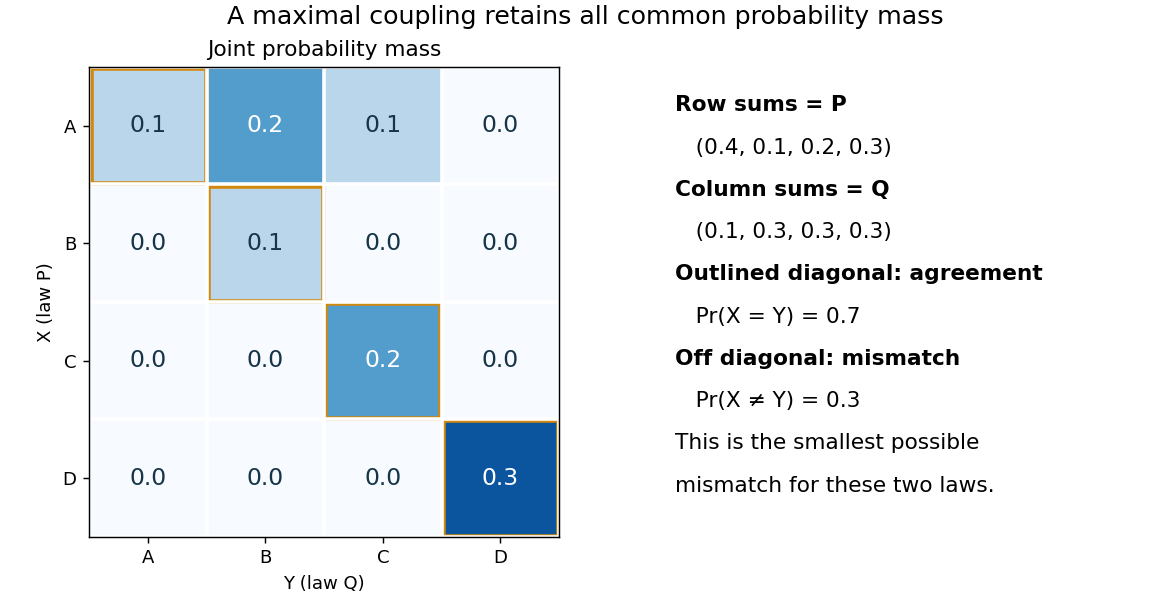

To see the lower bound, for any event ,The two indicator functions agree whenever . To attain the bound on a finite set, keep mass at and couple the remaining excesses. The two residual probability distributions live on disjoint subsets, so their part necessarily mismatches. When the probability distributions are identical, the residual part disappears entirely.
This is a choice of joint construction, not a claim that independently drawn observations are usually equal. Two independent random variables with the same continuous probability distribution can disagree with probability one even though their total variation distance is zero. The construction of a maximal coupling deliberately introduces statistical dependence to reveal how similar the marginal laws are.
Articles by others on the same topic
There are currently no matching articles.