The measuring electric current crosses the layer planes. This geometry motivates the serial-layer paths in the two-current resistor model. A quantitative material calculation can also require interface electrical resistances, spin relaxation and spin accumulation; the circuit below intentionally isolates a smaller set of assumptions.
Consider two identical magnetic layers separated by a nonmagnetic layer, between reservoirs that impose the same terminal electric potential difference on both spin channels. Neglect spin-flip scattering and assume each layer obeys Ohm's law. In a magnetic layer, define positive channel electrical resistances . Let the spacer contribute to each channel. These are circuit parameters, not measured iron or chromium resistivities.
For parallel layer magnetizations, one channel meets and the other . For opposite layer magnetizations, each meets one , one , and the spacer. The two channels share the same terminal electric potential difference and run in parallel. Writing givesThe inequality is algebra, given the specified network. It shows how a difference between spin-channel responses can yield a difference between magnetic configurations even though all the constituent resistors are ohmic.
For chosen , , , the parallel channels have total electrical resistances and , while the opposite-alignment channels each have . Thus and . At a common terminal electric potential difference , the total electric currents are and , respectively.
A quoted percentage needs its denominator. Define the resistance increase relative to the low-resistance state by . The decrease relative to the high-resistance state is instead . For ,The chosen example has and : a increase and a decrease describe the same pair of resistances. A paper reporting a field-induced drop relative to its zero-field value need not be using the same percentage convention as a plot normalized by .
Define a dimensionless channel contrast and spacer ratio . Positive give , and substitution gives the displayed expression. Equal channel responses, , eliminate the model's magnetic-configuration signal. Increasing the common spacer resistance at fixed increases the denominator and decreases .
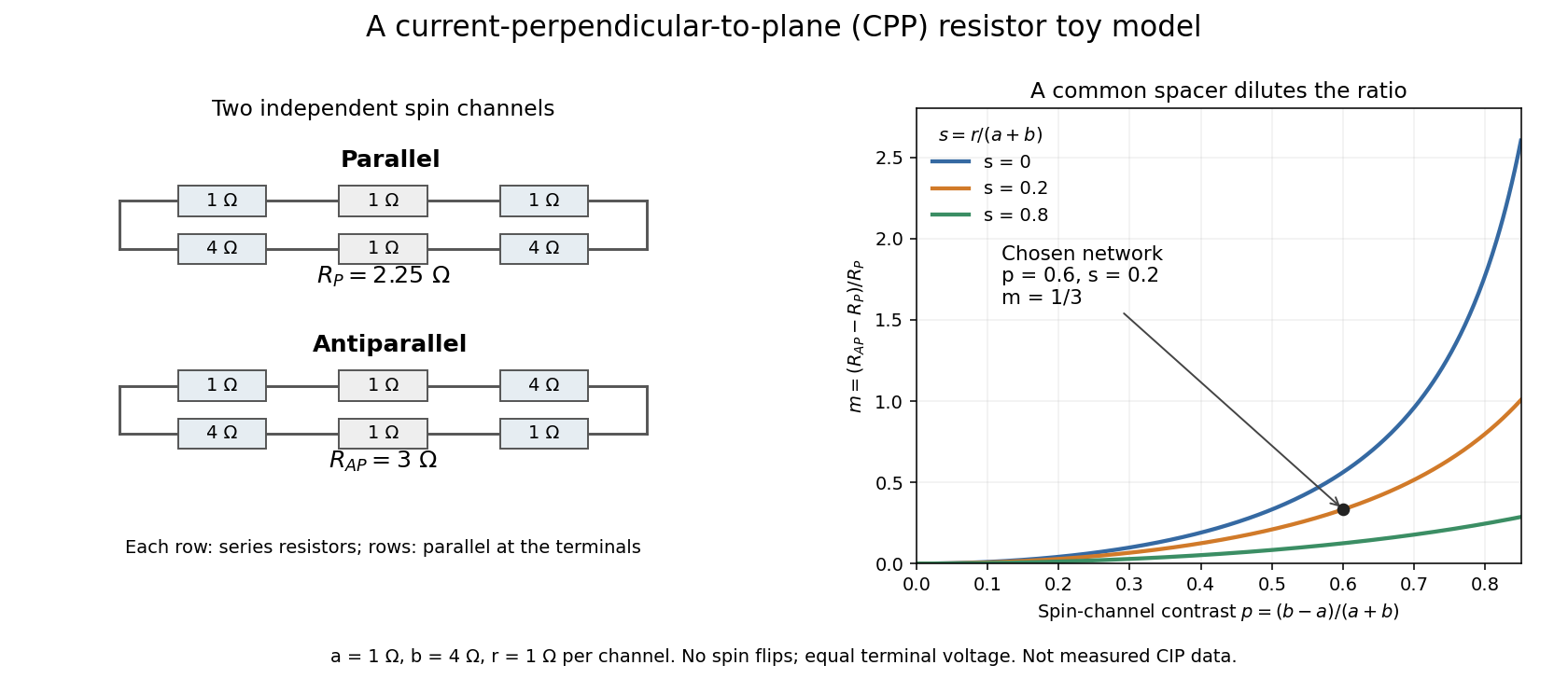

This is a controlled comparison within the model. In an actual multilayer, changing a spacer thickness can change the magnetic coupling and the interfaces as well as electrical transport. Spin-flip scattering also mixes the channels that the calculation kept independent.
Let the first layer have channel resistances and the second , with a common spacer . Define . The same circuit rules giveSubtracting their numerators gives . The sign therefore depends on whether the two layers favor the same global spin channel. With , and , the values reverse: , . The model's ratio is then . Positive magnetoresistance was a consequence of the identical-layer assumptions, not a theorem about every two-channel network.
Articles by others on the same topic
There are currently no matching articles.