A dark-loss control for STY-BODIPY autoxidation distinguishes initiation-associated chemical loss from changes caused by illumination, handling or the measurement itself. The control must preserve the relevant experimental conditions while accounting for the photons needed to read the sample. “Dark” handling followed by an optical measurement does not mean zero photon exposure.
The primary antioxidant method uses STY-BODIPY as a co-autoxidizing signal carrier monitored by visible-light spectrophotometry.[ref]
A Continuous Visible Light Spectrophotometric Approach To Accurately Determine the Reactivity of Radical-Trapping Antioxidants by Evan A. Haidasz and others. Abstract
The manufacturer describes monitoring absorbance loss at 571 nm.[ref] That signal does not label its own cause.An original diagnostic design crosses initiation absent/present with low-exposure handling/continuous illumination. Let be the matched fractional absorbance loss, where marks initiation and illumination. The interaction contrast isIt is zero under a simple additive loss model. A nonzero result shows that subtracting an independently measured light-only loss may not isolate the initiated process.
For stipulated losses , , and , the additive prediction for the last condition is 0.16, while the observed-model value is 0.20. The interaction is 0.04. These are constructed observations, not published STY-BODIPY data. They illustrate why photobleaching and chemical oxidation need not combine as independent corrections.
Illumination-initiation interaction in dye-loss controls can arise in a measurement model without being uniquely diagnosed by this contrast. Temperature, oxygen availability and exposure timing also need matching. Compare spectral changes and final readout conditions, rather than assuming every difference is photobleaching.
A proposed control series includes carrier without initiation, initiation without test antioxidant and test material without carrier where its own absorbance could contribute. Record readout duration and photon exposure for each condition. A dark endpoint measured once and an illuminated sample monitored repeatedly have different acquisition histories. Interpret their difference using that history before converting absorbance loss into antioxidant kinetics or trapping capacity.
Illumination-initiation interaction in dye-loss controls tests whether changing illumination has the same response in the absence and presence of chemical initiation. A crossed factorial design separates the four conditions. For mean fractional losses , with indicating initiation and illumination, the contrastmeasures statistical interaction on the fractional-loss scale. In the STY-BODIPY assay context, the optical observable is carrier loss during co-autoxidation, not a direct label of its chemical cause.[ref]
A Continuous Visible Light Spectrophotometric Approach To Accurately Determine the Reactivity of Radical-Trapping Antioxidants by Evan A. Haidasz and others. Abstract: visible-light spectrophotometric co-autoxidation and kinetic/stoichiometric interpretation
The crucial qualification is response-scale dependence of dye-loss interactions. Consider an original first-order survival model with fully additive rate constants,ThenFor positive , and , this is negative even though the rates have no interaction term. With stipulated , in reciprocal time units and , the losses are , , and , giving . Saturation of fractional loss produces the contrast without a new chemical coupling.
On the transformed scale , the same noiseless model gives and zero interaction contrast. This transformation is appropriate only when the measured signal genuinely follows the stated survival model; product absorption or changing backgrounds can invalidate it. A transformed zero is therefore a conditional model check, not proof of a reaction mechanism.
For independent replicate measurements, the variance of the estimated loss contrast is . Four replicates per condition with common standard deviation 0.01 give a contrast standard uncertainty of 0.01. The modeled contrast above is smaller than that scale. Shared references instead introduce covariances that must be retained.[ref]
Match temperature, oxygen access, timing and readout exposure across conditions. Specify the response scale before interpreting a nonzero contrast as evidence about photobleaching or initiated oxidation.
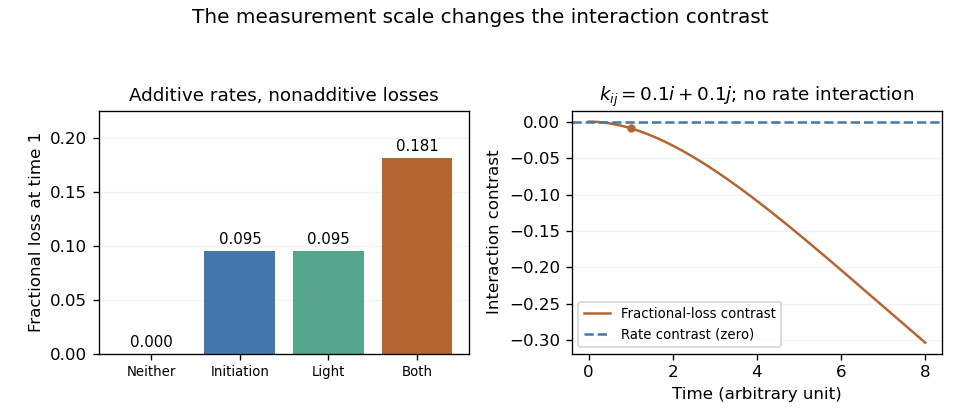
An original additive-rate model gives a negative interaction contrast on the fractional-loss scale. Transforming the same ideal observations back to rates gives zero rate interaction.
Details. 
A dye-loss interaction is a departure from additivity on a specified response scale. Changing from fractional loss to survival, logarithmic survival or a fitted rate can change that departure. The contrast must therefore be defined before it is interpreted as evidence about coupled chemical mechanisms.
For a crossed initiation/illumination experiment, write fractional losses at a common observation time and defineAn original example takes losses . The contrast is . Yet the surviving fractions obey , with . They are exactly multiplicative on the survival scale.
For first-order survival , transform to . The rate-scale interaction isThe example gives . More generally, additive rates yieldwhich is negative for positive . The fractional-loss ceiling creates the contrast without an additional rate interaction.
The transformation also changes noise. First-order uncertainty propagation gives , so near-complete loss can strongly amplify uncertainty. In addition, the mean of a nonlinear transformation need not equal the transformation of the mean; Jensen's inequality makes that distinction explicit. Averaging transformed replicates and transforming an average need not produce the same result.
The STY-BODIPY readout is a coupled oxidation signal. Its primary method distinguishes radical-trapping kinetics from stoichiometry.[ref]
A Continuous Visible Light Spectrophotometric Approach To Accurately Determine the Reactivity of Radical-Trapping Antioxidants by Evan A. Haidasz and others. Abstract, co-autoxidation method and kinetic/stoichiometric interpretation
A rate transformation requires a justified survival model after product absorption and background have been addressed. Report both the response definition and the uncertainty model; a transformed zero is conditional evidence about that model, rather than a unique identification of the chemistry. Articles by others on the same topic
There are currently no matching articles.