
Characteristic X-ray 2026-10-18
A Characteristic X-ray comes from an electronic transition filling an inner electron shell vacancy. The emitted photon carries the difference between atomic energies. Vacancy creation by direct Electron impact requires kinetic energy above the shell's binding energy, exceeding the line energy. Higher tube voltage need not move the spectral line.[ref]
Chapter 5: X-Ray Production (teaching slides) by K. P. Maher. Diagnostic Radiology Physics: A Handbook for Teachers and Students; IAEA Chapter 5, §§5.2.2–5.2.3: shell vacancy, binding-energy threshold and characteristic radiation
An original stipulated shell model illustrates the distinction without using measured atomic data. Let positive binding energies be and , ignoring relaxation corrections. Filling a K-shell vacancy from the L shell releasesAn tube can energetically emit a bremsstrahlung photon, yet cannot directly remove this K-shell Electron. A tube can create that vacancy by Electron impact; if radiative filling occurs, the line is still , not . This argument concerns direct Electron impact and an initially unexcited target; it does not describe every possible excitation route.
X-ray tube 2026-10-18
An X-ray tube accelerates Electrons from a negative cathode to a positive target anode. A heated cathode supplies Electrons by thermionic emission; the evacuated envelope limits collisions before the target. This differs from the gas-discharge tube in the Röntgen X-ray discovery experiment.[ref]
Chapter 5: X-Ray Production (teaching slides) by K. P. Maher. Diagnostic Radiology Physics: A Handbook for Teachers and Students; IAEA, Chapter 5: X-Ray Production, §§5.2–5.3.2; authored teaching slides, inspected transcription
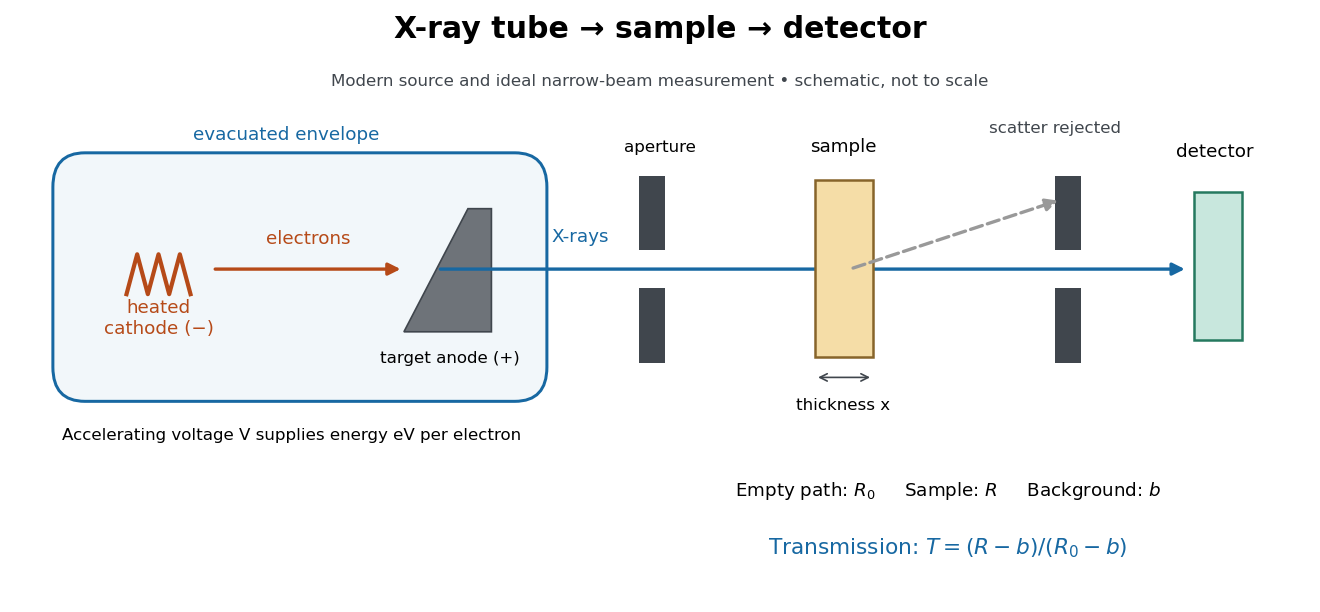

In bremsstrahlung, an Electron changes velocity in the target's electric fields, emitting a photon while losing kinetic energy. Different encounters allow a continuous range of transferred energies. This is distinct from the discrete electronic transitions producing Characteristic X-rays.
Changing the accelerating voltage changes the available kinetic energy per Electron and the X-ray tube cutoff. Changing the number of arriving Electrons changes the number of opportunities for photon emission. These are distinct controls: a larger electric current does not by itself give each Electron more energy. For an original idealized budget, and tube electric current give electrical power and arrival rate , where is the elementary charge. This is input power, not emitted X-ray power; obtaining the latter requires a conversion efficiency.