A divided difference table arranges divided differences by starting interpolation node and order . Its base column is ; every later entry uses two neighboring entries from the previous column:The denominator spans all interpolation nodes of that entry, even though the numerator uses adjacent table entries. The interpolation nodes must be distinct; they need not be equally spaced or sorted.[ref]
3.3 Interpolation. NIST Digital Library of Mathematical Functions; §3.3(iii), equation 3.3.34: initial values and divided-difference recurrence for distinct nodes
Take the polynomial at the interpolation nodes , giving values . Its divided difference table isThe first divided differences are , , and . The second divided differences use the wider spans: and . The third divided difference is . Reading the top row gives the Newton polynomial coefficients , rather than all the entries in any one column.
The resulting Newton polynomial grows through four partial interpolants:At , misses by ; the correction supplies exactly there and vanishes at the earlier interpolation nodes . At , misses by ; the correction supplies exactly there and vanishes at all three earlier interpolation nodes. Each added term therefore preserves the previous agreements while satisfying the next one.
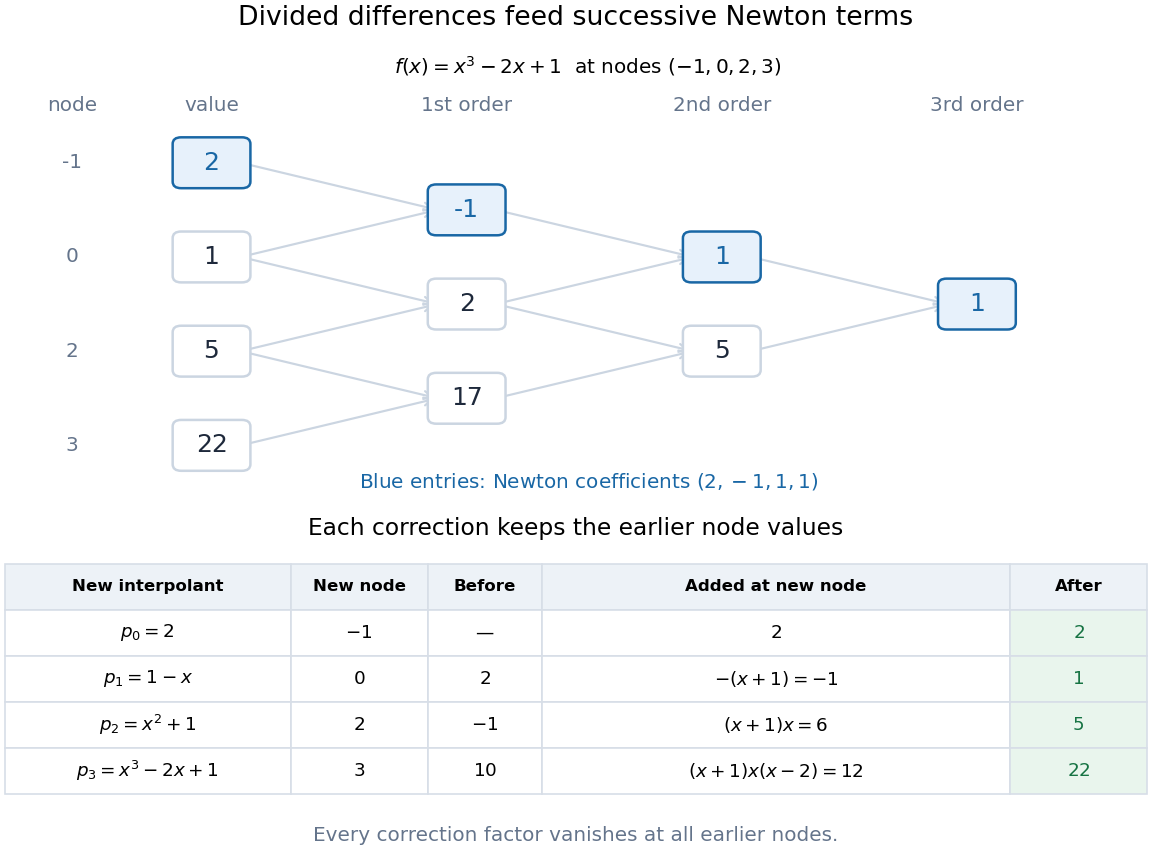
Divided-difference triangle and successive Newton interpolants for the constructed polynomial x cubed minus 2x plus 1
. Details. 
For interpolation nodes, the triangle contains recurrence steps. Once the top row is known, nested evaluation of the Newton polynomial uses only multiplications and additions per argument. The triangle organizes the work; the factors explain why the construction works.
Articles by others on the same topic
There are currently no matching articles.