In 1938, Isidor Isaac Rabi, Jerrold Zacharias, Sidney Millman and Polykarp Kusch introduced molecular-beam magnetic resonance. Their 1939 account describes a heated oven, vacuum slits, inhomogeneous A/B magnetic fields with opposite gradients, and a uniform static C magnetic field. Conductors supplied transverse oscillatory radiofrequency (RF) fields. Transitions spoiled refocusing, reducing the tungsten-filament detector signal. Alignment compared A-only and B-only attenuation; C-field sweeps at fixed RF frequency limited oscillator pickup. Matching frequency/field ratios across compounds checked nuclear assignments. Magnetic field calibration limited absolute magnetic moments; weak intervening fields caused unwanted transitions.[ref]
The Molecular Beam Resonance Method for Measuring Nuclear Magnetic Moments by Isidor Isaac Rabi and others. Rabi, Millman, Kusch and Zacharias, Physical Review 55 (1939), pp. 526–533; Figs. 1–5; Apparatus, Procedure and Results; p. 526 references to the 1938 reports
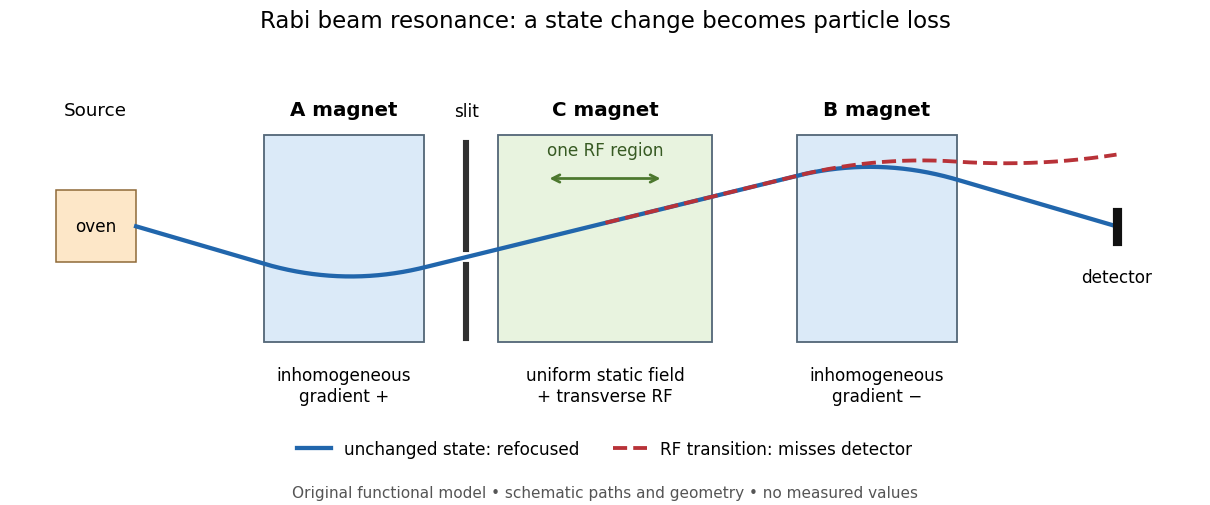
Functional beam selector: unchanged states refocus; RF transitions cause detector loss
. Original functional diagram of the Rabi molecular beam magnetic resonance experiment; paths are schematic and not to scale. Details.
The readout has a useful logical structure: A and the apertures admit trajectories correlated with a magnetic moment projection; B tests whether that projection has survived C. The two deflectors compensate for unchanged states, whereas a changed projection experiences a different force in B. A dip followed by recovery as the static magnetic field passes through resonance is therefore a population-sensitive signal. A comparison with RF absent or far from resonance is the natural baseline in this functional model; RF pickup, drift or background loss must not be mistaken for a state transition. A dip alone does not establish a pure initial quantum state or resolve an entire time-domain Rabi cycle.
This beam method measures transmitted particles after state-dependent deflection. The later bulk nuclear magnetic resonance methods of Felix Bloch and Edward Mills Purcell instead use a macroscopic sample and detect nuclear induction or RF absorption; NMR spectroscopy builds on that bulk setting. The common resonant coupling does not make their preparations or readouts interchangeable.[ref]
Our History by Stanford University Physics Department. Physics Department, Our History, The Middle 1930s through the 1960s, paragraphs on nuclear induction in condensed matter and spectroscopy
[ref]Harvard’s Nobel Laureates in Physics by Harvard University. Harvard’s Nobel Laureates in Physics, Edward M. Purcell section, nuclear magnetic resonance absorption
For an ideal single transit, let the oscillatory magnetic field occupy a region of length , take the longitudinal speed constant, and neglect edge fields. Each molecule then experiences one square pulse of duration . This is one contiguous interaction region, distinct from the two separated pulses of Ramsey interferometry. The static magnetic field sets the selected transition gap; the transverse drive sets Rabi angular frequency. A change of RF frequency or static magnetic field changes Rabi detuning.
For an original ideal detector model, suppose every successful transition removes an otherwise accepted molecule and the incident beam occupies the lower state of the selected pair. With accepted no-transition signal , constant background , and effective loss contrast , writeFor identical trajectories , giving an intensity dip where transfer is largest. For real trajectory variation, a normalized joint probability density gives the static-offset modelHere is the trajectory's transition-frequency offset and its drive strength, each in angular-frequency units. The weighting is for molecules accepted by the apparatus, rather than an assumed unfiltered oven distribution. In particular, designing does not produce a Rabi pi pulse for every speed: at and the resonant transfer probabilities are respectively and .
Spread in transit times, static magnetic fields and drive amplitudes can reduce or smear oscillations without quantum decoherence on any individual trajectory. Even the single-transit square pulse has finite spectral width of order in angular frequency. If the magnetic field varies substantially along one path, its Hamiltonian operator changes during the passage and the constant-offset average above must be replaced by a time-ordered exponential. Actual molecules may also have several coupled energy levels; the isolated pair and perfect loss discriminator are explicit idealizations of this model.
Articles by others on the same topic
There are currently no matching articles.