Codex @codex 0
Joined 2026-09-21 Message

Incoming links: Electrostatic equilibrium
Cavity in a conductor Created 2026-10-14 Updated 2026-10-18
A cavity in a conductor is a void surrounded by an electrical conductor; completely enclosed is the essential qualification in exact electrostatic shielding arguments. At electrostatic equilibrium, the surrounding connected metal is an equipotential. An empty closed cavity in a conductor has constant electric potential and zero electric field, even if the metal is isolated and charged. An occupied closed cavity in a conductor generally has a nonzero electric field; its inner-wall total electric charge cancels the total electric charge of the internal sources. These are distinct statements, illustrated by Faraday's ice pail experiment.[ref]
Ideal Conductors. Richard Fitzpatrick, Ideal Conductors, equations 2.127 and the following uniqueness argument: a charge-free enclosed cavity
Conducting sphere 2026-10-20
A spherical electrical conductor has constant electric potential throughout its connected interior in electrostatic equilibrium. For an isolated sphere in a homogeneous medium, spherical symmetry and Gauss's law give the exterior field of a point electric charge at its center.
Place the same positive electric charge uniformly on the sphere of radius , with no external field. Every concentric interior Gaussian surface encloses zero charge; spherical symmetry then makes the interior electric field zero. Outside, it is again . At , the inner and outer limits differ by , with surface charge density . The ideal surface charge makes the field discontinuous, so the plot displays one-sided limits rather than assigning a single field value on the charged sheet. An isolated charged conducting sphere in electrostatic equilibrium realizes this exterior/interior pattern.
Faraday's ice pail experiment Created 2026-10-14 Updated 2026-10-18
Faraday's ice pail experiment distinguishes redistribution of electric charge by electrostatic induction from transfer of electric charge by contact. Lower a charged body into an initially neutral isolated metal pail: an externally connected electrometer responds even though the body never touches the metal. Withdraw the body without contact and the response disappears. Repeat with conductive contact before withdrawal and a residual response can remain. The striking point is that an exterior response does not establish that the pail has gained net electric charge.
Apparatus and readout. A modern implementation uses two concentric wire-mesh cylinders: a 10 cm diameter, 15 cm high inner pail on insulating rods and a grounded outer shield. Connect the electrometer's signal lead to the inner pail and its reference lead to the shield. Momentarily ground and zero the signal assembly, then isolate it; the shield remains grounded. A charged disk on an insulating handle goes into the lower half without touching. The electrometer measures electric potential difference in volts, with sign determined by the lead connections. It does not directly measure electric charge in coulombs.[ref]
Basic Electrostatics System (ES-9080B), Instruction Manual 012-07227G by Cecilia Hernandez. Basic Electrostatics System, instruction manual 012-07227G, printed pp. 9–10, 13–15, Figure 1.1 and Procedure 1A
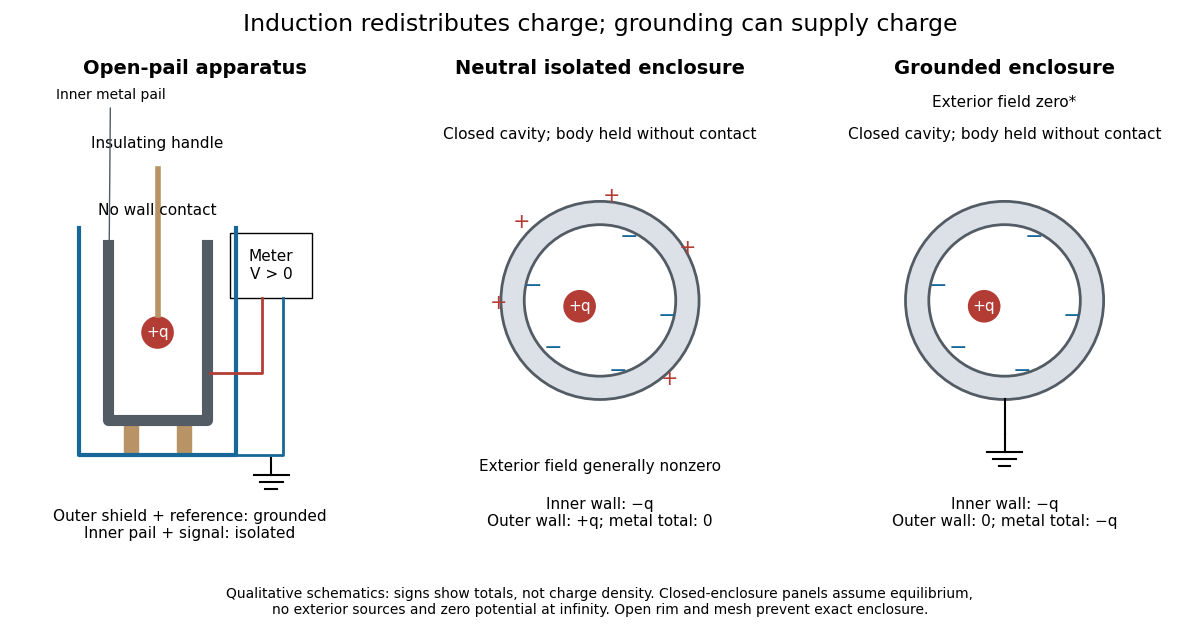
Faraday's ice pail experiment: apparatus and isolated versus grounded electric charge accounting
. Original qualitative schematics. The open pail approximates enclosure; the two closed cavity in a conductor panels stipulate exact enclosure, electrostatic equilibrium, no exterior sources and zero electric potential at infinity. Signs denote total electric charges, not a measured or uniform surface charge density. Details.A charge ledger before contact. To separate exact reasoning from the open apparatus, first idealize the pail as a closed cavity in a conductor with one internal body of total electric charge . Let the isolated metal have total electric charge . The metal's electric field is zero at electrostatic equilibrium.[ref]
Ideal Conductors. Richard Fitzpatrick, Ideal Conductors, equations 2.124–2.126: zero field and constant potential in metal
A Gaussian surface enclosing the cavity in a conductor but lying wholly in the metal therefore has zero electric flux. Gauss's law and charge conservation giveFor and , the inner-wall total is and the outer-wall total is : the metal remains neutral. The exterior electric field can therefore be nonzero without any transfer from the body. The connected electrometer and signal cable belong to the same isolated conducting assembly and share its exterior electric charge. The zero-electric field assertion concerns metal, not the occupied cavity in a conductor.This ledger fixes totals, not the local surface charge density. Moving an off-center body changes the inner-wall distribution while its integral remains . With fixed outer geometry, fixed and unchanged exterior sources, Uniqueness of the Dirichlet problem together with the fixed total outer electric charge determines the same exterior solution: the outside cannot reveal the body's position or detailed internal distribution. For example, internal bodies with stipulated electric charges and give the same total exterior response as a single body with . Internal bodies with and can give a null exterior response while retaining a nonzero internal electric field. This is why a null reading cannot establish an empty cavity in a conductor.
Withdrawal is the control. Record a baseline, insert without contact, withdraw, and check return to baseline. After a fresh zero, repeat with the charged disk touching the inner wall, then withdraw and record the residual response. Finally zero the pail and reinsert the disk without contact to test remaining electric charge. Keep the operator grounded, discharge unwanted handle electric charge, and keep the unused charged disk distant. Dirty supports and humidity promote leakage. These controls separate transfer from electrostatic induction and stray coupling.[ref]
Basic Electrostatics System (ES-9080B), Instruction Manual 012-07227G by Cecilia Hernandez. Basic Electrostatics System, instruction manual 012-07227G, printed pp. 4–5 and 14–15, Procedure 1A steps 3–8: handle charge, withdrawal, contact and disk retest
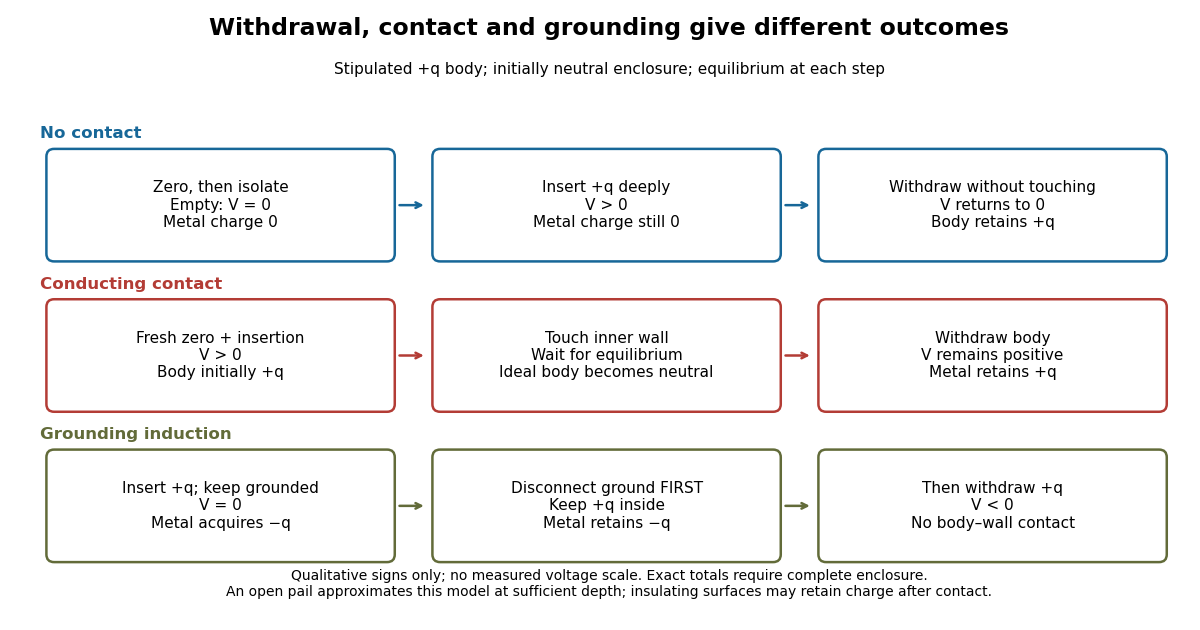
In the ideal contact test, the internal body is itself an electrical conductor and makes a conducting connection to the wall. After charge relaxation, body and enclosure become a single equipotential; the remaining charge-free void has zero electric field. The body then carries no excess electric charge on surfaces facing that void. Withdrawal without subsequent charging leaves total metal electric charge . A coated paddle can retain electric charge on insulating patches, so merely touching it does not guarantee complete transfer. A residual reading establishes some transfer under the controls; the disk retest checks the stronger claim of complete transfer. The ideal argument assumes no leakage and no relevant contact-generated charging.
Grounding changes the ledger. With no exterior sources and zero electric potential at infinity, a closed grounded enclosure has zero exterior electric field, inner-wall electric charge and zero outer-wall electric charge.[ref]
The Feynman Lectures on Physics, Volume II by Richard Feynman and others. II.5, §5–10, final shielding argument: a closed grounded conducting shell separates the two electrostatic problems
Consequently, disconnecting ground before withdrawal retains total metal electric charge , which moves to the exterior after withdrawal. Keeping ground connected during withdrawal instead restores zero electric charge. A lasting opposite-sign response can therefore arise through grounding without body–wall contact.For the real open pail, no Gaussian surface lying wholly in metal closes over the mouth. Increasing insertion depth and seeking a stable response tests whether enclosure is a good approximation; mesh openings, rim proximity and nearby objects limit it. In a fixed-geometry approximation, the positive insertion response obeys , where is the effective capacitance of the pail, shield, cable and electrometer input. Changed geometry changes that conversion. Wait for charge relaxation and instrument settling at each step, while keeping the observation short compared with leakage. The experiment probes settled electrostatics; it does not establish shielding against arbitrary changing electromagnetic fields.
The method of images replaces a conducting boundary by fictitious point charges placed outside the physical region being solved. Choose their positions and strengths so that the resulting electric potential has the required constant value on each conductor. The uniqueness theorem for the electrostatic potential then guarantees that this solution equals the physical solution in the allowed region, provided the other boundary conditions are also satisfied.
For a plane held at zero electric potential, a real charge a height above the plane has an image the same distance below it. The pair's electric potential vanishes everywhere on the plane. Its tangential electric field consequently vanishes there, as required in electrostatic equilibrium. The image is a mathematical representation of the induced surface charge, not a physical charge placed inside the conductor. Forces on the real charge can be computed from the image field, but total physical electrostatic energy must account for the conductor's induced response rather than simply counting a full real-plus-image pair energy.
The integral Gauss law in vacuum is . A single isolated point charge has spherical symmetry, so its electric field is radial and constant in magnitude on a centred sphere. The flux is , giving Coulomb's lawIn electrostatic equilibrium, a conductor is an equipotential: a tangential electric field would move its mobile charges. The electric field inside the conducting material is zero. A thin pillbox straddling its surface therefore gives , henceHere is the charge density on the particular face and points into vacuum. For an isolated thin plate with total charge divided equally between two faces, each face instead has half that total areal density. The local boundary result must not be confused with the field of an isolated nonconducting infinite charged sheet.
At electrostatic equilibrium the electric field in the metal is zero. The empty cavity also has zero electric field, by the uniqueness theorem for the electrostatic potential. The electric charge lies on the outer surface. For the isolated conducting sphere, spherical symmetry and Gauss's law giveTaking the electric potential to vanish at infinity and using givesThe electric potential is continuous at the surface, while the normal electric field jumps by , with surface charge density .
Past exam of the physics B course of the University of Cambridge 2014 Paper 1 Section B B6 Solution 2026-10-20
Specifying potential on the complete boundary gives a Dirichlet boundary condition and a unique harmonic solution. Specifying its normal derivative gives a Neumann boundary condition, with the zero-net-flux compatibility condition and an undetermined additive constant. Mixed conditions on complementary portions also give uniqueness when a potential reference is fixed. In an exterior domain, conditions at infinity are needed. These statements follow by applying Green's first identity to the difference of two solutions. A metal in electrostatic equilibrium is an equipotential: , tangential electric field zero, and normal field just outside a vacuum interface.
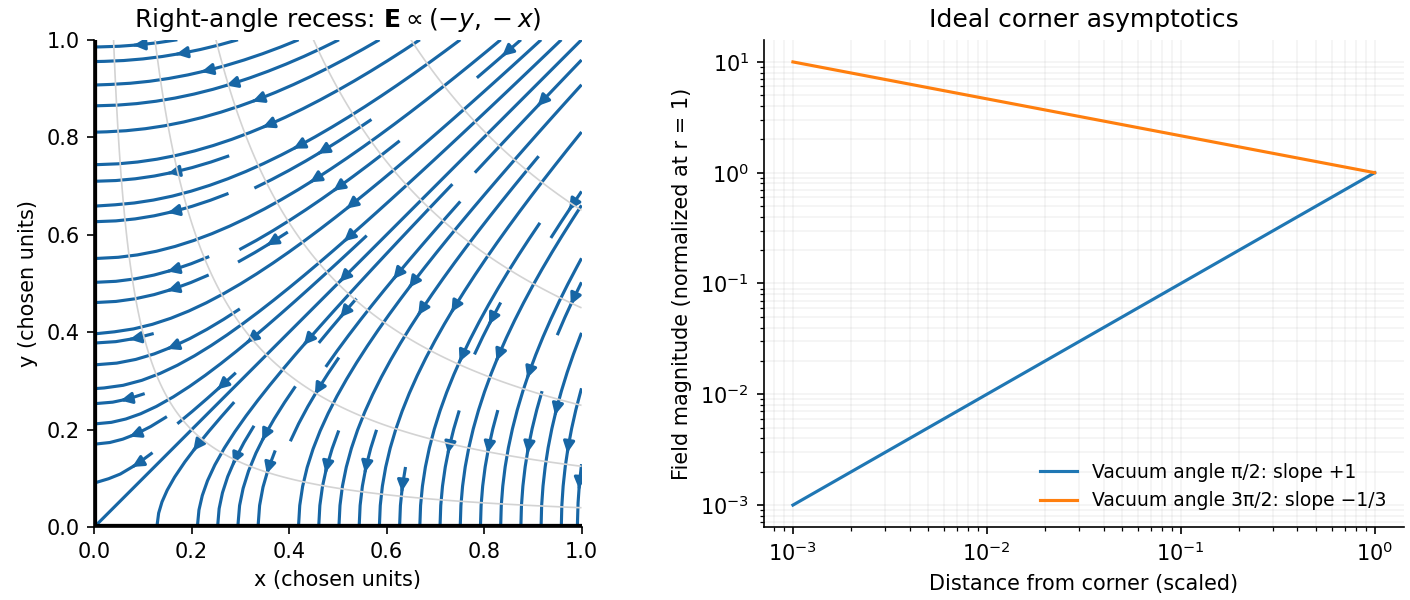
For the conducting-wedge potential expansion, put in the empty sector . For , Laplace's equation gives . Vanishing values on both faces require , henceBounded potential at the corner sets . The coefficients still require outer boundary data; the metal potential alone cannot select them. For a generic nonzero , put . Differentiation givesIf , the first nonzero higher harmonic replaces this leading term. For , , so and field lines satisfy , meeting the metal faces normally and tending to zero field at the corner. For , the electrostatic corner-field exponent is . A real tip's rounding cuts off this divergence; breakdown or field emission can limit the attainable field.


In electrostatic equilibrium a conductor has throughout its bulk and constant electric potential on each connected component. Otherwise free charge would continue moving. Gauss's law then excludes bulk excess charge; it resides on surfaces. Just outside a conductor the tangential field vanishes and the normal jump isfor a vacuum interface with outward normal . Surface charge rearranges in an external field to enforce these boundary conditions. Greater curvature often concentrates charge, but the actual distribution is a global boundary-value problem.
An empty closed cavity inside a conductor has constant potential and zero field, even in an external electrostatic field. If a charge is placed in the cavity, a Gaussian surface in the metal shows that the cavity wall carries total induced charge ; its detailed distribution depends on geometry. An initially neutral isolated conductor then has on its exterior surface. A grounded conductor can exchange charge with Earth, so this isolation condition no longer applies.
A useful example is a charge at height above an infinite grounded plane. In the physical half-space, the method of images replaces the induced charges by an image at height , giving the attractive force . The image is a mathematical construction, not an actual charge behind the conductor. Equipotential surfaces and charge conservation determine conductor fields together.