An elevator mode is a normal mode whose fluid motion is purely vertical while its velocity, temperature and composition perturbations are independent of height. Neighbouring columns can move upward and downward without a vertical return-flow structure, hence the name. Such modes describe the fastest-growing disturbances in the ideal local salt fingering problem.[ref]
Double-diffusive processes in stellar astrophysics by Pascale Garaud. Section 2.2.1, paragraph following equation 16: vertically invariant elevator modes
Take upward and write the velocity field and scalar perturbations asThe incompressibility condition is automatic because . More surprisingly, the perturbation's own advection of every one of these fields vanishes:The background need not be uniform: if its temperature and salinity gradients are constants , vertical motion still advects those backgrounds. This supplies the terms and below.
In a nonrotating local model with the Boussinesq approximation, constant kinematic viscosity and constant thermal diffusivity and solutal diffusivity , the ansatz reduces the equations toHere is gravitational acceleration, the thermal expansion coefficient, the haline contraction coefficient, and the horizontal Laplace operator. A constant pressure perturbation is compatible with the absent horizontal motion.
For example, let all three fields be proportional to , with . The upward and downward columns alternate with wavelength . Their amplitudes satisfy a three-variable linear differential equation; eliminating the scalar amplitudes gives the characteristic polynomial used in the salt-finger instability criterion. Although that criterion is a linear stability result, the vanishing self-advection means that this particular ansatz also solves the corresponding nonlinear local equations exactly within the stated ideal model.
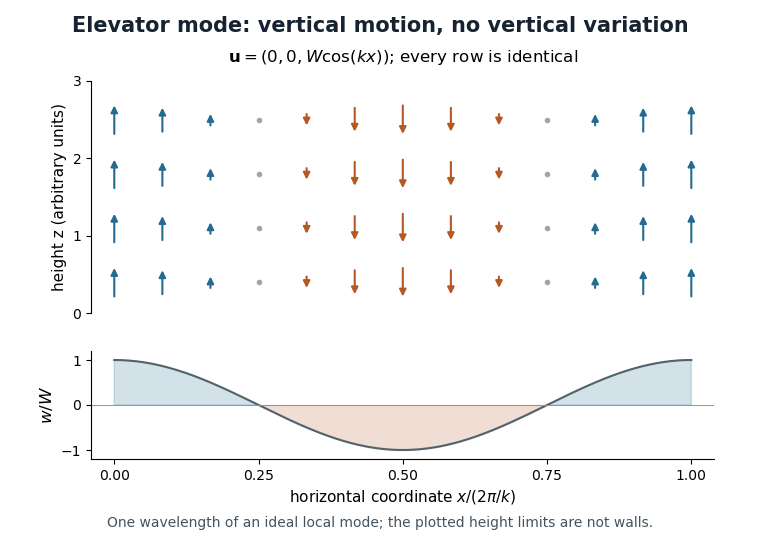
An elevator mode across one horizontal wavelength
. Original schematic with vertical velocity field . Each height has the same pattern of upward and downward motion; the lower plot shows its horizontal profile. The top and bottom of the drawn region are not impermeable walls. Details.
That exactness does not imply that unlimited growth describes a laboratory tank. An impermeable horizontal wall requires the vertical velocity to vanish there, excluding a nonzero height-independent pattern. Other perturbations can also grow on the rising and falling columns and disrupt them. Elevator modes are therefore useful ideal building blocks, with boundary conditions and additional disturbances determining how faithfully a real flow follows them.
Articles by others on the same topic
There are currently no matching articles.