Fingering convection is a form of double-diffusive convection in which a rapidly diffusing stabilizing contribution to buoyancy competes with a more slowly diffusing destabilizing contribution. The combined mass density stratification can resist an ordinary vertical displacement, yet unequal diffusion permits narrow rising and sinking structures to grow.
A displaced parcel initially carries both contributions. If the restoring anomaly diffuses away faster than the destabilizing anomaly, the remaining buoyancy reinforces its motion. In the common thermal-compositional case, thermal diffusivity exceeds solutal diffusivity; the initial stability of the combined mass density profile is therefore insufficient to decide stability once diffusion acts.[ref]
Double-diffusive processes in stellar astrophysics by Pascale Garaud. Section 2.2.1: fingering regime, density ratio and diffusivity contrast
In seawater, salt fingering realizes this competition with temperature and salinity: the thermal contribution stabilizes while salt-rich material above fresher material supplies the destabilizing contribution. Its laboratory examples make the different transport rates visible.[ref]
The Salt-Fountain and Thermohaline Convection by Melvin E. Stern. Warm saline water above cooler fresh water and unequal thermal/salt transport
In a star, chemical composition can play the slower role. A larger mean molecular weight tends to increase mass density at fixed pressure and temperature, so a molecular-weight inversion can oppose the thermal restoring effect. Rapid thermal transport can then permit fingering even when the total local stratification is stable.[ref]
Double-diffusive processes in stellar astrophysics by Pascale Garaud. Sections 1–2: inverse composition gradients and fingering instability
The density ratio measures the competition, and the salt-finger instability criterion shows why there is also an upper limit to the stabilizing contribution: if it is too strong, unequal diffusion no longer produces growing modes. The elevator mode gives a particularly simple local pattern with vertical motion and no height dependence.
Salt fingering is double-diffusive convection in which narrow rising and sinking fluid structures develop because heat and dissolved salt diffuse at different rates. Warm, salty water above colder, fresher water can have a stable total mass density stratification: the stabilizing temperature difference outweighs the destabilizing salinity difference.[ref]
A small upper parcel displaced downward enters colder surroundings. It loses heat relatively quickly while retaining more of its salt, becoming denser and continuing downward. A fresher parcel displaced upward can gain heat while remaining relatively fresh and light. The distinction between thermal diffusivity and solutal diffusivity supplies the feedback; stability of the initial combined mass density profile does not exclude this mechanism. The density ratio records the competing contributions, while the salt-finger instability criterion specifies the parameter regime.
A laboratory analog can replace heat and salt by two dissolved substances. David Osmond describes a 1820-by-80-by-120 millimetre tank with salt and sugar solutions entering at opposite ends and an overflow at the centre. The supplied solutions had matching mass density, but salt diffused faster than sugar. The salt-rich plume could lose salt faster than it gained sugar, producing a lighter core and denser surroundings. Fingering and diffusive layers appeared in different regions, showing that identical source densities need not remain dynamically equivalent when composition diffuses.[ref]
Some analysis of a two-dimensional double diffusion experiment by David Osmond. Section 2 and Figure1: apparatus and plume evolution; subsequent profiles identify the fingering regions
In this analog, salt plays the faster-diffusing role played by heat in the ocean, while sugar plays the slower-diffusing role of oceanic salt. Keeping that correspondence explicit prevents reversing the physical explanation.
An elevator mode is a normal mode whose fluid motion is purely vertical while its velocity, temperature and composition perturbations are independent of height. Neighbouring columns can move upward and downward without a vertical return-flow structure, hence the name. Such modes describe the fastest-growing disturbances in the ideal local salt fingering problem.[ref]
Double-diffusive processes in stellar astrophysics by Pascale Garaud. Section 2.2.1, paragraph following equation 16: vertically invariant elevator modes
Take upward and write the velocity field and scalar perturbations asThe incompressibility condition is automatic because . More surprisingly, the perturbation's own advection of every one of these fields vanishes:The background need not be uniform: if its temperature and salinity gradients are constants , vertical motion still advects those backgrounds. This supplies the terms and below.
In a nonrotating local model with the Boussinesq approximation, constant kinematic viscosity and constant thermal diffusivity and solutal diffusivity , the ansatz reduces the equations toHere is gravitational acceleration, the thermal expansion coefficient, the haline contraction coefficient, and the horizontal Laplace operator. A constant pressure perturbation is compatible with the absent horizontal motion.
For example, let all three fields be proportional to , with . The upward and downward columns alternate with wavelength . Their amplitudes satisfy a three-variable linear differential equation; eliminating the scalar amplitudes gives the characteristic polynomial used in the salt-finger instability criterion. Although that criterion is a linear stability result, the vanishing self-advection means that this particular ansatz also solves the corresponding nonlinear local equations exactly within the stated ideal model.
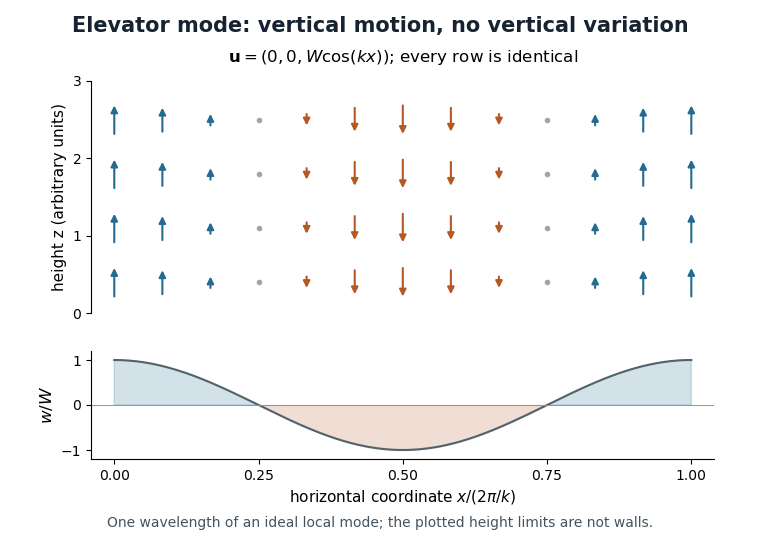
An elevator mode across one horizontal wavelength
. Original schematic with vertical velocity field . Each height has the same pattern of upward and downward motion; the lower plot shows its horizontal profile. The top and bottom of the drawn region are not impermeable walls. Details.
That exactness does not imply that unlimited growth describes a laboratory tank. An impermeable horizontal wall requires the vertical velocity to vanish there, excluding a nonzero height-independent pattern. Other perturbations can also grow on the rising and falling columns and disrupt them. Elevator modes are therefore useful ideal building blocks, with boundary conditions and additional disturbances determining how faithfully a real flow follows them.
In an ideal unbounded fluid governed by the Boussinesq approximation, take uniform background temperature and salinity gradients , with upward. Let be the thermal expansion coefficient and haline contraction coefficient, and let the thermal diffusivity exceed the solutal diffusivity . With the conventiona strictly stable total mass density gradient has . The band admitting exponentially growing salt fingering modes isThe upper equality is the marginal long-wavelength limit. This local linear stability result assumes no rotation and constant positive kinematic viscosity; finite boundaries can restrict the available wavelengths.[ref]
Double-diffusive processes in stellar astrophysics by Pascale Garaud. Section 2.2.1, equations15–16 and the definition of the density ratio
A dimensional derivation makes the signs explicit. Put and , where is the gravitational acceleration. Consider a normal mode with growth rate , squared wavenumber and horizontal fraction , where is the wave vector and its horizontal magnitude. Eliminating the temperature, salinity and pressure perturbations from the linearized equations gives the characteristic polynomialwhere is the kinematic viscosity.
For an elevator mode, and the perturbation is independent of . Its constant term isIf , choose a sufficiently small positive to make . Since tends to positive infinity along the positive real axis, the intermediate value theorem supplies a positive real growth rate.
For the converse, write . When , all three coefficients are positive, andThe Routh-Hurwitz criterion therefore puts every root in the left half-plane. This covers oblique modes too, since . If , ordinary density-driven overturning is already available; that is a different regime from fingering within a stably stratified background.
Articles by others on the same topic
There are currently no matching articles.