An enthalpy cycle is a collection of compatible thermodynamic processes that returns the entire material inventory to its initial thermodynamic state. Its signed enthalpy changes sum to zero. This supplies a consistency check and lets a missing change be recovered from the others.
Consider three abstract thermodynamic states of the same conserved material inventory at common temperature and pressure. Choose their molar enthalpies, on the same one-mole basis, asThese are constructed values, not material measurements. Endpoint subtraction givesThus : the two-step route and the direct route have the same molar enthalpy change. Closing the route with gives . Shifting every by the same arbitrary reference constant leaves all these differences unchanged.
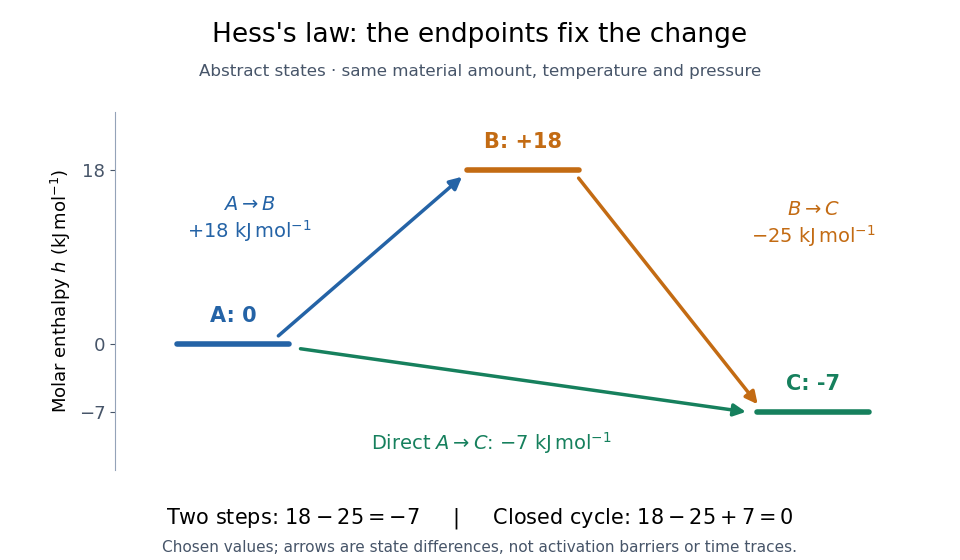

The short proof is cancellation:Adding any finite number of consecutive endpoint differences works the same way. For a closed enthalpy cycle the final cancels the initial . A nonzero experimental residual can therefore expose mismatched states or measurement error; it does not identify which individual input is responsible.
Articles by others on the same topic
There are currently no matching articles.