Consider an original noninteracting model with three orthonormal spatial orbitals at energies , where . Both spin projections are available at each energy, so there are six spin orbitals. The Quantum Hamiltonian is , with no interaction between particles and no dependence on spin. Comparing its allowed ground states isolates the effect of fermionic exchange symmetry.
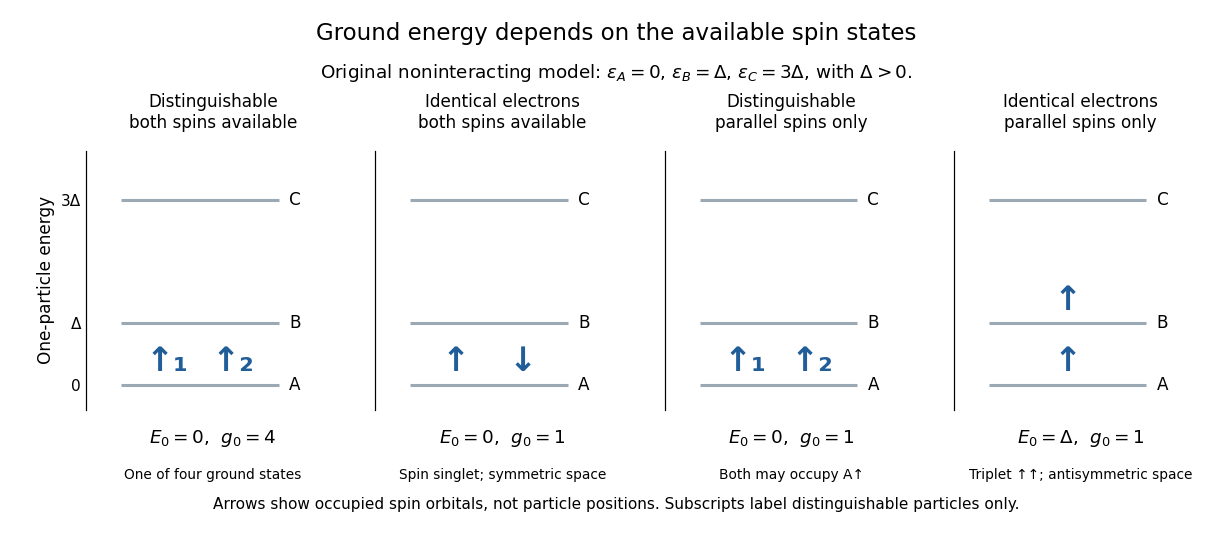
For two distinguishable spin-one-half particles, the spatial ground state is and any of four independent two-spin states is possible: and ground-state degeneracy four. For two identical Electrons, both can still occupy , using and , but there is just one allowed ground state: the symmetric spatial factor times the spin-one-half singlet state,Exclusion has reduced the ground-state degeneracy without raising the ground state energy.
Now restrict both particles to the same spin projection . Distinguishable particles can still both occupy , so . Identical Electrons must occupy different spatial orbitals; the lowest choice is , withThe spin factor is a spin-one-half triplet state, and the spatial factor is antisymmetric. These are ground states within the restricted parallel-spin sector, not the unrestricted two-Electron ground state. Both restricted models have ground-state degeneracy one.

The first excited two-Electron energy in the unrestricted model is , with four independent quantum states: one occupant in , one in , and two spin choices for each. A basis adapted to particle exchange operators separates these into one spin-one-half singlet state with symmetric spatial factor and three spin-one-half triplet states with antisymmetric spatial factor. All four have equal energy in this model. Singlet versus triplet does not by itself determine an energy gap; an interaction or a spin-dependent term is needed to split them.
As a further count, the full two-Electron space has dimension . Its energies in units of and corresponding multiplicities are and . For distinguishable spin-one-half particles the ordered tensor product instead has dimension , with multiplicities at those same energies. These are exact model counts, not atomic measurements. The higher restricted ground state energy follows from removing forbidden quantum states; the Quantum Hamiltonian contains no additional “exclusion force”.
Articles by others on the same topic
There are currently no matching articles.