Physical states of identical particles have definite symmetry under every particle exchange operator: symmetric for bosons and antisymmetric for fermions.
Bosons are identical particles whose total multiparticle state is symmetric under exchange. In three-dimensional relativistic quantum theory they have integer spin.
Bosonic exchange symmetry is the symmetric exchange statistics of identical bosons. Commuting creation operators build the symmetric bosonic Fock space; a normalized one-particle mode has occupation states for every nonnegative integer . At thermal equilibrium this symmetry leads to Bose-Einstein statistics and the Bose-Einstein distribution. Exchange symmetry itself does not require thermal equilibrium.
Commuting creation operators make multiparticle states invariant under exchange of their labels. With , the normalized number states exist for all , giving unrestricted bosonic occupation numbers. The single-mode thermal sum is and the mean occupation is . Thus the exchange symmetry and the Bose-Einstein distribution are two expressions of the same bosonic algebra.
Fermions are identical particles whose total multiparticle state is antisymmetric under exchange. In three-dimensional relativistic quantum theory they have half-integer spin.
The antisymmetric exchange statistics of identical fermions. Interchanging two one-particle labels reverses the total state, and fermionic creation operators anticommute. Occupation of a one-particle mode is therefore zero or one, giving the Pauli exclusion principle; thermal equilibrium leads to the Fermi-Dirac distribution. Color, flavor, spin and orbital factors must together have the required antisymmetry, even if one factor is symmetric.
For two identical spin-one-half fermions with no additional antisymmetric internal factor, the antisymmetric spin-one-half singlet state combines with an even- symmetric orbital state, while the symmetric spin-one-half triplet state combines with an odd- antisymmetric orbital state.
The Pauli exclusion principle says that each complete one-particle state can have fermionic occupation number zero or one. “Complete” includes spin and any other internal labels, as well as the spatial wavefunction. Thus two Electrons can share a spatial orbital with opposite spin projections: these are two different spin orbitals. Equal energy alone does not mean equal quantum state, because degenerate energy levels contain several independent one-particle states.
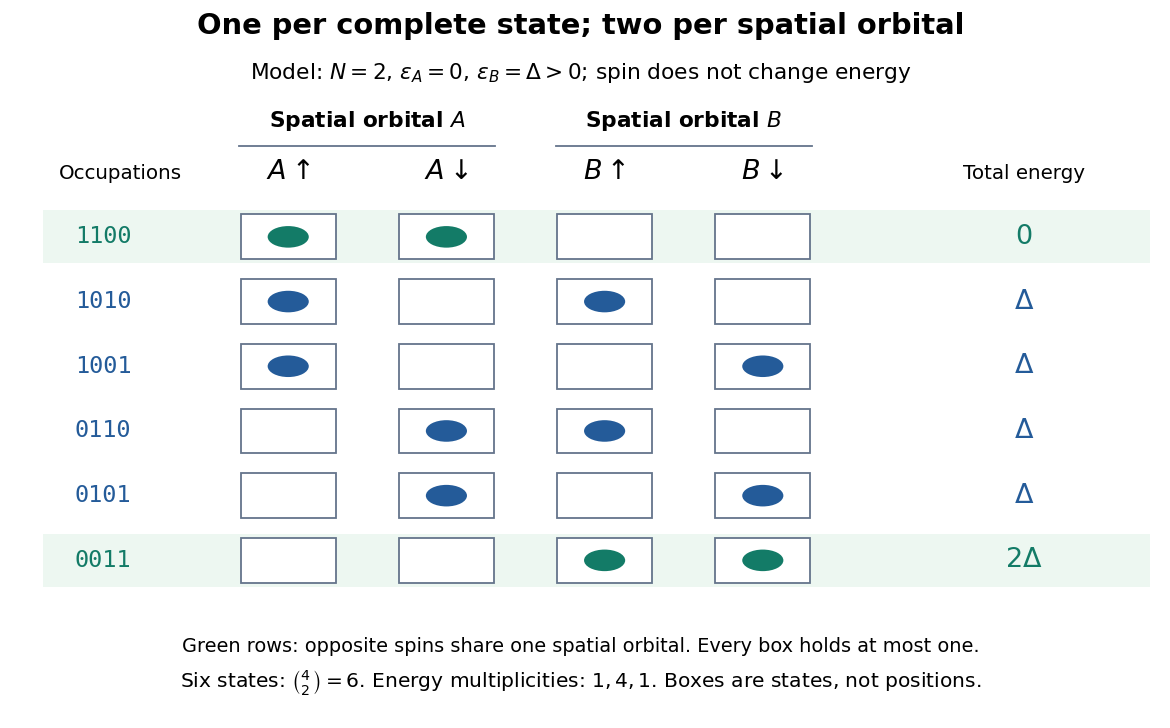
This distinction explains how an electron shell can accommodate several Electrons while exclusion still allows only one per complete one-particle state. It also makes a finite model of fermionic state counting surprisingly simple: two spatial orbitals with two spin choices each give four complete one-particle states, and exactly six two-Electron basis states. The following diagram enumerates them; its boxes represent occupation numbers, not locations in space.

Pauli's Exclusion principle and quantum mechanics by Wolfgang Pauli is his retrospective account, delivered on 13 December 1946 for the 1945 Nobel Prize. On printed pp. 29–30, he describes proposing an extra two-valued Electron property in autumn 1924 and formulating exclusion in 1925. The crucial clue linked counts of resolved energy eigenstates in alkali spectra under a magnetic field with the populations of closed electron shells. Resolving every label turned a complicated shell capacity into one Electron per complete one-particle state. This historical route preceded the modern spin interpretation and the antisymmetric wavefunction formulation; it was not originally a deduction from a Slater determinant.
A spatial orbital is a normalized spatial wavefunction used in a one-particle description. An atomic orbital is the corresponding notion for a chemical atom; a molecular orbital belongs to a molecule. A spatial orbital is not a trajectory and does not by itself specify spin.
When spatial and spin factors separate, a spin orbital combines a spatial orbital with a normalized spin state . For an Electron, choose spin one-half along an axis with . The two spin orbitals and are orthogonal even though their spatial orbital is identical, since their inner product contains . When spatial and spin variables do not separate, the complete one-particle state is instead a multicomponent wavefunction ; exclusion still applies to that complete quantum state.
The particle exchange operator swaps the complete particle slots, including spin. Its antisymmetric projector is . For orthonormal one-particle states , the normalized multiparticle quantum state isBut attempting the same construction with gives the zero vector:The zero vector cannot be normalized to a quantum state. This is exclusion as cancellation of probability amplitudes, rather than a repulsive force. More generally, for normalized the squared norm of the numerator divided by is ; the expression has unit norm only when are orthogonal. An overall quantum phase difference between describes the same one-particle state and also gives zero. Pauli explicitly connects exclusion with a vanishing antisymmetric wavefunction.[ref]
Exclusion principle and quantum mechanics by Wolfgang Pauli. p. 31, antisymmetric functions with repeated states
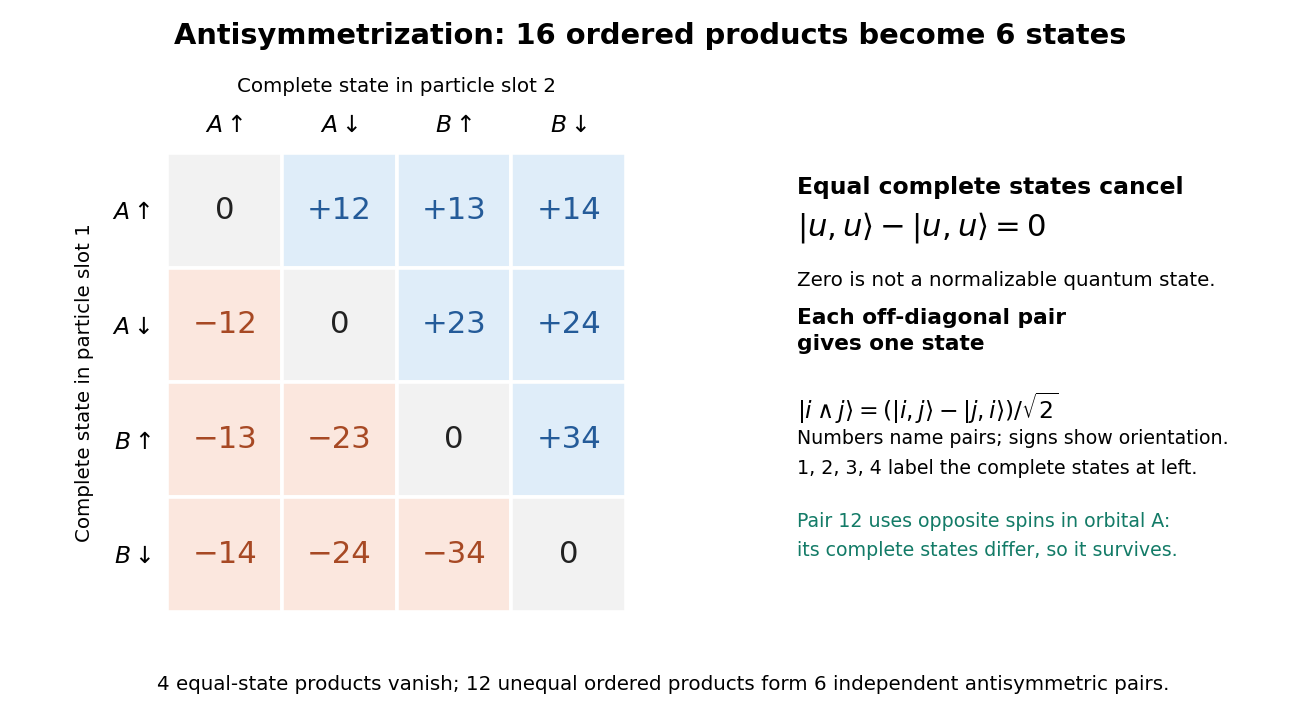
Antisymmetrization removes equal-state pairs and pairs the twelve remaining ordered products into six fermionic basis states
. Details. 
A Slater determinant extends two-particle antisymmetrization to fermions. Here contains position and spin or other internal variables. Distinct orthonormal one-particle states give the normalized wavefunction displayed in the title. Repeating a one-particle state repeats a column of the determinant, so the wavefunction vanishes. Exchanging particle slots exchanges rows and reverses its sign. A general fermionic quantum state can be a quantum superposition of Slater determinants; it need not be one Slater determinant.
Exclusion constrains complete one-particle states, not a collection of little spatial boxes. In particular, two opposite-spin Electrons in the same spatial orbital haveThe spatial factor is symmetric; the spin-one-half singlet state supplies the required antisymmetry. At , this wavefunction need not vanish for opposite spin labels. For equal spin labels it does vanish. In a continuous position description, an exact coincident point has zero measure anyway; the useful comparison concerns joint probability densities or detection in finite regions. Equal positions do not imply equal complete quantum states.
The fermionic occupation numbers refer to a chosen orthonormal basis of one-particle states. A quantum superposition need not have definite occupation numbers in that basis, and an expectation value can be fractional. For example, one Electron in has mean occupation number in each of two orthogonal spin orbitals, without splitting into two particles. The canonical anticommutation relations give and make a projector, so its expectation value stays between zero and one in every normalized quantum state.
For complete energy eigenstates of a one-particle Quantum Hamiltonian for identical noninteracting fermions, order their energies . At fixed particle number , the Quantum Hamiltonian and the particle-number constraint areThe ground state occupies the lowest complete one-particle states. A short minimization argument suffices: moving an occupant from a higher energy to an empty lower energy decreases the total energy. This filling describes the ground state at temperature ; exclusion by itself also applies to excited quantum states and at positive temperature. The underlying thermal description is the Fermi-Dirac distribution.[ref]
3 Quantum Gases. Sections 3.6–3.6.2, occupation restriction, spin multiplicity and zero-temperature filling
If the last occupied energy belongs to a group of one-particle states at the same energy and of them must be occupied, with all lower states filled, the ground state subspace has dimension . Exclusion does not select a particular basis or a particular quantum superposition in that subspace. The factor of two for an Electron spatial orbital assumes both spin projections are included; a model restricted to one spin projection has only one state per spatial orbital. A magnetic field can split the degenerate energy levels, and interactions can change the lowest-energy electron configuration. Thus this finite noninteracting filling rule is not a complete prescription for interacting chemical atoms.
Choosing different complete one-particle states from an orthonormal basis of size gives independent Slater determinants. This is the binomial coefficient because only the occupied subset matters: permutations change the sign of the Slater determinant, not the physical quantum state. Summing over particle numbers gives states in the finite fermionic Fock space.
For the diagram's two spatial orbitals , take energies with , each independent of spin. In the complete-state order , the six occupation number strings are . Their total energies are , giving energy multiplicities . For , the ground state energy is with two independent ground states, according to which spin orbital in is occupied. Across , the counts are , summing to . These are exact counts for this model, not measured atomic energies.
The 2007 paper Comparison of the Hanbury Brown-Twiss effect for bosons and fermions by T. Jeltes and others compares polarized helium-3 fermions with helium-4 bosons. The chemical atoms occupy a metastable atomic level. Switching off magnetic trapping of neutral atoms releases them onto a microchannel plate detector with a delay-line anode, 63 cm below. Position and arrival-time readouts give three-dimensional pair separations by time-of-flight atom detection. About 1000 clouds per isotope supply histograms; normalization removes the broad cloud shape.
The pair detection correlation dips below one for helium-3 and rises above one for helium-4. The same apparatus, matched temperatures near , nearly identical trapping potentials, negligible interactions, and magnetic field gradient checks of spin polarization support an exchange-statistics interpretation. Finite detector resolution suppresses contrast; trap switch-off and resolution uncertainties limit quantitative agreement. A diverging laser lens deepens the dip, but its aberrations preclude a precise lens-model test. This detects exchange correlations, rather than measuring occupation of one selected spin orbital.[ref]
Comparison of the Hanbury Brown-Twiss effect for bosons and fermions by T. Jeltes and others. pp. 3–7, Methods, Figs. 1–3; supplementary pp. 14–16
The pair detection correlation divides joint detection probability by the product of single detection probabilities. The baseline means independent detection; means suppressed pairs. Its value depends on the prepared quantum state and detector resolution, so exclusion alone does not require every experimental curve to reach zero.
The experiment above combines a microchannel plate detector with a delay-line anode to record individual atom arrivals. The apparatus is described in the paper's Fig. 1 and Methods.
The spin-statistics theorem associates integer-spin particles with bosonic exchange symmetry and half-integer-spin particles with fermionic exchange symmetry in relativistic quantum field theory under the standard locality and positivity assumptions.
For two spin-one particles, the spin tensor product has a six-dimensional symmetric subspace and a three-dimensional antisymmetric subspace. A symmetric spatial state combines with symmetric spin, while an antisymmetric spatial state combines with antisymmetric spin, so that the total bosonic state remains symmetric.
Articles by others on the same topic
There are currently no matching articles.