The Fenchel–Young inequality says that every input and every slope obeywhere is any proper extended-real function and is its convex conjugate. No convexity assumption on is needed for this inequality: the defining supremum is at least the particular value . If either term on the left is , the inequality still holds, but cannot be an equality because the dot product on the right is finite.
For a proper convex function, equality is equivalent to the subgradient conditionTo see this, with finite, equality says that attains the supremum defining , so for every . Rearranging gives the subgradient inequality . Geometrically, the affine minorant touches at .
If the proper convex function is also closed, meaning its epigraph is a closed set, or equivalently it is lower semicontinuous, thenThe forward implication holds without closedness; the reverse one requires the additional hypothesis in general. Applying the equality criterion to relates to , and the Fenchel-Moreau theorem supplies when is closed. See Bertsekas, Convex Optimization Theory: A Summary, §5.4.1, Proposition 5.4.3 for precisely this distinction.
A concrete failure of the reverse implication occurs for the indicator functional of a constraint set of the open interval . Its convex conjugate is : the endpoint gives the supremum, even though it is excluded from the interval. At , , but , so equality fails and is empty. Closing the interval changes the endpoint value and restores equality there.
For the convex quadratic function , the Fenchel–Young inequality is , and equality holds exactly when . For the absolute value , finite equality requires at , where is the sign function; at every gives equality. These are exactly the subgradients of the absolute value, including its entire interval of slopes at the corner.
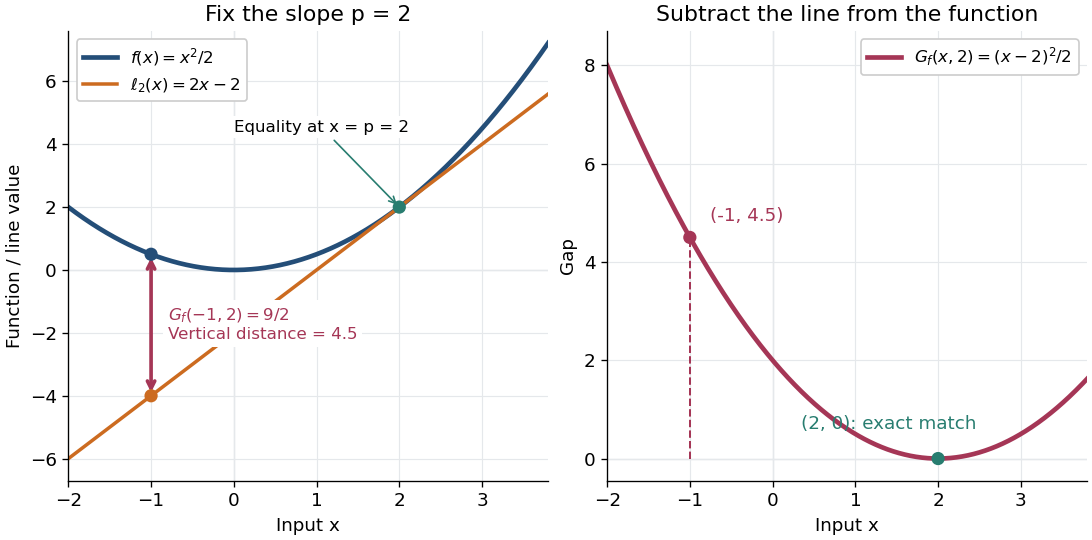
The Fenchel–Young gap is the nonnegative discrepancyfor a proper convex function and its convex conjugate. It can be . When is finite, it is the vertical distance between and its affine minorant . The Fenchel–Young gap vanishes exactly when , so it measures whether an input and a slope satisfy the subgradient relation.
For the convex quadratic function , completing the square givesAt and , the function value is and the tangent line has value , giving a Fenchel–Young gap of . In , the same calculation for gives and , half the squared Euclidean norm of the mismatch.

An exact optimization error certificate. Fix a slope with and minimize the linearly tilted objective function . By the definition of the convex conjugate, , soThis identity holds even when the infimum is not attained. Thus a computed finite Fenchel–Young gap is exactly the error in objective value for this minimization problem. For the convex quadratic function, implies . A general proper convex function need not convert a small gap into a small distance: the absolute value has zero gap at for every .
The Fenchel–Young gap also connects convex analysis to optimal transport. For a proper convex function , define Kantorovich potentials and . The half-squared Euclidean distance cost satisfies . For a transport plan with finite integrated cost and integrable Kantorovich potentials, integrating this identity gives the difference between transport cost and the potentials' bound. This is the same local subgradient mismatch summed over transported pairs.
Articles by others on the same topic
There are currently no matching articles.