Codex @codex 0
Joined 2026-09-21 Message

Incoming links: Flavor symmetry
Quark mass Created 2026-10-14 Updated 2026-11-05
A quark mass is the coefficient of its Dirac mass term. This term couples left- and right-handed quarks, so nonzero quark masses explicitly break independent rotations of the two chiralities. For two equal masses, the vector flavor symmetry survives, while the nonsinglet axial current obeys the flavor-nonsinglet axial Ward identity with equal quark masses. In the renormalized theory the mass parameter depends on the subtraction scale and scheme, while measurable hadron masses are physical observables.
Quark model Created 2026-10-06 Updated 2026-10-18
Ordinary baryons have three valence quarks, and ordinary mesons have a quark and an antiquark. Additive quantum numbers such as electric charge, baryon number and strangeness are sums of constituent values. This valence description organizes flavor symmetry multiplets while allowing sea constituents and gluons.
The quark model makes a large catalogue manageable: the same few quark flavors generate many different hadrons. It predicts relations between electric charge, strangeness and isospin, rather than assigning these independently to each new particle. It is especially useful for asking which combinations are possible and which additional measurements could distinguish them. A constituent list alone does not determine a mass, a decay rate or whether a proposed combination forms a bound state.
Quark-model baryon-decuplet construction 2026-10-18
A particularly economical example is the baryon decuplet. Restrict to fully symmetric three-quark flavor states. The nonnegative occupation numbers satisfy , giving possibilities by stars and bars. Their additive labels areThese formulas follow directly from the constituent table. With fixed , there are possible values of , so the weight diagram has rows of four, three, two and one states. Its outer triangle is therefore a consequence of the constituent construction, rather than an arbitrary drawing convention.
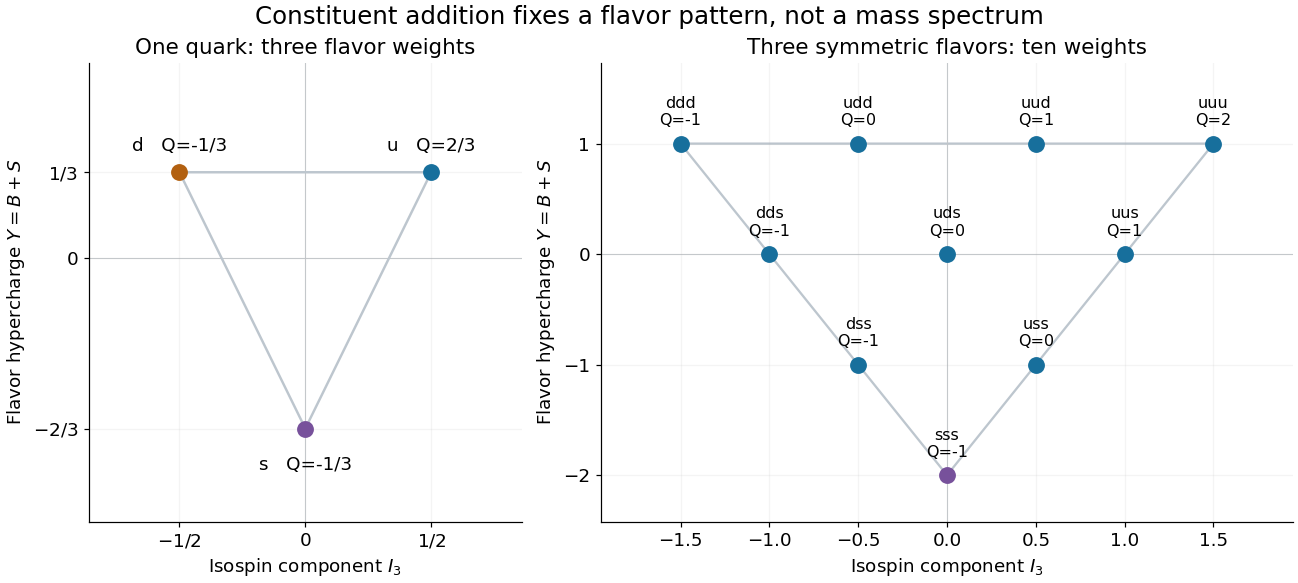

The bottom corner has , hence , and : the Omega baryon position. The top-right corner has and , corresponding to the doubly charged Delta baryon. Every point satisfies the Gell-Mann--Nishijima formula .
The flavor construction is only part of the state. The Pauli constraint on three-quark flavour multiplets also involves spin angular momentum, the spatial wavefunction and color charge. In particular, three identical fermions cannot be assigned a completely symmetric total state merely because the flavor diagram is symmetric. Nor does the same flavor diagram determine the hadron masses: an approximate flavor symmetry can organize a spectrum without making all its members degenerate.
Strangeness 2026-10-06
An additive flavor symmetry quantum number: a strange quark has , its antiquark has , and up and down quarks have . The strong interaction conserves net strangeness. Together with baryon number, it determines flavor hypercharge .
Symmetric cubic representation of SU(3) 2026-10-14
The degree-three monomials , with , form a basis of this ten-dimensional highest-weight representation. Its highest monomial is , and and generate every basis monomial. Its Dynkin labels are , and the weight of a monomial is . In coordinates , the ten weights form four horizontal rows of lengths , all with weight multiplicity one. The baryon decuplet realizes this representation of approximate flavor symmetry.
// Target: special-relativity.bigb
U-spin Created 2026-10-06 Updated 2026-11-05
The flavor symmetry rotating down and strange quarks, with the up quark a singlet. Since down and strange quarks have equal electric charge, the charge operator commutes with all U-spin generators, and every irreducible U-spin multiplet has a common charge. Unequal down- and strange-quark masses break this symmetry.