Ordinary baryons have three valence quarks, and ordinary mesons have a quark and an antiquark. Additive quantum numbers such as electric charge, baryon number and strangeness are sums of constituent values. This valence description organizes flavor symmetry multiplets while allowing sea constituents and gluons.
The quark model makes a large catalogue manageable: the same few quark flavors generate many different hadrons. It predicts relations between electric charge, strangeness and isospin, rather than assigning these independently to each new particle. It is especially useful for asking which combinations are possible and which additional measurements could distinguish them. A constituent list alone does not determine a mass, a decay rate or whether a proposed combination forms a bound state.
Four quark flavours in the defining representation of flavour SU(4) and their antiquarks give sixteen meson flavour states. The trace of is the trivial representation; its traceless part is the Adjoint representation. Under light-flavour SU(3), the full content is . Relative to the light-flavour nonet, the new states are . Inside the traceless fifteen-dimensional multiplet the additional singlet is instead . The pure state is a linear combination of this state and the full SU(4) singlet. The classification concerns flavour; it does not imply degenerate physical masses or fix spin.
For three light flavours and two spin states, an approximate spin-flavour symmetry acts on the six-dimensional single-quark spin-flavour space. A spatial ground-state three-quark colour singlet requires the symmetric representation of dimension . Under flavour symmetry and ordinary spin rotations, it decomposes as : the baryon decuplet has spin and the baryon octet spin . The product of spin and flavour factors can require a correlated sum, rather than a single unentangled product.
The constituent-quark model describes a low-energy hadron using effective massive quarks and phenomenological interactions. Its constituent quark masses include strong-interaction dressing and differ from short-distance running quark masses.
This effective baryon mass model adds a colour-magnetic spin-spin interaction to a sum of constituent quark masses. The common coefficient absorbs a spatial contact density, colour factors, and the strong coupling. has dimensions of energy cubed in natural units. A shared coefficient is an approximation because different flavour configurations can have different spatial wavefunctions.
Use dimensionless spin angular momentum operators with and the common-coefficient baryon hyperfine mass formula. The identical pair has total spin one, so its pair expectation is . For total baryon spin , the two mixed-flavour pair expectations sum to ; for total spin , they sum to . Their difference is , giving the title formula for either repeated-flavour choice. The equality assumes the same effective coefficient in the two flavour configurations; different spatial overlaps can change it.
For a three-light-flavor example, take up quarks, down quarks and strange quarks with the following additive quantum numbers. Here denotes electric charge in units of the positive elementary charge , is baryon number, is strangeness, is the third component of isospin, and is flavor hypercharge. An antiquark reverses all five displayed values. These are flavor coordinates, not spatial coordinates or electroweak hypercharge.
Adding these columns immediately explains familiar hadrons. A proton with valence quarks has and ; a neutron with has and . A positive kaon with has , and . Thus the same constituent rules describe both baryons and mesons.
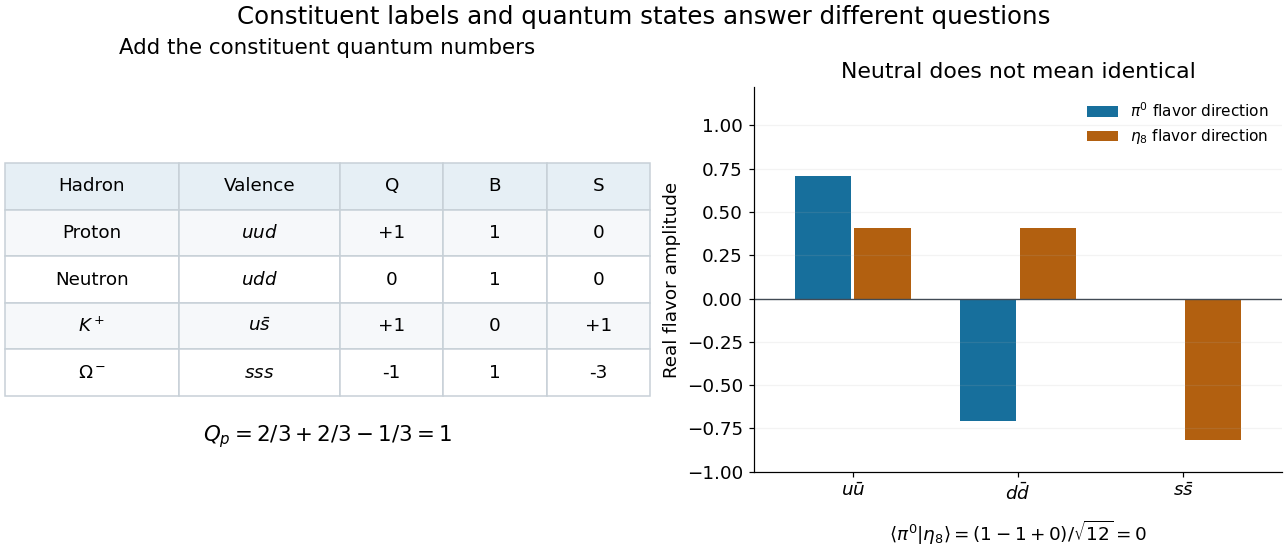
Adding constituent quantum numbers distinguishes charged and neutral hadrons
. Original arithmetic examples for the three-light-flavor quark model. The lower panel contrasts two orthogonal neutral flavor combinations: identical total electric charge does not make two states identical. These are ideal flavor basis states, not a mass fit or a reconstruction of an experimental event. Details.
Two hadrons can have identical additive labels while differing in their internal state. The Lambda baryon and neutral Sigma baryon both have valence content , yet their total isospin differs. Likewise, the neutral pion flavor direction and the Eta octet state both have , but their inner product vanishes. Expanding that inner product gives . Constituent counting must therefore be supplemented by quantum superposition and the symmetry of the state.
A particularly economical example is the baryon decuplet. Restrict to fully symmetric three-quark flavor states. The nonnegative occupation numbers satisfy , giving possibilities by stars and bars. Their additive labels areThese formulas follow directly from the constituent table. With fixed , there are possible values of , so the weight diagram has rows of four, three, two and one states. Its outer triangle is therefore a consequence of the constituent construction, rather than an arbitrary drawing convention.
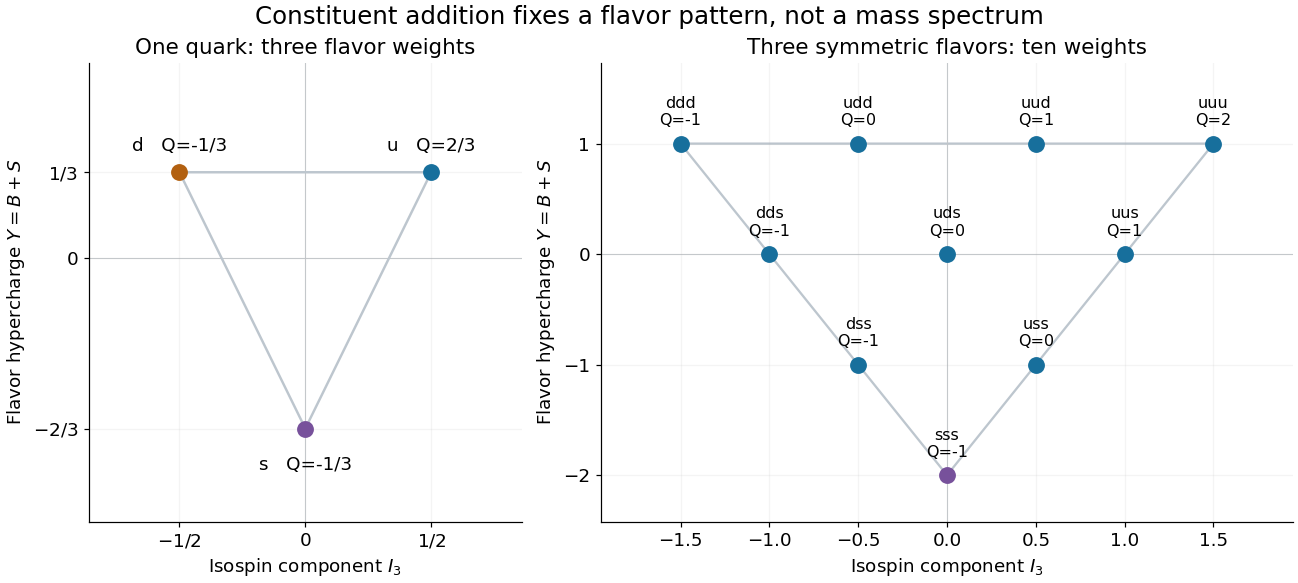

The bottom corner has , hence , and : the Omega baryon position. The top-right corner has and , corresponding to the doubly charged Delta baryon. Every point satisfies the Gell-Mann--Nishijima formula .
The flavor construction is only part of the state. The Pauli constraint on three-quark flavour multiplets also involves spin angular momentum, the spatial wavefunction and color charge. In particular, three identical fermions cannot be assigned a completely symmetric total state merely because the flavor diagram is symmetric. Nor does the same flavor diagram determine the hadron masses: an approximate flavor symmetry can organize a spectrum without making all its members degenerate.
In his 1964 paper, Murray Gell-Mann proposed fractional-charge quarks, constructing baryons and mesons from them. He also distinguished a mathematical constituent model from the hypothesis of finite-mass physical particles. The successful bookkeeping did not itself settle that distinction.[ref]
A Schematic Model of Baryons and Mesons by Murray Gell-Mann. pp.214–215: triplet construction and discussion of physical versus mathematical quarks
George Zweig's 1964 CERN model used three constituents called aces, with fractional electric charge and baryon number . Its abstract also proposed an experimental search.[ref]
An SU3 Model for Strong Interaction Symmetry and Its Breaking (Version 2) by George Zweig. Version2 title page and abstract, dated21February1964
The theoretical construction and the experiment that might discriminate between interpretations are separate parts of the argument. The Omega baryon discovery experiment illustrates the power of testing an incomplete particle pattern against new observations.A correlated pair of quarks. Its color, flavor, spin and orbital states are separate degrees of freedom and must collectively satisfy Fermi statistics. In flavor SU(3), the antisymmetric pair space is ; contraction with the invariant Levi-Civita symbol realizes the isomorphism. The antisymmetric flavor pair is an isospin singlet with flavor hypercharge . Combining two such flavor-antitriplet pairs with a strange antiquark permits the highest weight of the pentaquark antidecuplet; this flavor construction does not itself establish a bound state.
Articles by others on the same topic
There are currently no matching articles.